 Story
StoryHow to Rank #1 on the App Store (ASO Masterclass)
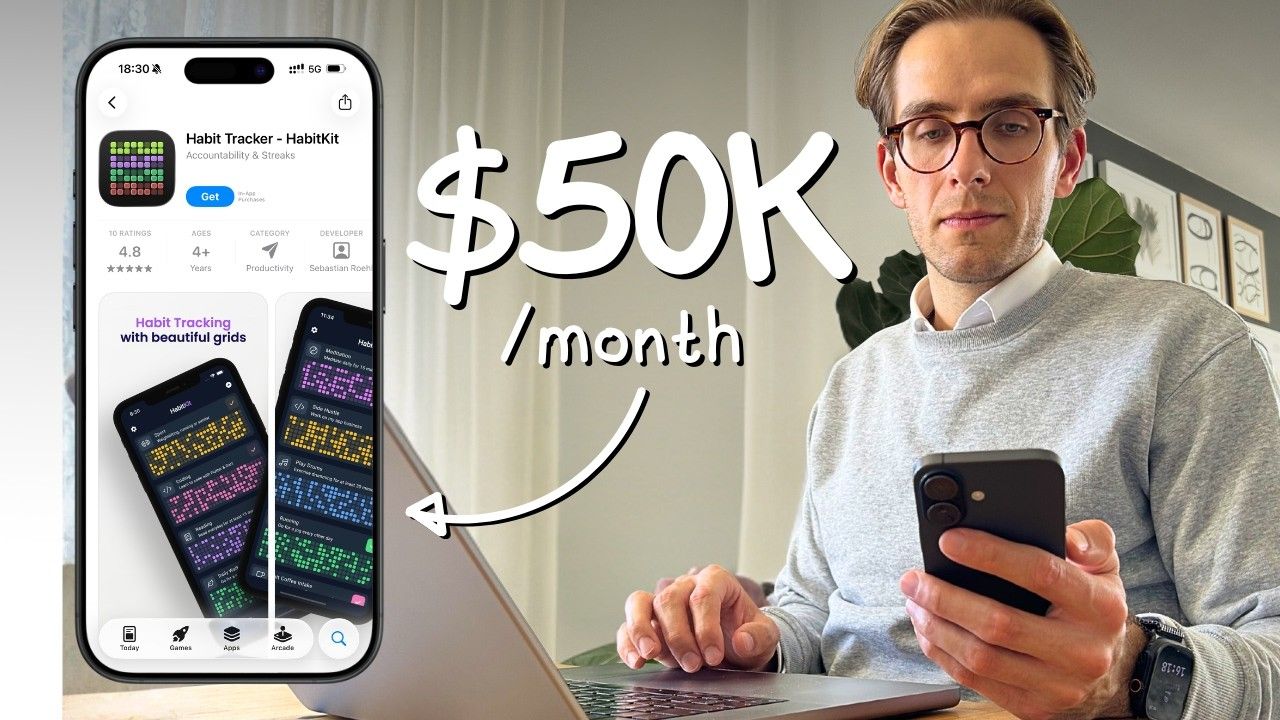
Sebastian Röhl earns $50k/month with HabitKit — and 98% of his users find him through the App Store alone. Here's his full ASO playbook.
Most app developers make the same mistake. They build something great, submit it to the App Store, and then just... wait. Hope. Maybe tweet about it once. And then wonder why nobody downloads it.
The reality is brutal: without App Store Optimization (ASO), even a genuinely great app is essentially invisible. It doesn't matter how good your UI is or how clever your onboarding flow is — if nobody can find you in search, none of that matters.
Sebastian Röhl figured this out. He's the builder behind HabitKit, a habit-tracking app for iOS and Android, and four apps total that collectively generate over $50,000 per month. He crossed $500,000 in total revenue, with over $100,000 made in January alone. And here's the kicker: 98% of his users find HabitKit directly through the App Store or Google Play. He does zero marketing on Twitter, Instagram, or anywhere else.
His secret? He treated ASO like a craft. He broke it down into three core foundations — keywords, screenshots, and reviews — and he worked each one deliberately over time. Let's go through all three.
Foundation 1: Keywords
Keywords are the backbone of ASO. Think of it exactly like SEO for websites, except the playing field is the App Store search bar. Apple and Google index your app's metadata to decide where it shows up when someone types "habit tracker" or "focus timer" or whatever your niche is.
Sebastian breaks keyword placement into three specific spots:
- App Name: This is the single most important field. Put your primary keyword directly in the name. Sebastian's app isn't just called "HabitKit" — it's called "Habit Tracker - HabitKit." That front-loaded keyword placement is intentional and makes a massive difference in how Apple ranks the app for that search term.
- Subtitle: You get 30 characters here, and they're fully indexed. Use them for secondary keywords. HabitKit's subtitle is "Streaks & Accountability" — two highly relevant terms that users in that niche actively search for.
- Keyword Field in App Store Connect: This is a 100-character field that Apple indexes but users never see. It's pure metadata fuel. The rules here matter a lot: separate keywords with commas and no spaces, don't repeat words already in your name or subtitle (wasted characters), don't use plurals if the singular is already included, and don't use competitor app names (against App Store guidelines).
The goal is to cover as much relevant search territory as possible without redundancy. Every character in those fields is real estate — treat it that way.
Example: If your app name already contains "habit," don't put "habits" in the keyword field. Use that space for something new, like "routine" or "daily goals" or "streak counter." Stack coverage, don't repeat.
This sounds like a small thing, but it's the difference between showing up on page one and being buried on page fifteen where nobody scrolls.
Foundation 2: Screenshots
If keywords determine whether people *find* your app, screenshots determine whether they *download* it. Sebastian is emphatic about this: screenshots have the biggest impact on your conversion rate of anything on your App Store listing.
You have roughly 3 to 5 seconds to convince someone scrolling through search results. That's it. Here's how he approaches it:
- Lead with your most impressive feature: The first one or two screenshots need to show what makes your app unique and visually compelling immediately. For HabitKit, that's the distinctive grid-based habit view — a feature that looks different from every other habit tracker out there. If your best feature is buried on screenshot six, most users will never see it.
- Show the real UI: This one surprised a lot of people. Sebastian's advice is to show the actual app interface, not abstract lifestyle photography or heavily stylized marketing graphics. Users want to know what they're actually downloading. They want to see the screens they'll interact with. Fancy graphics can actually lower trust if they feel disconnected from the real product.
- A/B test everything: Apple offers a feature called Product Page Optimization that lets you test different versions of your screenshots directly in the App Store. Sebastian used this and found something counterintuitive — his original, less-polished screenshots outperformed the professionally designed ones. The authentic version converted better. That's a lesson you can't learn by guessing. You have to test.
The takeaway: authentic beats professional. Real UI beats marketing fluff. And always, always be testing. What you *think* will convert and what *actually* converts are often completely different things.
Foundation 3: Reviews and Ratings
Reviews do two things simultaneously: they provide social proof to new users deciding whether to download, and they signal to Apple's algorithm that your app is high quality and worth ranking. Both matter enormously.
Getting reviews isn't about luck. Sebastian has a system:
- Time your prompt at a happy moment: Don't ask for a review when someone first opens the app or after they've hit an error. Ask at the peak of the experience. For HabitKit, that's right after a user completes their first habit — they've just had a small win, they feel good, and they're genuinely likely to leave a positive review.
- Respond to every single review: This builds trust with both existing users and potential ones browsing your listing. Thank people for positive reviews. For negative ones, offer real help. Sebastian notes that a thoughtful response to a bad review often leads the user to update their rating — a 1-star review becomes a 3 or 4 star after you actually solve their problem.
- The email signature trick: When replying to user support emails, add a simple line at the bottom: "If you're enjoying HabitKit, we'd really appreciate a review on the App Store." It's low friction, it catches people at a moment when they're already engaged with you, and it converts surprisingly well.
- Mine reviews for product insights: If five different users in the same week are asking for the same feature, that's not noise — that's a signal. Reviews are free user research. Sebastian uses them as direct input into his development roadmap.
Building a strong review base is compounding work. Each review makes the next download slightly more likely, which leads to more reviews, which improves your ranking, which brings more organic traffic. It's a flywheel, and it takes time to spin up — but once it does, it's powerful.
ASO is a Long Game
Here's the part nobody wants to hear, but Sebastian is honest about it: ASO takes time. A lot of it.
When HabitKit first launched, it was invisible for its core keyword — "habit tracker." Sebastian did everything right from day one. Good keyword placement. Solid screenshots. Actively collecting reviews. And still, it took about six months before he cracked the top 10 in non-US markets like the UK. Nearly a year before he started appearing in the US top 10. Close to three years before he was consistently ranking in the top 5.
That's a long runway. Most developers would have given up in month two, assumed the app was a flop, and moved on. Sebastian didn't. He kept iterating, kept collecting reviews, kept refining his metadata — and eventually the App Store rewarded that consistency.
This is the mindset shift that matters most. ASO isn't a launch tactic. It's an ongoing discipline. You're not trying to hack an algorithm with a one-time setup — you're building credibility with Apple and Google over months and years.
If you're just starting out, do the keyword work properly, make your screenshots honest and compelling, set up your review prompts thoughtfully, and then be patient. The rankings will come. HabitKit going from invisible to top 2 in the App Store didn't happen overnight — but it happened, and it happened because Sebastian played the long game.
That's really the whole playbook. No paid ads. No influencer campaigns. No growth hacking. Just three foundations, executed consistently, over time. 98% of downloads from organic search. $50k a month.
Go build something worth finding.
Original video
https://www.youtube.com/watch?v=I2GG0lyb_RI