 Story
StoryHow to Make $35k/Month Copying Apps (It's Smarter Than It Sounds)
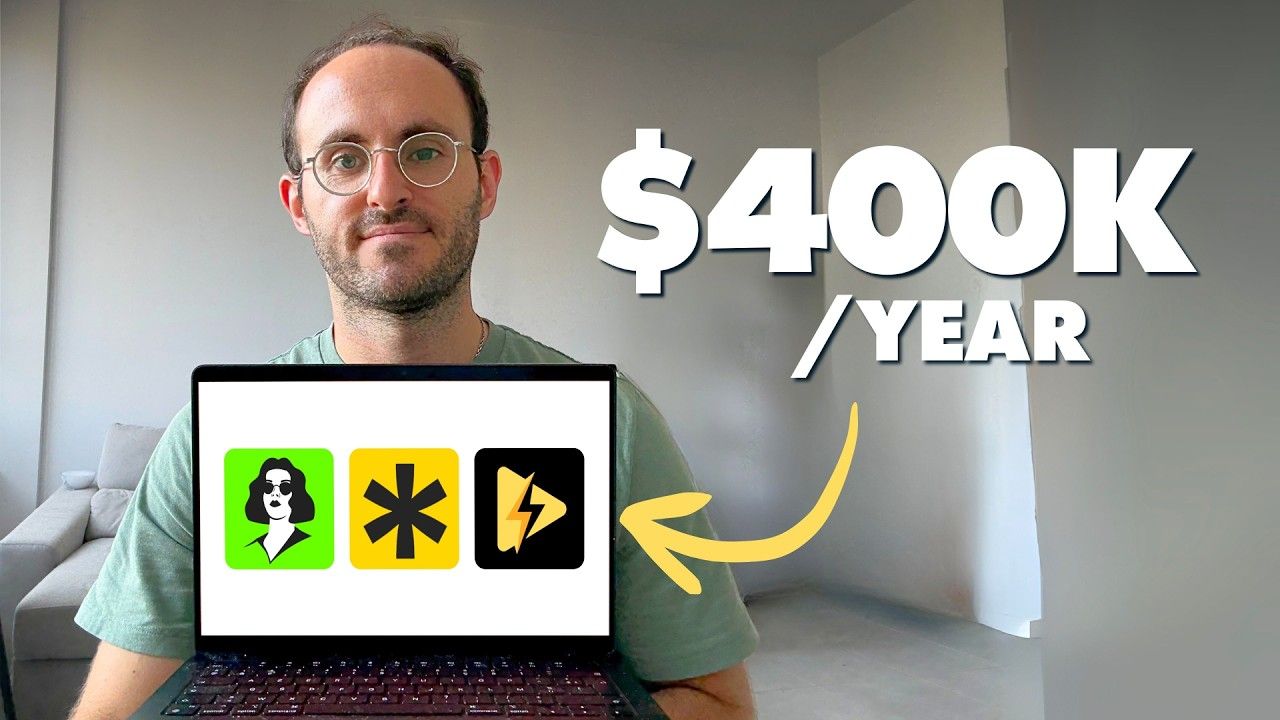
Samuel Rondot earns $35,000/month from three SaaS apps — not by inventing new ideas, but by finding what already works and making it 1% better. Here's his full playbook.
Most people think building a successful app means coming up with a revolutionary idea nobody has ever thought of. Samuel Rondot thinks that's exactly the wrong approach — and his $35,000 per month in monthly recurring revenue is a pretty good argument.
Samuel's background isn't what you'd expect. He was an optician. Full-time job, no coding experience, no startup pedigree. A few years ago he quit, taught himself to code with a 12-hour YouTube course, and built three SaaS apps that now generate $35k MRR combined. His strategy is almost aggressively counter-intuitive: don't invent something new. Find something that already works, and make it slightly better.
That's it. That's the core of the playbook. Everything else is execution.
Step 1: Learn to Code (The Right Way)
Samuel's origin story matters here because it shapes how he thinks about learning. He wasn't grinding LeetCode or chasing a computer science degree. He wanted to rebuild an Instagram tool he was already using, so he made that the project. Then he watched a 15-hour YouTube course — not as passive content, but as a manual for the thing he was actively building.
The three-step loop he used was simple: 1. Try to rebuild a real-world app he cared about. 2. Watch the relevant YouTube course. 3. Immediately apply each lesson directly to his project.
This project-based approach matters more than most people realize. When you're learning in a vacuum, every concept feels abstract and forgettable. When you're learning *in order to ship something*, every new concept has a purpose. You're not watching a tutorial about React because someone told you to — you're watching it because you need to make this one thing work.
If he were starting today, he says he'd go even further. He wouldn't learn the traditional way at all. His modern framework leans fully into AI: pick a real project you actually want to build, take a screenshot of whatever you're trying to replicate, and ask ChatGPT, "How can I build this landing page?" Then build step by step, using ChatGPT as your unblocking tool at every roadblock. He'd use tools like Cursor and Lovable to accelerate the build, and instruct ChatGPT to use modern technologies like Next.js and Node.js from the start. The goal isn't to become a traditional software engineer. It's to ship.
Step 2: Find a Winning App Idea
Here's Samuel's core rule, and it's worth reading twice: never build something that doesn't already exist and isn't already successful.
Most first-time founders do the opposite. They look for gaps — things nobody has built yet. But a gap in the market can mean two things: either there's a real opportunity, or the idea doesn't work and everyone else already figured that out. Samuel skips that uncertainty entirely.
His hunting ground is Twitter (X). Specifically, he hangs out in communities like Build in Public, Indie Hackers, and Solopreneur — spaces where founders share their revenue milestones, Stripe screenshots, and growth stories in public. That's free, real-time market research.
When he finds a product that catches his attention, he runs it through a four-point filter:
- Would he use it himself? If not, he can't build something meaningfully better.
- Does it already have traction? Public MRR numbers, growth screenshots, founder posts celebrating milestones — these are proof the market is real.
- Is the original creator not spending heavily on marketing? If a product is growing without a massive ad budget, that's genuine demand. It means people want it enough to find it on their own.
- Is it simple enough to maintain solo? Samuel runs everything himself. A product that requires a team to maintain is a product he can't own.
All four boxes need to check. If one doesn't, he moves on.
Step 3: Validate Before You Build
Finding an interesting idea and validating it are two different things. Samuel has a four-step validation process that goes deeper than just "it looks popular."
Traction first. The gold standard is an MRR or Stripe screenshot shared by the founder on Twitter. That's real money, not estimates. If someone is publicly showing $8,000/month in revenue, you know the market exists.
Traffic source analysis. He pulls up the competitor's site in Ahrefs and looks at where their traffic comes from. Are they running ads? Ranking on SEO? Both? A mix of paid and organic traffic is a strong signal — it means multiple acquisition channels work for this product, which reduces your risk as a copycat entering the same space.
Maintenance complexity. Can a solo developer realistically build and maintain this? Some products look simple on the surface but have brutal backend complexity. Samuel won't touch those. He needs to be able to own the whole thing himself.
Personal interest. This sounds soft, but he's serious about it. If you're not genuinely interested in the problem space, you'll lose motivation the moment things get hard — and things always get hard. Long-term consistency requires actual care.
Case Study: How StoryShort.ai Was Born
The clearest example of this whole system in action is StoryShort.ai, one of his three apps.
Samuel was scrolling Twitter when he came across a post from the founder of AutoShorts.ai — a tool that automated the creation of faceless videos. The founder was sharing impressive revenue numbers publicly. Samuel got curious and dug into their traffic with Ahrefs. What he found was clean and actionable: *all* of their traffic was coming from Facebook Ads. No complicated SEO moat, no viral loop he couldn't replicate. Just paid social, which he already knew how to run.
The idea passed every filter. Validated demand (real MRR, publicly shared). Simple product concept. A traffic channel he could copy. A market — AI-generated video content — he was personally excited about. So he built his version, launched his own Facebook and Google Ads campaign, and StoryShort.ai grew fast. He'd already validated the playbook before writing a single line of code.
That's the beauty of this strategy. The risk is dramatically compressed. You're not guessing whether people want this. You already know they do.
Step 4: The 4-Part Growth Stack
Building the app is only half the job. Samuel runs the same marketing playbook across all three of his products, and it's worth stealing in full.
Start with ads. Every launch begins with Google Ads and Meta Ads. Not because paid traffic is the end goal, but because it's the fastest way to get real validation data. If ads convert, the market is confirmed. If they don't, you learn that quickly and cheaply before you've invested months in SEO.
Build SEO. Once the ads are generating traction and cash flow, he shifts attention to SEO. This is the compounding channel — slower to build, but the traffic it generates eventually becomes free and persistent. Ads stop the moment you pause spending. Good SEO keeps delivering.
Faceless YouTube, TikTok, and Instagram channels. This one is clever, and it's baked directly into StoryShort.ai's own product. He uses his own tool to create automated daily videos about his products and publishes them across YouTube, TikTok, and Instagram. The channels run on autopilot, creating a constant drip of brand awareness and organic discovery. It's distribution that runs itself.
Affiliate program. The final layer is an affiliate program, which he runs for all his apps. Affiliates acquire customers at a fixed cost, which makes unit economics predictable. But the bigger benefit is virality — people actively promote your product when they earn a commission from it. You're essentially turning customers into a sales team.
Each of these channels compounds on the others. Ads bring in early users. SEO builds authority. The content channels drive ongoing awareness. Affiliates spread the product through trusted networks. By the time all four are running, you have a growth engine that doesn't require constant manual input.
The Bigger Idea
What Samuel has figured out is something most first-time founders resist: originality is overrated as a starting point. The market has already done the hard work of telling you what it wants. Public Twitter posts, Stripe screenshots, Ahrefs traffic data — all of that is free intelligence, sitting there waiting to be used.
You don't need to be the inventor. You need to be the person who executes slightly better, markets more consistently, and shows up for the long haul. Samuel went from optician to $35k/month not because he had a breakthrough idea, but because he had a system — and he repeated it three times.
That's the real playbook. And honestly? It's available to anyone willing to use it.
Original video
https://www.youtube.com/watch?v=8BtHk-oNlN0