 Story
StoryHow to Build an AI Company: Lessons from Opus Clip's CEO
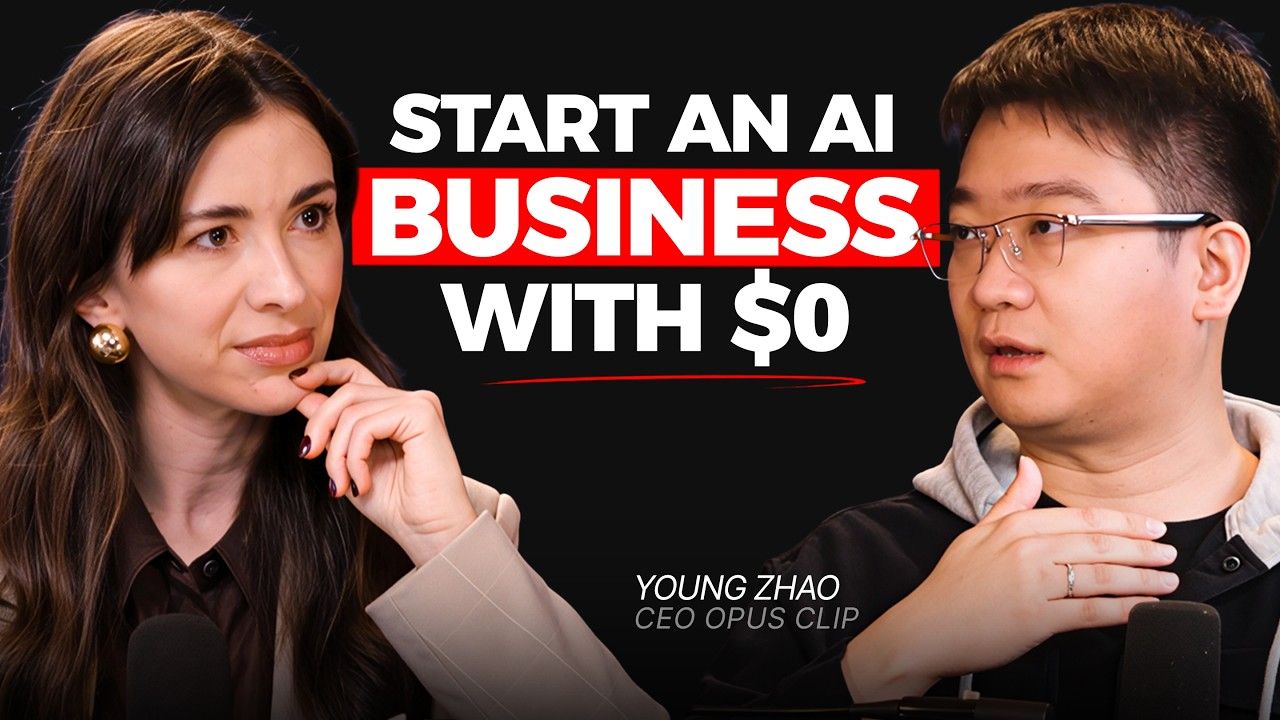
Young Zhao grew Opus Clip to 50 million users and a $215M valuation in under 3 years. Here's the exact playbook he used — from failed pivot to product-market fit.
Young Zhao didn't set out to build one of the fastest-growing AI startups in the world. He just kept failing until something worked.
As co-founder and CEO of Opus Clip, he's grown the company to over 50 million users and a $215 million valuation in just two and a half years. The product is simple in concept: take long-form video content and automatically generate viral short clips. But the path to get there? Anything but simple.
Step 1: Don't Fall in Love With Your First Idea
The reality: Zhao and his team spent a full year during COVID trying three to four different product ideas. None of them landed. Their first real swing was a live-streaming tool — and nobody liked it.
The pivot: But buried inside that failed product was one small feature people actually used: the clipping tool. That tiny signal, combined with the release of ChatGPT in November 2022, was enough to change everything. They killed the live-streaming product and went all-in on clipping.
How to apply this: Don't wait for a grand vision to appear. Watch what your users are quietly gravitating toward, even inside a product that's otherwise flopping. That's often where the real idea lives.
Step 2: Validate Before You Build Anything
The principle: The team didn't immediately spin up a full product. They did something much smarter and much cheaper.
What they actually did:
- First, they manually created video clips and emailed them directly to potential customers
- They got over 60% positive feedback, with users saying they desperately wanted to use those clips
- Then — and only then — did they build a Discord bot as a minimal MVP to test with thousands of creators
Why it mattered: They confirmed real demand without building a single line of UI. No expensive frontend, no wasted engineering sprints. Just signal, fast.
How to apply this: Whatever your AI product does, do it manually first. If people want it when you do it by hand, then you build. If they shrug, you haven't found the idea yet.
Step 3: Look for the Right Signals, Not Just the Obvious Ones
The insight: Zhao says the most powerful sign of product-market fit wasn't praise. It was complaints.
The signal that mattered: When users started getting angry about the daily usage quota and queue wait times, that was the green light. Complaints like that mean the product is so valuable that people want *more* of it. That's a completely different category than someone saying "cool tool."
How to apply this: If your users are begging you to raise their limits, you've got something real. If they're just saying nice things and logging off, keep digging.
Step 4: Pick a Boring, Specific Niche
The advice: Zhao is direct here — stop trying to build a general-purpose AI tool. The winners in 2026 won't be the broadest platforms. They'll be the ones who went deep on a specific, painful, almost unglamorous workflow.
The reasoning: Big incumbents can copy a feature. They can't easily copy a hyper-specific, niche-optimized product built around one type of user's exact workflow. A tool built specifically for, say, long-form video creators repurposing content for TikTok is much harder to replicate than a generic "AI video editor."
How to apply this: Find a niche so specific you can't segment it further. Then solve that one problem better than anyone else on the planet.
Step 5: Build Like an Athlete, Not a Hacker
The mindset shift: Zhao draws a direct comparison to Cristiano Ronaldo and LeBron James. Elite performance isn't about bursts of inspiration — it's about extreme discipline, sustained over time.
Using AI as a thinking partner: He suggests founders use AI not just to build product, but to analyze their own decisions. Document your journey. Feed your past choices into a model. Ask it what patterns it sees, where you keep getting stuck, what you should do differently. Treat it like a thinking partner, not just a code generator.
How to apply this: The founders who win aren't the ones who work the hardest in short sprints. They're the ones who build systems for learning, refining, and showing up consistently.
Takeaways
Zhao's playbook isn't complicated, but it requires patience most founders don't have. Start with manual validation. Watch for the signal inside the failure. Go narrow, not wide. And treat your own decision-making like something worth studying and improving.
Opus Clip didn't blow up because of a brilliant idea. It blew up because the team kept their eyes open, stayed disciplined, and built something people genuinely needed — even when the road there looked like a dead end.
Original video
https://www.youtube.com/watch?v=HQ3eVt2jgAY