 Story
StoryHow to Build a $50K/Month App in a Boring Niche
Tom Holliday built a simple website widget for tradespeople and grew it past $50K MRR in under a year. Here's exactly how he did it.
Most people building software are chasing the next AI breakthrough or trying to disrupt a sexy, venture-backed market. Tom Holliday went the other direction — he built a website widget for plumbers and mechanics, and now he's pulling in over $50,000 a month in recurring revenue. His company, Avenue, is proof that boring niches can be incredibly lucrative if you actually solve a real problem.
I came across Tom's story and had to dig in. He co-founded Avenue with his brother, and in roughly a year, they went from zero to over A$85,000 in monthly revenue. No viral launch. No VC funding. Just a simple idea, the right team, and some seriously old-school hustle.
Step 1: Identify a Simple, Painful Problem
The Problem: Tradespeople — electricians, plumbers, mechanics — are almost never available to answer the phone during the day. They're on a job site, under a car, or knee-deep in a wall. So when a potential customer calls to book a service, nobody picks up, and the lead is lost forever.
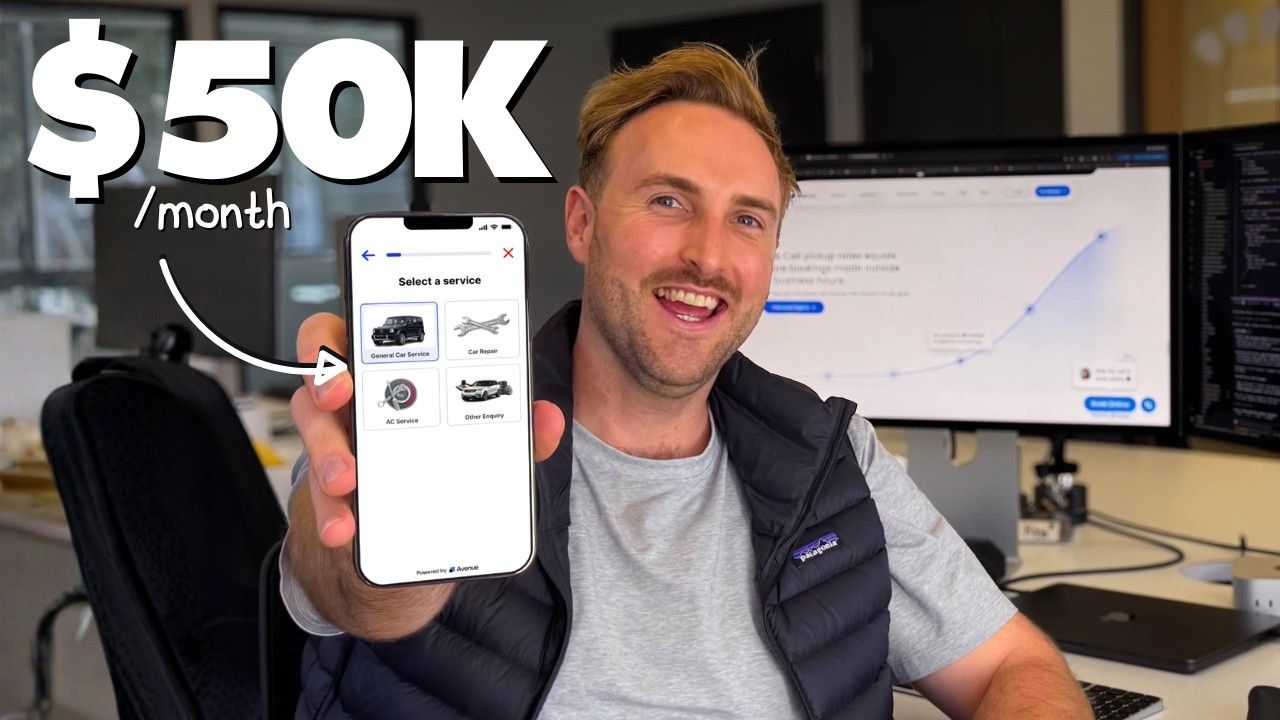
The Solution: Avenue is a website embed that lets service businesses capture bookings and leads automatically, even when they're unavailable. The widget presents a business's services in a clean, visual way and guides the customer through an inquiry or booking flow. Critically, it integrates with Google Reservations and Google My Business, meaning customers can book directly from a Google search result without ever needing to call.
Why it works: The insight is elegant in its simplicity. Tradespeople are busy doing the actual trade. They're not sitting at a desk managing inbound inquiries. Avenue just fills that gap — quietly, automatically, around the clock.
Step 2: Build an MVP With What You Have
Tom's background: Tom left school early. His first job paid $4 an hour. That experience lit a fire under him to understand different business models, and he became obsessed with software specifically because of its potential for passive, scalable income. He had zero coding experience and zero design skills. None of that stopped him.
The MVP: Development kicked off in February of last year with the help of a developer friend who built the first version of the product. Once the concept showed promise, Tom went all-in — hiring a lead designer, a backend developer, and a frontend developer before Avenue had earned a single dollar in revenue.
How he funded it: He didn't raise outside capital. Instead, he used profits from his existing marketing agency, which he'd been running for 10 years with over 70 clients paying for website hosting. That steady stream of agency income became the bootstrapping fuel for Avenue's early development. It's a smart play — use a cash-flowing business to de-risk a new one.
Step 3: Use Door-to-Door Sales to Get Your First Customers
The underrated tactic: This is the part that surprised me most. Avenue's initial growth came almost entirely from in-person, door-to-door sales. Tom and his team would physically walk into businesses, iPad in hand, and show owners the product on the spot.
The details matter: They specifically used an iPad rather than an iPhone for demos, because showing the widget on a larger screen helped business owners visualize what it would actually look like on their own website. They also brought printed brochures — physical, tangible marketing material — to explain the product clearly and leave something behind.
Why this worked: Door-to-door sales is brutally honest feedback in real time. There's no lag between a business owner seeing your product and telling you exactly what they think. You hear the objections immediately. You learn what resonates. And when someone says yes on the spot and hands over their card details, you know you've found product-market fit — not from a survey or an analytics dashboard, but from a real human making a real financial commitment.
Step 4: Let the Niche Find You
How Avenue found its market: Tom didn't start with a laser focus on trades and mechanics. Early on, he and his team pitched to everyone — music studios, repair shops, all kinds of service businesses. They just got out there and talked to as many people as possible.
The discovery: Through that process, a pattern emerged. Tradespeople were by far the most receptive. Tom describes them as direct, results-oriented, and quick to cut through the noise. They understood the value proposition immediately: "I'm losing leads because I can't answer my phone. This fixes that. Done." No hand-holding required.
The lesson: You don't always need to pre-select your niche before you start. Sometimes the niche selects you. But you only discover that by actually getting out there and talking to a broad range of potential customers. The market will tell you who wants what you're building — if you're willing to listen.
Step 5: Sell Before You Build
Tom's final piece of advice is the one I think every aspiring founder needs tattooed somewhere visible: sell before you build.
The idea is simple but powerful. Before you invest months of time and real money into building out a product, get someone to financially commit to the idea first. Not a compliment. Not a "yeah, that sounds cool." An actual payment, or at minimum a signed commitment.
Here's why this matters: customers don't care how hard you worked. They don't care how elegant the code is or how many hours went into the UI. They care about one thing — does this solve my problem? If someone is willing to hand you money before the product is fully built, you've answered that question in the most definitive way possible. You've validated that the market is real and that people will pay to access it.
It also reframes how you build. When you've already made a sale, you're building for a specific person with a specific need, not for an imaginary user you invented in your head. That constraint makes you sharper and faster.
The Revenue Reality
Tom shared his Stripe dashboard during the interview, which I always respect — transparency over hype. The numbers tell a clean story. Avenue started at A$597 in MRR in August of the previous year. By August this year, they were at A$63,108. That's a business that grew consistently month over month, without a single viral moment or press feature doing the heavy lifting.
The host put it well: this is proof that your idea doesn't need to be revolutionary. It doesn't need to disrupt an industry or leverage cutting-edge AI. It needs to solve a real, recurring problem for a specific group of people who are willing to pay for the solution. Tradespeople lose leads every single day because they're too busy to answer their phones. Avenue solved that. Full stop.
Conclusion
What I love about Tom's story is how unsexy it is — and I mean that as the highest possible compliment. There's no flashy tech, no enormous funding round, no overnight virality. Just a guy who noticed a frustrating problem, scraped together a team using money from his existing business, hit the pavement with an iPad and some brochures, listened carefully to who responded best, and built something those people genuinely needed.
The playbook is right there in front of you:
- Find a boring, painful problem in a niche people overlook
- Bootstrap using what you already have
- Get out from behind your laptop and sell in person
- Let the market tell you who wants your product
- Validate with real money before you go deep on building
You don't need a technical background. You don't need outside funding. You don't need a revolutionary idea. You need a real problem, a real solution, and the willingness to go knock on some doors. Tom and his brother did exactly that — and they're now building a very real business in the most underrated niche imaginable.
Original video
https://www.youtube.com/watch?v=mr4YV-9MY0Q