 Story
StoryHow Rashid Built $32k/Month From 3 Simple Database Sites
Three curated databases, one patient founder, and $32k in monthly recurring revenue. Here's the full playbook Rashid used to get there.
Most people overthink what a SaaS business needs to be. They imagine complex algorithms, years of engineering, a big team. Rashid Khasanov built $32,000 in monthly recurring revenue with something far simpler: curated databases that solve one specific, tedious problem for a very specific kind of person.
His three products — AngelMatch, Investor Hunt, and Journalist Hunt — aren't flashy. They don't use AI in some magical way. They're databases. But they solve real pain, they charge fair prices, and they compound over time. That's the whole game.
Step 1: Start With a Problem You've Actually Lived
Rashid is a non-technical founder with a finance background. He didn't set out to build a SaaS company. He and a college friend were building a fintech investment app, and they'd already raised $100,000 from family and friends. But they needed more — they needed professional investors.
Finding those investors turned out to be exhausting. There was no clean, centralized place to look. So Rashid and his co-founder did it the hard way: they manually built an Excel spreadsheet of roughly 600 investors. Hours and hours of tedious work just to get a list of people to pitch.
At some point, Rashid had a very simple thought: if this problem was painful for him, it was painful for thousands of other founders too. That realization became AngelMatch — a database of 125,000+ angel investors and VCs designed specifically to help startup founders find capital without the grinding manual research.
This is the most underrated part of his story. He didn't find the idea in a trend report or on a list of hot startup verticals. He found it by living through the frustration himself. That personal experience gave him real clarity on what the product needed to do and who it was for.
Step 2: Build the Database (However You Can)
Rashid is upfront about not being a developer. He partnered with developers to build the actual product. If you're non-technical, that's fine — the key is identifying the problem and owning the direction. The technical execution can be hired or partnered for.
The data itself can be built manually, like Rashid did with that original investor spreadsheet, or through more automated scraping and aggregation systems as the business grows. AngelMatch now has over 125,000 angel investors and VCs. Journalist Hunt has over 200,000 journalists. That scale didn't happen overnight, but it started with someone willing to do the unglamorous work of pulling data together.
The tech stack Rashid landed on is solid and practical:
- Front-end: Next.js
- Back-end: NestJS
- Database: PostgreSQL
- Hosting: DigitalOcean
- Security: Cloudflare
- SEO research: Ahrefs
- Email outreach: Nylas
- Email marketing: Klaviyo
- Business email: G Suite
Nothing exotic. Nothing that requires a PhD to maintain. It's a stack that lets a small team move quickly and keep things stable.
Step 3: Launch Fast to Get Real Validation
Rashid's framework for building database businesses has three steps, and the third one is the most important: launch the product and get paying customers as fast as you can.
Feedback from people who haven't paid you is interesting. Feedback from people who have paid you is the truth. A paying customer is telling you the problem is real, the solution works well enough, and there's a market here. That signal is worth more than any survey or beta waitlist.
Don't wait until everything is perfect. Launch early, put it in front of people, and let their wallets do the validating. Rashid's businesses weren't polished out of the gate — they were functional and focused, which is exactly what early-stage products need to be.
Step 4: Go All-In on SEO and Content
Once AngelMatch had paying customers and Rashid knew the idea worked, the focus shifted entirely to growth. And his primary growth channel was SEO.
He hired content writers to consistently publish blog posts targeting the kinds of searches that startup founders make when they're trying to raise money. He built free tools to bring in organic traffic. He treated content as an investment that would compound over time — not a quick win, but a slow and powerful flywheel.
That SEO-first approach took AngelMatch from $3,000 MRR to $20,000 MRR. That's not a small jump. That's the kind of growth that changes what a business can do and what the founder's life looks like. Later, once the organic foundation was solid, they layered in Meta ads to push growth further.
Investor Hunt, his second product, is an even cleaner example of this in action. It currently makes $2,827 MRR with basically no active marketing — just SEO doing its thing. That's a business generating nearly $3k a month almost on autopilot because the content and search ranking work was done consistently over time.
Where Each Business Stands Today
Let's look at the actual numbers Rashid shared from his dashboards:
AngelMatch — the flagship. $29,446 MRR with 360 active subscribers. Trial conversion rate sits at 33.3%, which is genuinely strong. The site pulls 800 to 1,000 clicks per day from various channels. Pricing starts at $59/month.
Investor Hunt — the steady earner. $2,827 MRR driven almost entirely by SEO with no active marketing spend. Pricing tiers are $57, $97, and $297 per month, which gives it some nice room to capture different kinds of customers.
Journalist Hunt — the newest and smallest. $260 MRR with pricing between $49 and $99 per month. It's early days, but it follows the same model: a painful, specific problem (getting press coverage), a large curated database (200,000+ journalists), and a clear target user (small businesses and media companies wanting earned media).
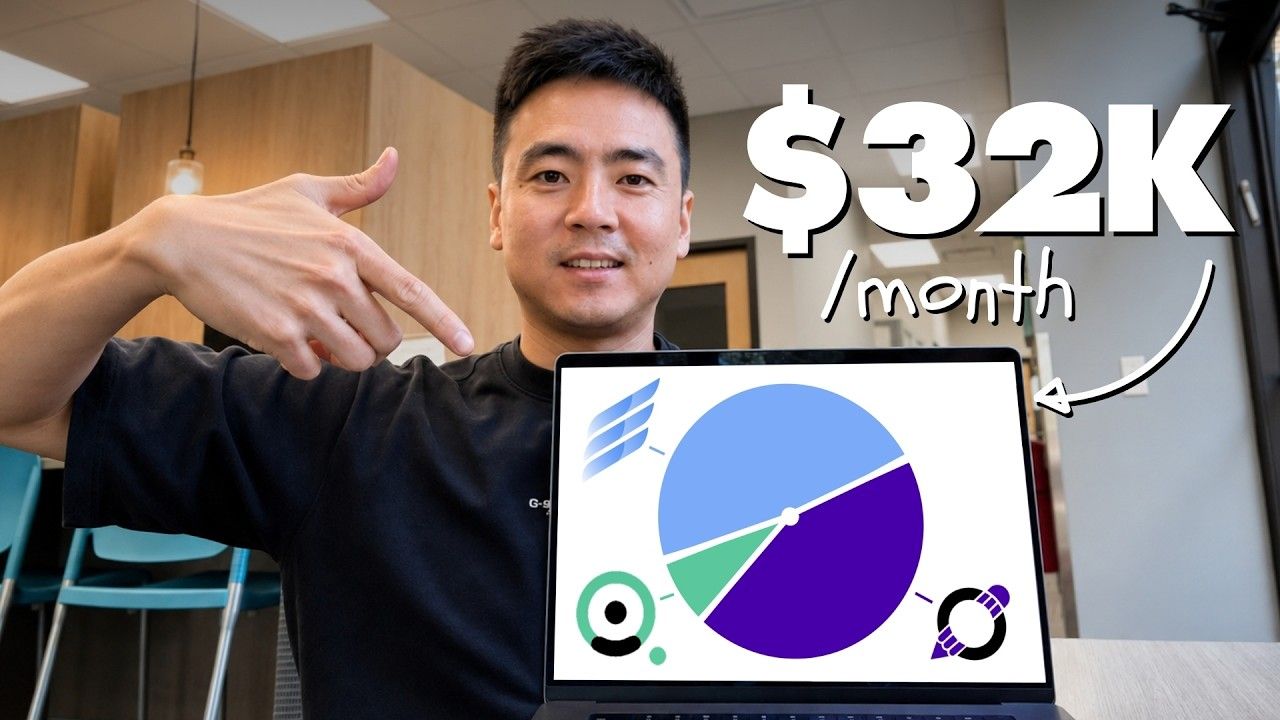
Combined, that's $32,533 MRR from three products that all share a single underlying idea: curate a large, relevant database, charge people to access it, and market it through search.
Why This Model Works (And Where the Opportunity Is)
The honest reason these businesses work is that they do something genuinely useful and they do it reliably. There's no magic. There's no viral hack. There's a real problem — finding investors is tedious, finding journalists is tedious — and a product that makes it less tedious.
Database businesses are also fundamentally defensible over time. The data itself has value. The SEO content compounds. The brand builds trust in its niche. A founder who starts and quits after six months will never see these effects. But a founder who sticks around and keeps publishing, keeps improving the data, keeps iterating on the product? They build something that gets harder for competitors to displace.
And there are so many niches left to serve. Real estate investors. Stock traders. Independent consultants. Podcast guests. The framework is the same — find a group of people who need to find other people, build the database, and charge for clean, fast access to it.
The Advice That Actually Matters
Rashid's final words in the interview were about patience. He's watched other founders start businesses around the same time he started AngelMatch. Some of them were growing faster early on. But they gave up. They moved on to the next thing, chased the next trend, stopped putting in the work.
Rashid didn't. And now he's running $32k MRR while those other businesses are gone.
Consistency isn't a glamorous lesson. It doesn't make for a great highlight reel. But it's the actual competitive advantage in this kind of business. You're not trying to go viral. You're trying to build something that grows a little every month and doesn't stop.
If you're thinking about building a database product, the playbook is genuinely simple: find a painful problem you understand deeply, build a focused database around it, launch as fast as you can, and then spend the next year writing content and doing SEO. Then do it again the year after that.
That's it. That's how you get to $32k a month.
Original video
https://www.youtube.com/watch?v=5-G9WHwQMwQ