 Story
StoryHow Prayer Lock Grew to $20k/Month in Six Months
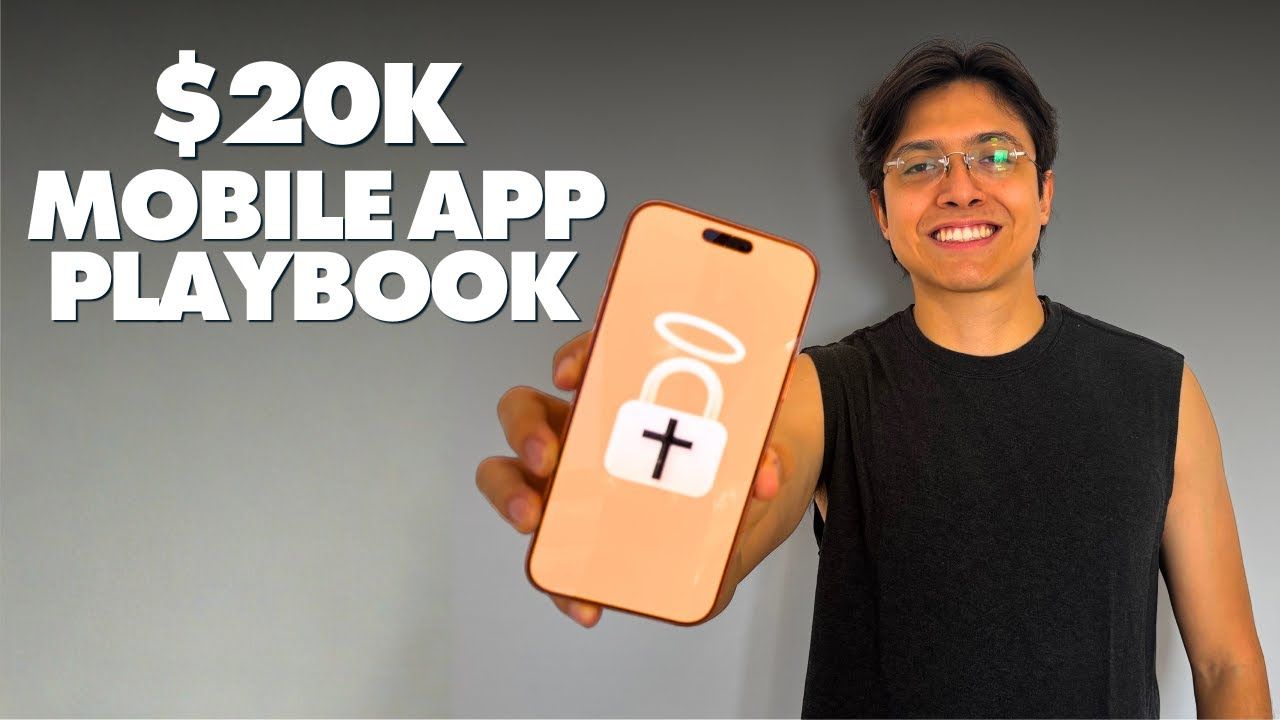
Mau Baron built a Christian focus app using AI in just three days — then grew it to over $20,000/month by nailing distribution, not just the product.
Most people who build apps spend months perfecting the product and wonder why nobody shows up. Mau Baron did the opposite. He built Prayer Lock — a Christian app that blocks distracting apps on your phone until you pray — in just three days using AI tools, then spent the next six months obsessing over marketing. The result? Over $20,000 a month by December, with more than 58,800 total downloads and a 4.9-star average from 6,700 ratings.
The story is worth unpacking in detail because it's not just a feel-good indie win. It's a concrete playbook — how to build with AI, how to find your first paying users through organic content, and how to scale that into a real paid ads engine.
How the App Works and What the Numbers Look Like
Prayer Lock is elegantly simple. When a user tries to open a blocked app — Instagram, YouTube, whatever is eating their attention — they're stopped and asked two short questions: how are they feeling, and how is their relationship with God? Based on their answers, the app generates a personalized AI prayer. Then they can proceed.
The monetization is a straightforward subscription: $49.99 per year or $9.99 per week. Looking at the revenue dashboard Mau shares in the video, the growth is striking. October came in at $10,754. November climbed to $14,814. December hit $21,097 — over 50% month-over-month growth, sustained for multiple months. The conversion rate sits at 43.6%, and the average proceeds per paying user are $23.60. A 12% review rate is exceptional by any standard.
These aren't vanity numbers. They tell you the product resonates deeply with its audience and that the funnel is working.
Mau's Background and Why He Pivoted to This
Mau didn't come from a technical background. He studied finance. In 2022, he discovered OpenAI's original Codex model and became obsessed — teaching himself how to code through AI tools before many people had even heard of the concept. His first real project was an adult content AI app, which he describes as ultimately leaving him feeling empty and disconnected from his values. That experience pushed him to pivot completely into the Christian space as a way to reconnect with his faith.
But the early days weren't smooth. He spent three months building apps that nobody wanted. Then he stumbled on a competitor called Pray Screen — a similar concept of blocking your phone for prayer. He studied it carefully, believed he could improve both the design and the feature set, and that conviction became Prayer Lock.
Building with AI: The Actual Advice
Skip the mockups, study the competition. Mau's first piece of advice is to stop spending time designing things from scratch. Instead, go find the best apps in your niche — and outside your niche — using tools like `screens.design`. Study their onboarding flows, their UI patterns, what makes them feel polished. He compiled competitor screenshots directly into a Canva file as a reference before writing a single line of code. This isn't copying; it's research. You're learning what good looks like before you try to build it.
Use the right AI tool for the right job. Not all AI tools are created equal, and using them indiscriminately gets expensive and frustrating. Mau's daily driver for coding is Cursor. For complex, multi-step tasks that need more horsepower, he uses Codex CLI. For quick questions and small code changes, he uses the ChatGPT Mac desktop app. Each tool has a job. Mixing them up wastes money and time.
Don't try to one-shot the whole app. This is probably the most important technical point. Mau is explicit: AI cannot build a complete, error-free app from a single prompt. Trying to do that leads to a broken mess that's hard to debug. Instead, break the app into logical blocks — frontend, backend, infrastructure — and build piece by piece. Treat AI like a very fast junior developer who needs clear, scoped instructions rather than a magic wand.
Skip authentication and databases if you can. Prayer Lock has neither. No login, no database storing user records. Mau argues that for a lot of consumer apps, this complexity is unnecessary friction — both for you as the builder and for users during onboarding. Yes, users might lose their data if they switch phones. But that's a niche edge case, and optimizing for it at launch means adding backend costs and development complexity that slows everything down. Ship lean.
The Growth Playbook: Organic First
With the app live, Mau had no audience and no budget. His starting strategy was pure volume testing on TikTok. He was posting around 40 times a day across 12 different accounts, trying every content format imaginable to see what would stick. That's an uncomfortable level of output for most people, but it's the fastest way to get real data on what an audience actually responds to.
The winning format he discovered was what he calls the "UGC girl reaction" video combined with an app demo — a real person reacting authentically to using the app, paired with a screen recording showing how it works. That combination drove enough downloads and conversions to get him to his first $1,000 a month in revenue, entirely without spending on ads.
From there, he hired another UGC creator to expand output and started experimenting with paid distribution. His first attempt was an influencer partnership, which flopped. He moved to Meta ads next — also underwhelming. Then he tried TikTok Spark Ads, which is where things clicked.
Scaling with Paid Ads: What Actually Worked
The first paid campaigns failed, and the reason is worth highlighting: Mau was optimizing for downloads. Downloads are a vanity metric. What matters is trial starts — users who actually engage with the app enough to begin a subscription trial. Optimizing for the wrong action burns budget without generating revenue.
At the same time, he completely overhauled the onboarding experience. The original flow took about 5 minutes. He rebuilt it into a 15-minute, story-driven experience that walked users through the app's purpose and value in a much more emotionally resonant way. The result was that his organic conversion rate tripled. The product itself became a better marketing asset.
With a working conversion funnel and the right optimization target, he started TikTok ads at $20 a day. He found a UGC creator named Matthew whose videos hit a $3 cost per trial — an excellent number. Confident in the unit economics, Mau invested his entire savings of $4,000 into ads. October came in at $10k. He reinvested another $6k, and November hit $15k. He kept scaling ad spend into December and landed at $21k.
The compounding logic here is simple but powerful. When you know your cost per trial and your conversion rate from trial to paid, you can calculate exactly what a dollar of ad spend is worth. Once that math works, the only constraint is how much you can reinvest — and confidence to actually do it.
Takeaways
What Mau built isn't magic. It's a repeatable set of decisions: pick a niche you genuinely care about, study competitors before you build, use AI to ship fast without over-engineering, test content at volume until you find what works, and then reinvest profits into scaling what's already proven.
The 15-minute onboarding might seem counterintuitive — conventional wisdom says shorter is better. But story-driven onboarding builds emotional connection, and for an app rooted in faith and personal accountability, that connection is everything. The tripled conversion rate proved it.
Six months. Three days to build. $20k a month. The leverage was always in the marketing, not the code.
Original video
https://www.youtube.com/watch?v=yBjcmMhXSDk