 Story
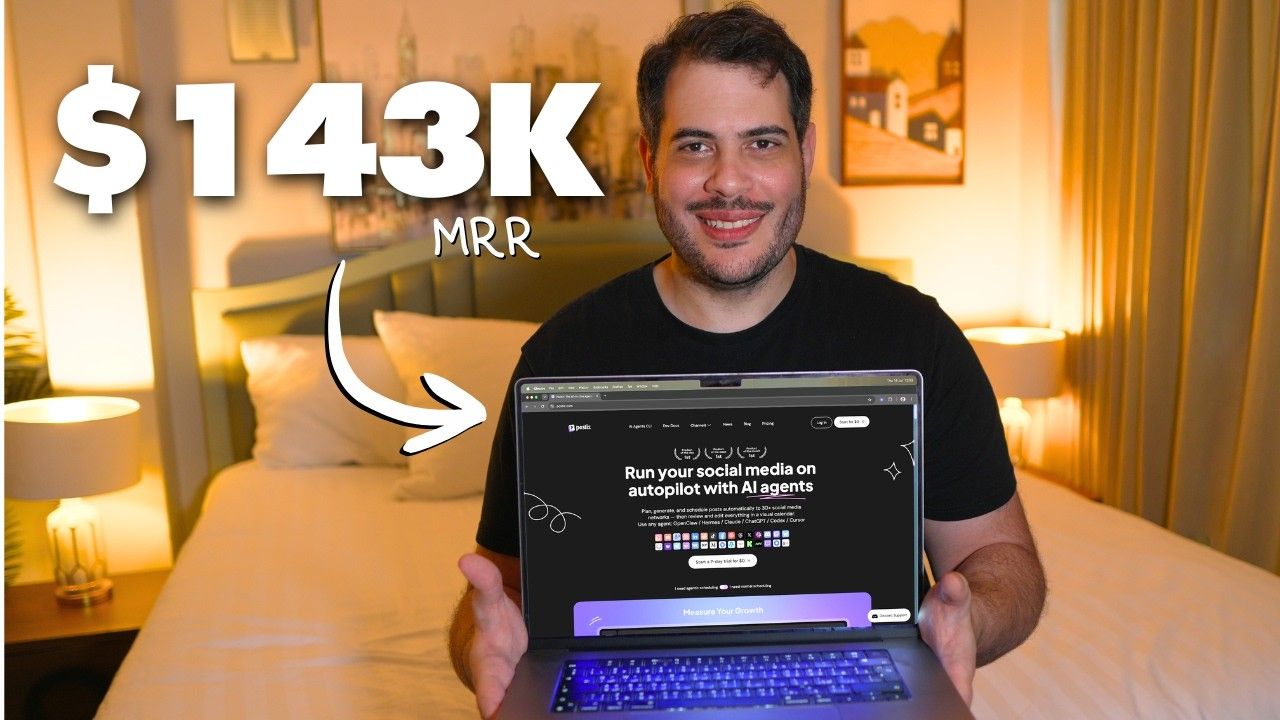
StoryHow Postiz Grew from $17K to $143K MRR in Four Months
Nevo David pivoted his social media scheduling tool to an agentic AI model and rode a viral wave to explosive growth. Here's exactly how he did it.
Most growth stories are slow burns. You grind for months, maybe years, and the revenue line creeps up like it's afraid of heights. Nevo David's story with Postiz is the opposite of that — and it's worth paying close attention to.
Five months ago, Nevo was sitting at $17k MRR. A solid number, but one that had taken him a year and a half to reach. Then something clicked. Over the next four months, Postiz went from $17k to $143k MRR. That's nearly 10x, growing at roughly $1,000 in new MRR every single day. By late June, the dashboard read $143,807.12 with 4,271 active subscribers.
So what actually happened?
Step 1: The Pivot to Agentic SaaS
Postiz started as a pretty standard social media scheduling tool — manual interface, users pick a time, write their post, hit publish, repeat across 30+ platforms. It worked, but it wasn't special.
The pivot was radical. Nevo completely transformed Postiz into an *agentic* social media scheduling tool. Instead of a user opening a dashboard and doing things manually, they now talk to AI agents — Claude, OpenClaw, Hermes Agent, ChatGPT — tell the agent what they want to create, and the content gets generated and scheduled automatically. The human is largely out of the loop. The agent handles everything.
This isn't a feature update. It's a fundamentally different product. The value proposition flipped from "we make scheduling easier" to "we remove the scheduling work entirely." That's a much bigger promise, and it turns out, users believe it.
The proof is in the churn numbers. Before the pivot, Postiz was bleeding 26–28% of its customer base every month. That's brutal — it means you're running on a treadmill, constantly needing new users just to stay flat. After going agentic, churn collapsed to 13.7%. The product became stickier because it was doing more of the actual work. When a tool automates the painful, repetitive parts of your job, you don't cancel it.
Step 2: Catch the Right Trend at the Right Time
Here's the thing about the agentic pivot — it only worked because the timing lined up with a massive wave of external hype. Nevo spotted that wave early.
A new open-source tool called OpenClaw, released by developer Peter Steinberger, was generating serious buzz. Nevo integrated Postiz with it quickly. Then something unexpected happened: a creator named Oliver Henry started using an OpenClaw agent — which he named Larry — with Postiz to automate TikTok marketing for his own app, Snuggly.
Oliver documented the whole thing in a long-form article on X titled *"How my OpenClaw agent, Larry, got millions of TikTok views in one week."* It went viral. 7.2 million views. And with that, Postiz was suddenly the tool everyone in the AI agent community knew about. At peak, they were pulling 700 concurrent trials per day.
Nevo didn't manufacture that viral moment — Oliver created it organically. But Nevo had built the product to a point where it could be the star of that story. That's the unlock. Being ready when someone else decides to shout about you.
Step 3: Build a Repeatable Content Engine on X
After that first viral hit, Nevo didn't just wait for the next lucky break. He reverse-engineered why it worked and built a repeatable system around it.
He noticed something about X's algorithm: it was heavily favoring long-form articles. The platform wants users to stay on X longer, and articles do that better than short posts. So he started writing his own articles about trending topics — specifically OpenClaw integrations, how to use AI agents for social media, and how Postiz fit into that workflow. One of his articles pulled half a million views.
Then he scaled it. Rather than just relying on his own audience, he started paying other creators and influencers on X to repost his articles. He'd find accounts with high engagement on similar topics and pay anywhere from $60 to $350 per repost. That's an incredibly efficient ad spend — for a few hundred dollars, you're getting distribution to an already-engaged, already-relevant audience who trusts the person sharing it.
This two-step system — write articles on trending topics, pay for amplification — became his primary growth engine. It's not glamorous, but it works. And it's something any founder with a few hundred dollars and a good story to tell can replicate.
Step 4: Build Before the Trend Hits
Nevo is direct about something that most founders miss: you can't build during a trend. By the time a trend is obvious, it's already crowded. You need to have something real and functional before the moment arrives.
His advice for other SaaS founders is specific and practical. First, make your product agent-ready right now, even if agents aren't your core feature. Add a public API. Export your documentation as an MD file. Publish your tool in agent marketplaces — the ChatGPT plugin store, the Claude integrations marketplace. This is table stakes for being discoverable when someone is building an agent and looking for tools to chain together.
Second, understand your audience. The people who are building and using AI agents right now are early adopters in the truest sense — small in number but massive in influence. They write articles. They share workflows. They create the viral content that brings everyone else along. Nevo calls them powerful early adopters, and he's right. One Oliver Henry moment is worth more than a thousand generic ad impressions.
Third, and this is the counterintuitive one: adding agent features can actually *reduce* churn even for your existing non-agent users. Why? Because the manual work that agents eliminate is often the exact same work that causes people to give up on your product. Remove the friction, and people stick around.
The Real Lesson Here
What Nevo built isn't magic. It's a product that was ready, a pivot that was bold, a trend that he spotted early, and a content strategy that was systematic. Each piece mattered.
The churn dropping from 28% to 13.7% tells you the product change was real, not just a marketing story. The hockey stick starting in January 2026 tells you the timing of the trend mattered. The viral article from Oliver tells you community and ecosystem matter. And the $60–$350 influencer reposts tell you that expensive paid acquisition isn't the only way to scale.
If you're sitting on a SaaS that feels stuck, ask yourself honestly: is there a way to remove more of your users' work? Can an AI agent do the thing they're logging in to do manually? If yes, that's your pivot. And if you can ride that pivot into a trend that's already moving — with a content strategy ready to amplify it — you might just find yourself writing a growth story that nobody believes when they first hear the numbers.
Original video
https://www.youtube.com/watch?v=n7Obxh9-Rc8