 Story
StoryHow One Stay-at-Home Mom Makes $16K/Month Flipping Furniture
Kara Ward turned a garage side hustle into a six-figure business — buying cheap furniture, transforming it, and selling it for massive profit. Here's exactly how she does it.
Most people look at an old dresser on the curb and see trash. Kara Ward looks at that same dresser and sees $1,000.
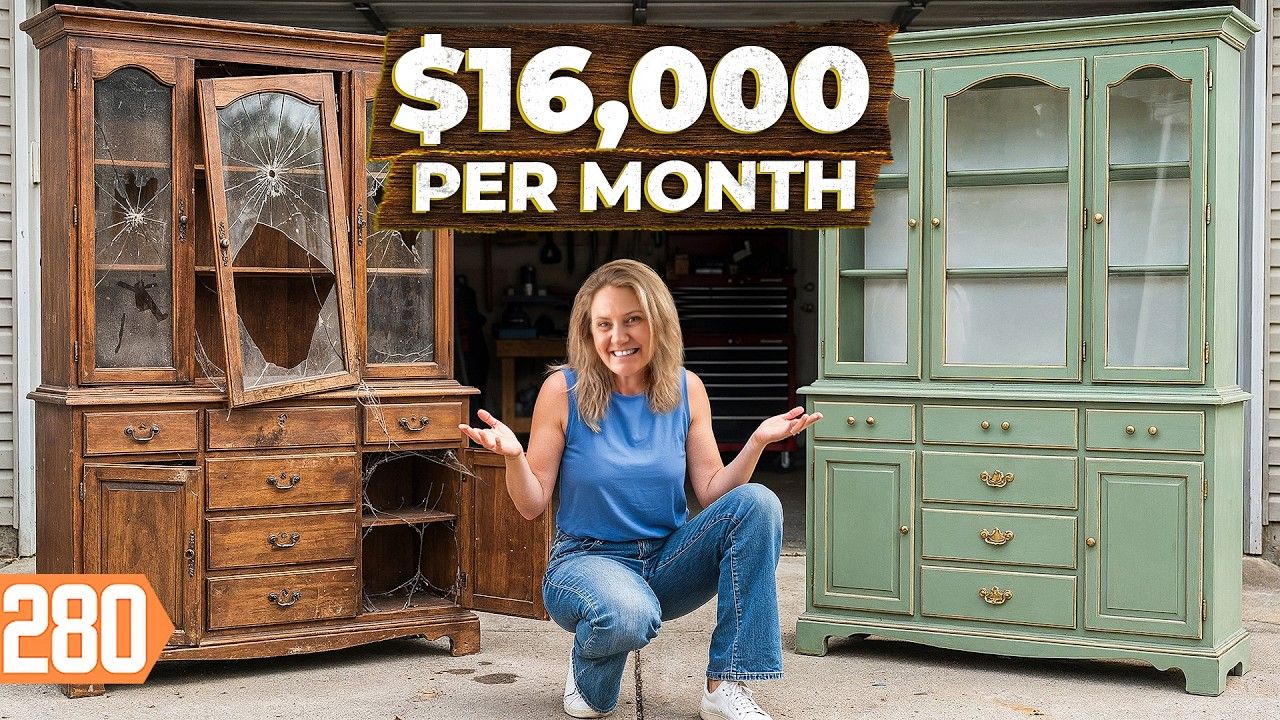
Kara is a homeschool mom and the owner of Lemons to Lemonade Home. She earns up to $16,000 a month flipping used furniture out of her garage — no warehouse, no employees, no outside investors. Just her, a can of Sherwin Williams paint, and a very sharp eye for what people actually want in their homes. The whole thing started out of pure necessity: her husband worked in events, COVID hit, he lost his job, and suddenly their family of four was drowning in debt with a scary amount of nothing coming in. What began as a desperate attempt to keep food on the table grew into a business that made $80,000 in its first year and has only climbed since.
Her playbook is surprisingly systematic. Once you understand the logic, you realize this is less "arts and crafts" and more "repeatable business engine."
Step 1: Source Smart — Free and Cheap is the Whole Game
Kara's sourcing rule is simple: never pay more than $80–$100 for a dresser or nightstand, because the return on investment is already enormous at that price point. Her dressers typically sell for $800 to $1,200. Nightstands — consistently her highest-selling category — can bring in serious margins too.
Where to look: Her go-to spots are Habitat for Humanity ReStores (great for beginners), Goodwill, estate sales, and the curb. Yes, the curb. That $1,000 dresser she mentioned? Found it on the street for free. That's a 1000% ROI before she even picked up a paintbrush.
Pro tip on thrift stores: Most use color-coded tags to mark items at 25%, 50%, or even 75% off. If you know the tag rotation schedule, you can time your visits to hit deep discounts.
Online estate sales are another underrated channel. These have moved to bidding platforms, and they're goldmines for solid, well-made pieces at below-market prices — often from estates where families just want things gone quickly.
Step 2: Know What Will Actually Sell
This is where most beginners go wrong. You can't just flip what *you* personally like. You have to design for what other people want in *their* homes.
How Kara researches trends: She browses furniture catalogs and physically visits stores like Pottery Barn and Arhaus to see what's moving right now. Then she hunts thrift stores for pieces with similar silhouettes or "good bones" that she can transform to match those trends.
Example: She spotted a solid wood 1980s bookshelf with great character. On its own, it looks dated. But by cutting curves into it with a router — a style that's very popular right now — it becomes something a design-conscious buyer would happily pay top dollar for.
Why she loves 1960s–1980s furniture: Pieces from those decades are typically built from solid wood, which is durable, takes paint beautifully, and has real weight and presence. Newer laminate furniture? Skip it. It doesn't sand properly, doesn't hold paint the same way, and buyers can feel the difference in quality.
Step 3: Prep Like a Pro (Most People Skip This)
The biggest mistake beginners make is jumping straight to painting. Kara's first step is always a deep clean — decades of wax and Pledge buildup will ruin your finish if you don't remove it first. This alone separates a professional-looking result from an amateur one.
The prep sequence:
- Clean the piece thoroughly to strip old wax and product buildup
- Scuff-sand the surface so the new paint has something to grip — she uses a 180-grit pad on an orbital sander
- Always sand in the direction of the wood grain to avoid scratches
- Use a paint sprayer (not a brush or roller) for a smooth, furniture-grade finish
For the dresser she worked on in this video, she chose a color called "Muddled Basil" from Sherwin Williams — a trending neutral she found while browsing Pinterest. One can of paint often stretches across multiple projects, which keeps costs low and margins high.
Step 4: Stage It Like You're Selling a Home
High-quality photos aren't just helpful — they're the difference between a listing that gets ignored and one that generates a dozen messages in an hour.
Kara built a dedicated staging area inside her garage: a shiplap backdrop, a rug, carefully chosen decor. The goal is to help buyers *visualize* the piece in their own home, not stare at it in a cluttered garage.
Her photo process:
- Shoot from multiple angles — wide shots plus close-ups of hardware and details
- Open the drawers in photos to show they're clean and functioning
- Use an AI staging app to generate a cover photo that shows the furniture inside a professionally designed room — this is the image buyers see first in the listing
For the listing itself, the title needs to work hard. She doesn't just write "dresser." She writes something like "Upscale Buffet Credenza Dining Room Solid Wood" — stacking multiple keywords so the listing surfaces in more searches. She also includes exact dimensions in the description upfront, which cuts down on back-and-forth messages from buyers and signals that she's a serious, organized seller.
Her platform of choice is Facebook Marketplace, which remains the dominant destination for used furniture buyers in most markets.
Step 5: One Flip, Multiple Income Streams
Here's where Kara's business model gets genuinely clever. Most people think of a furniture flip as one transaction: buy low, sell high, done. Kara treats each piece as a content opportunity that can pay her multiple times.
About six months into flipping, she and her husband were moving five or six pieces a week and realizing they were making a real dent in their $60,000 of medical debt. She posted about her debt-payoff journey on personal Instagram, and the Dave Ramsey show reached out to feature her story. Someone watching asked if she was filming her process. She wasn't. Their response: *"You have literal gold in your garage. People need to hear this story."*
That nudge launched a YouTube channel that got monetized in just five months — another meaningful income stream layered on top of the flips themselves. From there came affiliate marketing, brand sponsorships, and eventually a collaboration with MrBeast for his #TeamWater initiative, where she flipped a piece and donated the proceeds to the campaign.
One dresser. Multiple revenue events. That's how you build something that compounds.
The Numbers That Make This Real
Let's put it together concretely:
- Buy a pair of nightstands for $80 → sell for $800
- Find a dresser curbside for free → sell for $1,000
- Flip 5–6 pieces per week at those margins and the math gets serious very fast
- Year one: $80,000 in revenue from a garage
- Current peak: $16,000 in a single month
Kara's early pricing was much lower than this — she admits to selling full bedroom suites for around $800 when she was starting out and left a lot of money on the table. Confidence grew alongside skill, and her prices grew with it. That's the natural arc of the learning curve.
The Bigger Point
What Kara built isn't magic. It's a system: find undervalued solid wood furniture, transform it to match current trends, photograph and list it in a way that makes buyers excited, and then document the whole process to generate additional income streams on top of the sale.
She started in debt, homeschooling her kids, with no business background and no creative credentials beyond a willingness to figure it out. The playbook exists. The platforms exist. The inventory is sitting in thrift stores and on curbs in almost every city in America right now.
The only real question is whether you're willing to pick it up.
Original video
https://www.youtube.com/watch?v=VhBY4vbtSxg