 Story
How One Solo Founder Built 30+ Apps and Hit $1M
Sanskar Tiwari went from working night shifts at a call center to crossing $1M in revenue — with zero employees and a portfolio of tiny, single-feature apps.
Most people are still waiting for the perfect app idea. Sanskar Tiwari just kept shipping.
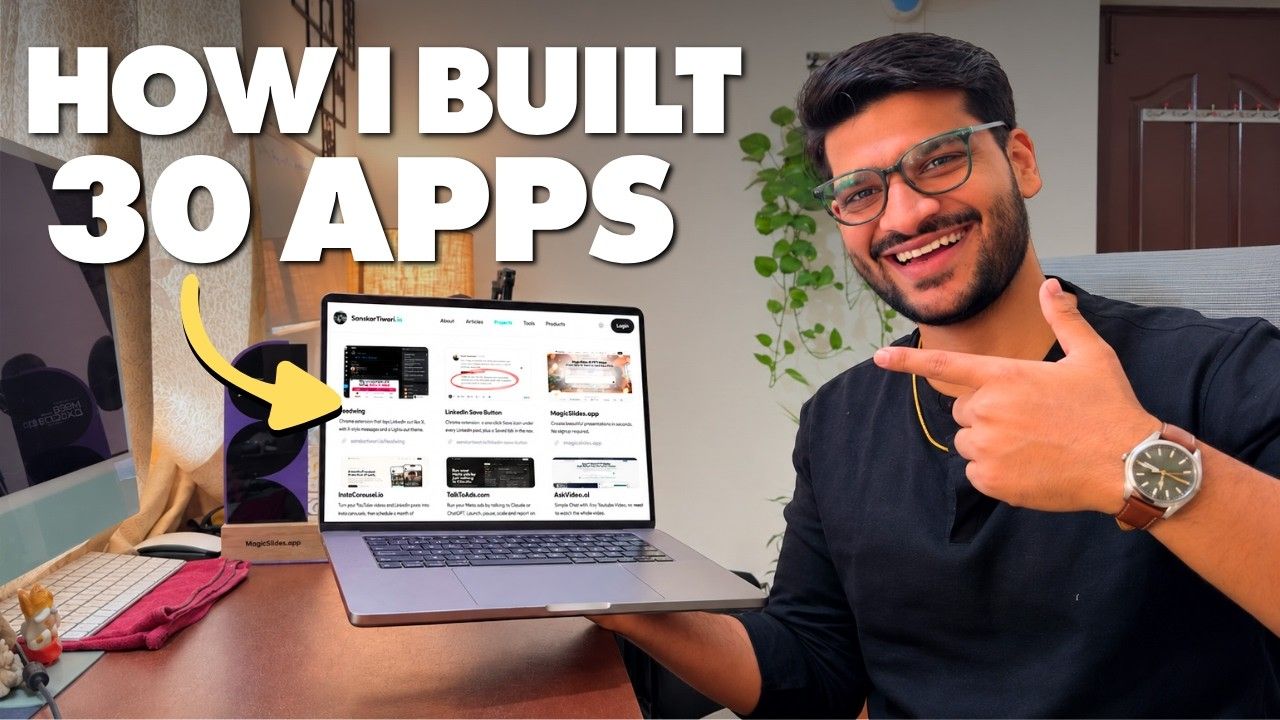
A few years ago, Sanskar was working the night shift at a call center. Today, he runs eight profitable products as a solo founder, has built over 30 apps total, and recently crossed $1 million in total revenue. No team. No investors. No single moonshot bet. Just a portfolio of small, focused apps solving specific problems — and a relentless bias toward execution.
His most quoted line from the interview sums up his entire philosophy: *"A lot of people watch, very few execute."*
The Portfolio: Small Apps, Real Money
Out of 30+ products, eight became profitable. That hit rate might sound low, but that's exactly the point — you can't know which ones will work until you ship them. His biggest product is MagicSlides.app, an AI presentation maker that converts documents, PDFs, or YouTube videos into full PowerPoint presentations. It's the kind of tool that solves a genuinely painful, recurring task for students, marketers, and business professionals alike.
His second major product is AskVideo.ai, which lets users paste in a YouTube video URL and chat with its content — no need to watch the whole thing. Then there's BlurWeb.app, a Chrome extension that hides sensitive information on your screen (great for screensharing), MagicForm.app for generating quizzes from any text or topic, SheetAI.app for using AI directly inside Google Sheets, and TalkingPDF.io, which does for PDFs what AskVideo does for YouTube.
Notice the pattern: each one does one thing. Clearly. Specifically. Memorably.
The Numbers (And the Timeline)
The total revenue breaks down like this: around $856,000 through Stripe, plus over $85,000 from lifetime deals on platforms like AppSumo. Combined, that's just over $1 million — earned across six years.
But here's the part people gloss over: the first *two years* generated zero revenue. This wasn't some overnight viral success story. It was slow, compounding growth built on consistent execution. Understanding that timeline matters, because it reframes the whole thing. You're not trying to blow up in six months. You're building a body of work.
What Makes His Products Actually Work
Sanskar identifies three things his successful projects have in common, and they're worth unpacking properly.
Build on existing platforms. Rather than building standalone web apps from scratch, Sanskar plugs into established distribution channels — the Google Workspace Marketplace, the Chrome Web Store, Google Slides, Google Forms, Google Sheets. These platforms come with built-in trust, built-in search, and built-in audiences. You're not starting from zero. The infrastructure is already there; you're just adding value on top of it.
One core feature per app. This is the one that most builders get wrong. The instinct is always to add more — more features, more use cases, more integrations. Sanskar pushes back hard on that. "When you add too many features, you don't even know yourself what you're selling." A single-feature app forces clarity. It's easier to build, easier to explain, easier to market, and easier for users to understand why they need it. MagicSlides doesn't do 20 things. It makes presentations. That's it. That's the whole pitch.
Compound your knowledge across products. Sanskar's earlier work building SendSimple, a Google Sheets add-on, gave him the deep familiarity with Google's ecosystem that made MagicSlides and MagicForm possible later. Each product he ships teaches him something that makes the next one easier and faster to build. This is a real, underappreciated advantage of building a portfolio. You're not starting from scratch every time — you're stacking knowledge.
Finding and Validating Ideas
Sanskar's approach to finding ideas is refreshingly practical. He browses platforms like TrustMRR — a database of verified startup revenues — and Twitter to stay inspired by what other builders are shipping. He also solves his own problems, which gives him natural insight into whether a problem is real and painful enough to pay to fix.
But the validation step is where most aspiring founders drop the ball, and Sanskar has a simple, non-negotiable fix: put a buy button on a landing page before you build anything.
Not a waitlist form. Not a "coming soon" email capture. An actual payment option. If people are willing to pre-order or at minimum express interest in paying, the idea has legs. If nobody clicks, you've saved yourself weeks of development time.
He puts it in a way that stuck with me: *"If you don't have an option for people to pay you, you are not even letting the God make the magic happen."*
He also gives a sharp piece of advice on market selection: don't build for people who don't have money. Build for people who are already spending. That sounds obvious, but a huge number of indie projects target communities or demographics with zero purchasing intent, and then founders wonder why they can't convert.
Marketing Without a Team
All of Sanskar's marketing is organic and content-driven — no paid ads, no sales team, no growth hacker on retainer.
His early traction came from posting in relevant Facebook groups, specifically AppSumo-related communities where his target audience was already gathering and already in a buying mindset. It's a low-cost, high-relevance approach that most builders underuse.
For longer-term growth, he runs dedicated YouTube channels for each major product — MagicSlides App, MagicForm App, SheetAI App each have their own channel. The key insight here is YouTube's longevity. A tutorial video he posted years ago is still generating views and customer signups today. That's compounding content. It costs you time once and pays you back indefinitely.
He applies the same logic to Instagram, posting lots of short-form videos across each product account. He treats every post as an experiment — throw a lot at the wall, see what resonates, then double down on the formats and topics that actually drive engagement and clicks. It's not glamorous, but it works.
The Advice He'd Give His Younger Self
Sanskar's biggest regret is spending too long doubling down on a single product that wasn't working, adding features nobody asked for instead of moving on. It's a trap almost every early-stage builder falls into — the sunk cost of time and effort making it hard to let go and try something new.
His parting advice: put more buy buttons on the internet.
It sounds almost too simple, but the logic is airtight. The number of payment options you have live at any given time is a direct proxy for your potential to make money. Every buy button is a vote you're asking the market to cast. Some will get zero votes. Some will get a trickle. Occasionally, one takes off. But you can't find the ones that work if you're not running enough experiments.
Stop polishing. Stop adding features to products nobody is buying. Start shipping, start validating, and let the market tell you where to invest your energy.
Sanskar went from zero revenue in his first two years to $1 million total — not by building one perfect product, but by building *many* imperfect ones and letting the winners reveal themselves. That's the whole playbook. 🚀
Original video
https://www.youtube.com/watch?v=X2T92MVx7xs