 Story
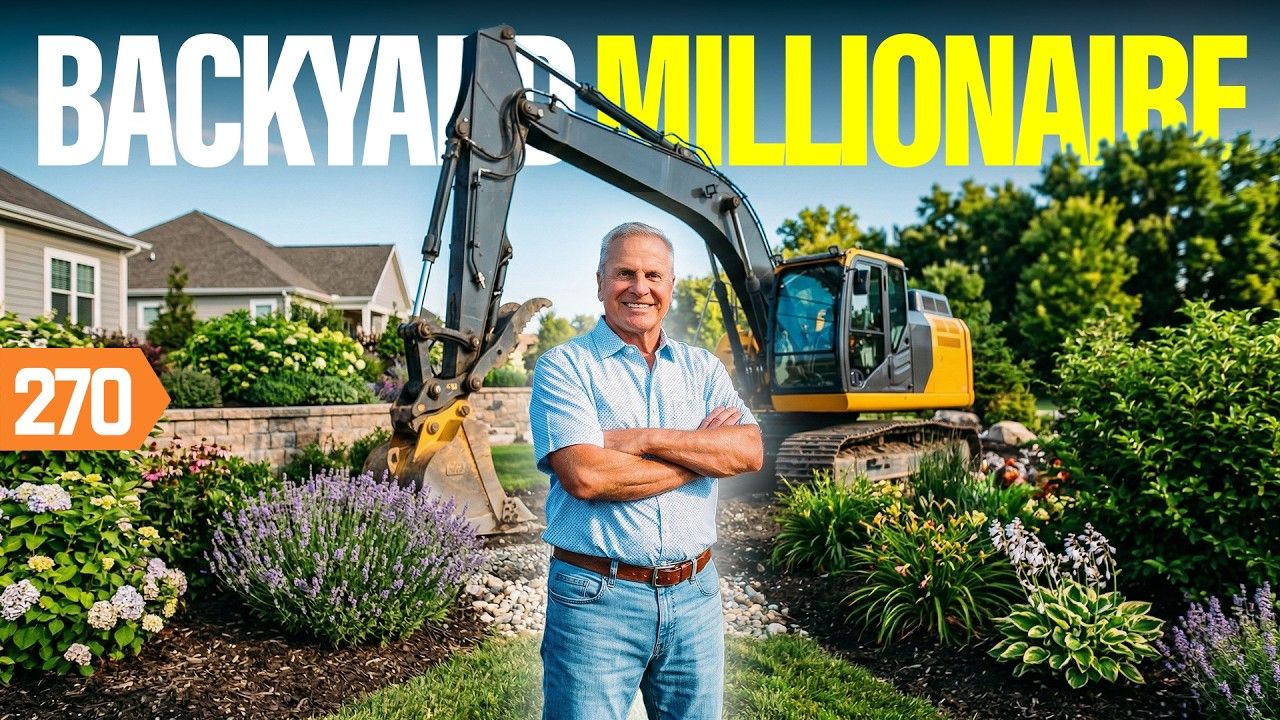
StoryHow One Landscaper Went from Broke to $300k/Month
Steve Griggs built a $4M/year landscaping business by doing what most contractors won't — niching down, building real relationships, and selling a vision instead of a service.
Most people picture a landscaper as someone who mows lawns and trims hedges. Steve Griggs is not that person. He runs a business doing $4 million a year — roughly $300,000 a month — and he hasn't picked up a shovel in years. The average landscaper in America earns about $31,000 a year. Steve isn't playing the same game.
His story took 40 years to build, but the lessons inside it can shortcut a decade of trial and error for any entrepreneur willing to listen.
Step 1: Create an Outdoor Resort, Not a Patio
Steve's first and most important differentiator is how he describes — and therefore sells — what he does. He doesn't build patios or install pavers. He creates outdoor resorts for homeowners. That reframe alone changes everything: the price point, the client expectations, the scope of work, and the margins.
When you position your work as a transformation rather than a transaction, clients stop comparing you to the cheapest guy on Craigslist. They start comparing you to a five-star hotel experience — which is exactly where Steve wants to compete. He specializes in five-to-seven-figure projects, jobs that most landscapers would never even quote.
The other half of this strategy is deep client involvement. Steve gets genuinely close with his homeowners — not in a salesy way, but in a relational one. He listens, he follows up, he shows he cares about the result as much as they do. That approach pays off over and over again, because a happy client doesn't just leave a review. They call him back for the second project, then the third. The relationship compounds.
Step 2: Niche Down Until It Hurts
Steve is direct about what he sees as the number one mistake entrepreneurs make: trying to be a jack of all trades. Offering rocks, pavers, retaining walls, patios, and drainage all at once sounds like it gives you more opportunities. In reality, it makes you forgettable.
His advice is to pick a lane — maybe butterfly gardens, maybe Zen gardens, maybe high-end pool environments on difficult terrain — and become the person in that niche. Not *a* landscaper who does it. *The* landscaper everyone calls when it needs to be done right.
He proved this with a project that four other pool companies had already turned down. The site was on top of a mountain, and nobody wanted the headache. Steve's team built a 40-foot inclined roadway from the driveway all the way up to the build site just to get equipment access. That's the kind of creative problem-solving that separates the specialists from the generalists. The homeowner didn't even know how to swim before the project — and by the end of that summer, he was doing laps. That outcome is what Steve sells.
When you become known for taking on the projects others call impossible, clients seek *you* out. You're no longer competing on price because there's no one else to compare you to.
Step 3: Build Relationships Before You Need Them
The origin story matters here. Steve started at age 13, during the 1970s recession, when his dad would drive him to trim bushes, drop him off, let him do all the work, and collect the money. That early fire — pun very much intended, since his first $500 truck literally caught on fire on a client's front lawn — built a kind of resilience you can't manufacture.
But the real test came in 2008. The recession hit, the economy cratered, and Steve lost everything. He couldn't sell a bag of mulch. Cars were repossessed in the middle of the night. He was starting from zero.
What saved him wasn't a savings account or a hot marketing campaign. It was his client list. The people who knew him, liked him, and trusted him kept calling. They hired him for maintenance work — mowing, tree cutting, the basics — just to keep him going. That sustained income let him rebuild, slowly but steadily, from the ground up.
The lesson: your relationships are your most recession-proof asset. Build them before you need them. Invest in clients like they're long-term partners, because when things get hard, they're the ones who show up.
Step 4: Market Like You Mean It
Steve's business today is 95% referral-based. But referrals don't appear from thin air — especially early on. His most effective early marketing? Old-school yard signs and door hangers. Simple, physical, local.
His field strategy is particularly sharp: when his crew is working a job, he walks over to the neighboring houses, introduces himself, explains what he's doing next door, and offers a small free service as a goodwill gesture. It costs almost nothing. It builds enormous trust. And it converts neighbors into clients because they've already seen the quality of his work right in front of them.
Then there's the coffee-table book. Steve authored a book called *Straight Dirt*, which cost him around $25,000 to produce. It doesn't turn a profit on its own. But it does something more valuable: it positions him as the authority in his field. When a wealthy homeowner is choosing between two landscape designers and one of them hands over a beautifully produced hardcover book, the conversation shifts. You're not a contractor anymore. You're an expert.
That's worth far more than $25,000.
Step 5: Stop Digging, Start Thinking
This is Steve's core philosophy for anyone who wants to scale: they pay you to think, not to dig.
Most homeowners have no idea what their backyard could become. They can't visualize it. They stand in a patch of grass and see a patch of grass. Steve stands in that same patch and sees an outdoor resort — the fire pit, the pool, the lighting, the flow, the whole experience. His job is to transfer that vision from his mind into theirs. That's the high-value skill. That's what commands five and six-figure fees.
As long as you're the one doing the labor, your income is capped by your hours. The moment you shift into the visionary role — designing, selling, managing, directing — your ceiling disappears. Steve doesn't just talk about this philosophically. He also applies it to pricing. When a client pushes back on cost, he doesn't discount. He exchanges value. He'll offer an additional service or upgrade to keep the deal together while protecting his margins. Never drop the price; always add to the offer.
The Takeaway
Steve Griggs went from a kid trimming bushes for his dad to running a $4 million landscaping operation, with a bankruptcy and a near-total wipeout in the middle of that journey. The throughline isn't luck or talent. It's clarity.
He got clear on who he serves — affluent homeowners who want transformation, not maintenance. He got clear on what he sells — a vision, not a service. And he got clear on how he grows — through deep relationships, not discounts.
The landscaping industry is just the vehicle. The lessons are universal. Pick your niche, protect your relationships, and stop selling the thing you do — start selling the result you deliver.
Original video
https://www.youtube.com/watch?v=A8gi3G-B4mg