 Story
How One AI Wrapper Hit $130K in Four Months
Bogdan Dragomir had no coding background — just a marketing brain and a repetitive problem. Here's the full breakdown of how he built getebook.ai and scaled it fast.
Most great product ideas come from the same place: you're doing something manually, over and over again, and you eventually get tired of it.
That's exactly where Bogdan Dragomir started. He was selling ebooks online, manually bouncing between ChatGPT for content and Canva for design. It worked, but it was tedious. So he asked himself the obvious question — what if there was a tool that just did all of this automatically?
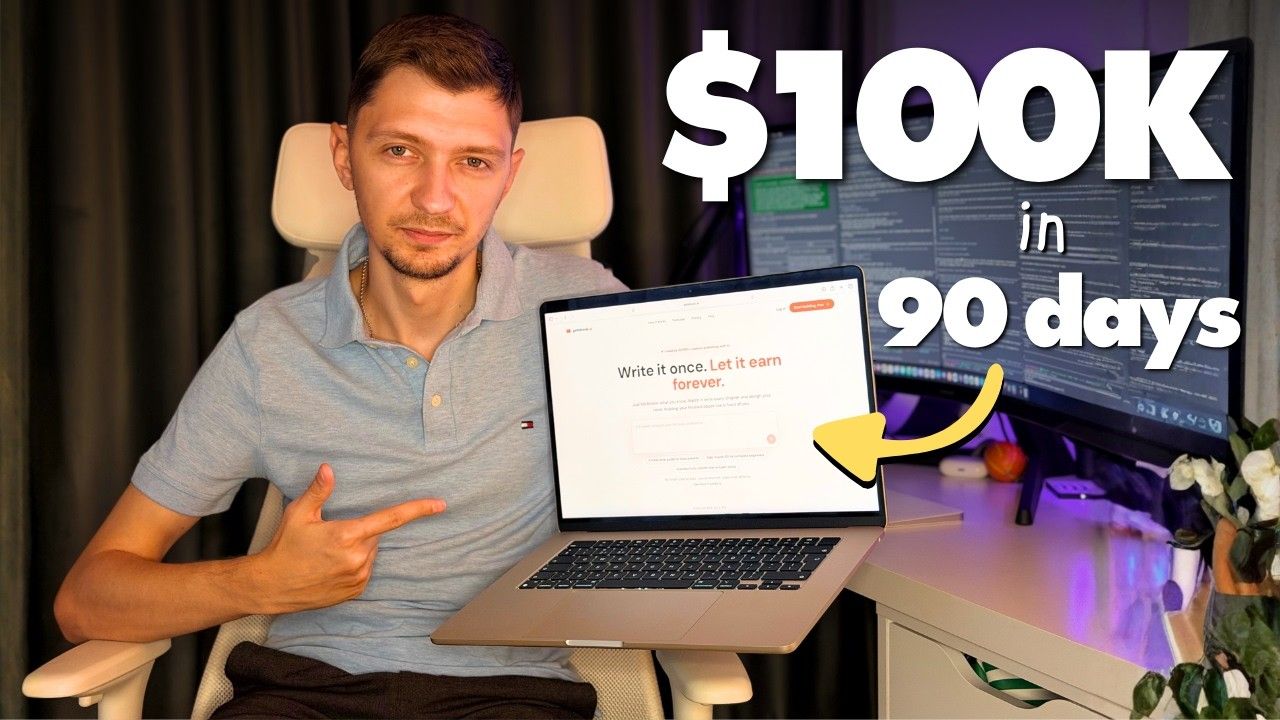
That question turned into getebook.ai, an AI-powered platform that lets users generate complete, fully-formatted ebooks from a single idea. No Canva. No manual prompting. Just an idea in, a finished ebook out. Within four months of launching, Bogdan's Stripe dashboard was showing over $132,000 in gross revenue. This is the full breakdown of how he did it.
The Idea
Bogdan is 28, has a degree in Computer Science for Business Management, and — here's the part that matters — never actually learned to code. His professional background is in marketing; he runs a small social media marketing agency. So when he had the idea for getebook.ai, he wasn't approaching it as a developer. He was approaching it as a customer.
That distinction is huge. He already knew there was demand because *he was the demand*. He was already paying for the problem to exist — spending hours manually creating ebooks he could sell. He knew the workflow was painful and repetitive. He just needed to automate it and charge others to use that automation.
The real validation, though, didn't come until he launched and ran ads. When complete strangers started pulling out their credit cards for a product they found through a Facebook ad, that was proof the market was real. Personal pain is a great starting signal. Strangers paying is confirmation.
What getebook.ai Actually Does
The platform lets users turn any idea into a complete ebook using AI. It handles multiple formats — lead magnets, guides, reports, workbooks, courses, even novels — and takes care of the design and formatting automatically, eliminating the need for separate tools like Canva.
The primary customers are digital product sellers, marketers, creators, affiliates, and business owners who either want to sell ebooks directly or use them as lead magnets to grow their email lists. The business model starts at a $29/month subscription, with upsells for additional credits and other digital products like tutorials layered on top.
According to Bogdan's Stripe dashboard — which he shares in the video — the app pulled in over $132,000 in gross revenue across four months, acquired over 1,730 paying customers from roughly 5,000 total sign-ups, and was sitting at around $7,391 in Monthly Recurring Revenue at the time of filming. That MRR figure might sound lower than expected given the total revenue, and that's the point: a large chunk of the income comes from one-time purchases — extra credits, upsells, and additional digital products in the funnel — not just recurring subscriptions.
Building It Without Being a Developer
The first version of getebook.ai was built using Lovable, a no-code tool that lets you spin up applications quickly without writing code. For early-stage validation, it worked great. Fast to build, fast to test.
But as the product grew more complex, the no-code base became what Bogdan describes as a mess — difficult to manage, difficult to debug, difficult to extend. He made the call to rebuild the entire application from scratch, this time using Claude AI to write the actual code.
His tech stack ended up being:
- Claude AI for coding the application
- ChatGPT for research and ideation
- Supabase for authentication and the database
- Vercel for hosting
- Resend for email marketing
- OpenAI and Gemini APIs for image generation
The key lesson he took from the build process: AI lets you move fast, but you have to understand what you're building. If you're just blindly accepting whatever the AI outputs without understanding the logic, you end up with a codebase that works until it doesn't — and then you have no idea how to fix it. The speed is a gift. The understanding is still your responsibility.
The Growth Strategy: Meta Ads Done Right
This is where things get genuinely interesting. The primary growth channel for getebook.ai has been Meta Ads, and Bogdan's approach is more sophisticated than "run ads and hope."
Here's how he actually scaled past $100K.
First, he tested aggressively. Instead of picking one ad creative and scaling it, he tested a massive number of creatives simultaneously, trying different hooks, angles, visuals, and copy to find what actually resonated. Most of them didn't work. That's fine. The ones that did gave him the signal he needed.
Second, he built multiple tailored funnels. Rather than sending all ad traffic to a single homepage, Bogdan created separate landing pages for different customer segments. One example he mentions specifically: a landing page built around a Kindle royalty calculator, designed to target Amazon KDP authors — a very specific audience with a very specific pain point around ebook creation. Each funnel spoke directly to one type of customer, which dramatically improved conversion rates.
Third, he engineered his LTV. This is the part most people skip. The subscription at $29/month is just the entry point. Inside the funnel, there are upsells for extra credits, tutorial packages, and other digital tools. This increases the average customer lifetime value significantly, which in turn means Bogdan can afford to spend more acquiring each customer. When your LTV is higher than your competitors', you can outbid everyone else on ads and still be profitable. That's a moat.
Finally, once he found what worked, he scaled hard. Ad spend started at $200 per day. By the time of this interview, he was running between $20,000 and $30,000 per month in ad spend while maintaining a 40 to 50 percent profit margin. That kind of margin at that spend level is the result of the funnel work — not just the ads themselves.
Don't Give Up — Seriously
Bogdan's closing advice is blunt and genuine: don't give up. He's not saying it as a platitude. He's saying it because getebook.ai went through real moments of feeling like a complete failure. The no-code version became unmanageable. Rebuilding from scratch is daunting. Things didn't work the way he expected, more than once.
But every failure taught him something specific — about the product, the funnel, the customers, the tech — that made the next version better. The only way to access those lessons is to stay in the game long enough to learn them.
If you're building something right now and it feels harder and messier than you expected, that's not a sign to stop. It's a sign you're in the middle of the story, not at the end of it.
The Real Takeaway
Getebook.ai is, at its core, a focused automation of a repetitive task. It doesn't do everything. It does one thing well — takes an idea, produces a finished ebook — and charges a reasonable amount to do it. No proprietary technology. No deep moat other than execution and a well-built funnel.
Bogdan didn't have a coding background. He used AI tools to build the product, marketing instincts to find the audience, and genuine persistence to push through the messy middle. $132,000 in four months is the result.
The tools are available. The templates are out there. The only thing that's genuinely scarce is the willingness to actually start — and then to keep going when it gets hard.
Original video
https://www.youtube.com/watch?v=P3RVeg8YCg0