 Story
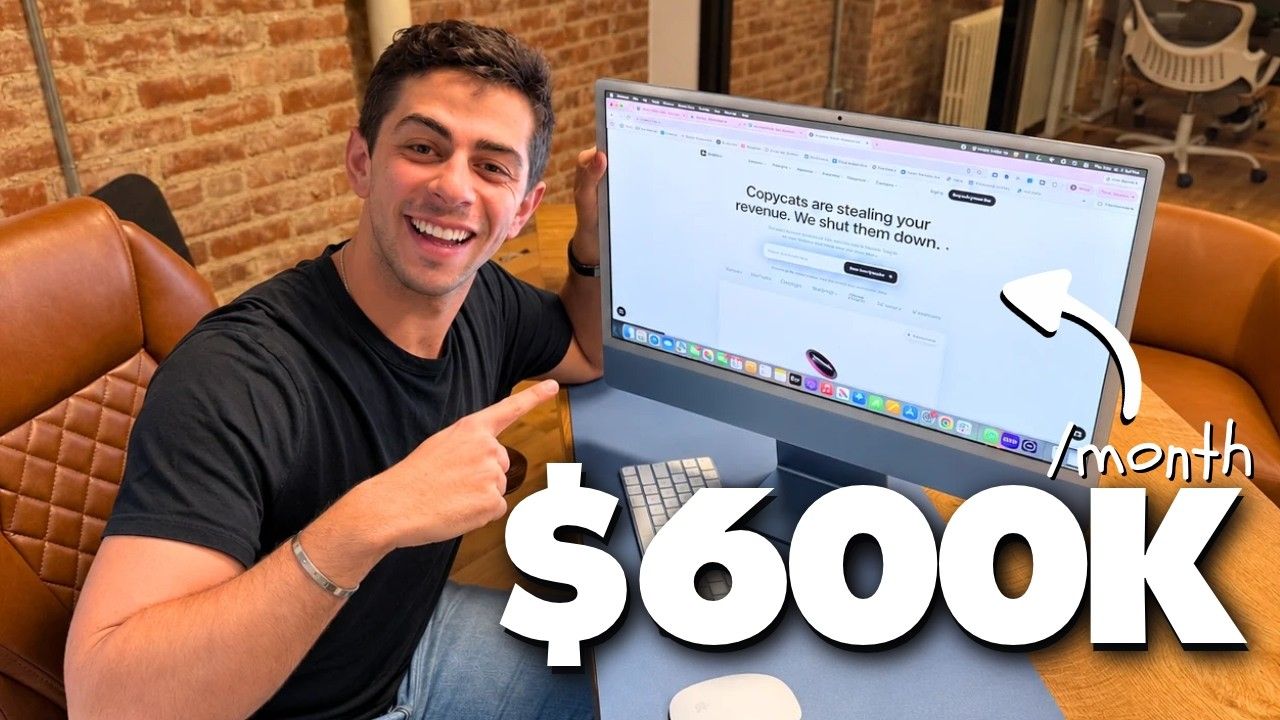
How Oliver Brocato Built a $600K/Month Business (Again)
Oliver Brocato sold his e-commerce brand for millions — then built something completely different. Here's how Bustem hit $600K/month by ditching SaaS for a smarter hybrid model.
Most great businesses are born from a problem the founder lived through personally. Oliver Brocato is a perfect example. He built Tabs Chocolate from scratch at 19 years old, scaled it to $11 million a year, and eventually sold it for a multi-million dollar exit. Most people would take a long break after that. Oliver started building again almost immediately — this time, to solve a problem Tabs Chocolate had made him intimately familiar with: copycats.
The result is Bustem, a fully bootstrapped, profitable company generating $600,000 per month with zero outside investors. No VC money. No runway anxiety. Just a real problem, a smart model, and a founder who was willing to kill his original idea and start over when the market told him to.
The Problem: Copycats Are Destroying E-Commerce Brands
When you build something that sells, people copy it. It sounds obvious, but the scale of it is staggering. Once Tabs Chocolate started gaining traction, Oliver watched competitors steal their product images, clone their website, rip their ad creatives on Meta, and spin up unauthorized resellers on marketplaces. This isn't a niche problem — it's happening to nearly every successful e-commerce brand online.
Bustem is designed to be the "kill switch" for this. The company helps e-commerce businesses find and take down copycats, counterfeit product listings, and unauthorized resellers across the web. It scans billions of web pages, marketplaces, and social media platforms, identifies the infringers, and then actually handles the takedown process from start to finish. It's a comprehensive solution to a problem that previously had no clean, reliable answer.
The Pivot: Why the SaaS Model Flopped
Here's the part of this story that makes it genuinely worth studying. The first version of Bustem, launched about two years ago, was a pure SaaS tool. Oliver beta-tested it with roughly 30 different e-commerce brands for free. Free access, real customers, real feedback.
None of them actually used it.
The tool worked fine. The problem wasn't the technology. The problem was that even with a solid piece of software, the process of identifying infringers, categorizing them, and filing the right takedown requests was still too time-consuming and tedious for the brands themselves to actually do. They had businesses to run. They didn't want to become enforcement agents on top of everything else.
This is the insight that changed everything: customers didn't want a tool. They wanted the outcome. They wanted the copycats gone. They didn't want to learn a new platform and spend hours every week managing enforcement cases. They just wanted the problem solved.
So Oliver killed the SaaS and pivoted to a full-service agency model. That pivot — made possible only because he actually listened to his beta users instead of defending his original vision — is what turned Bustem into a $600K/month business.
The Hybrid Model: Software + Humans
What makes Bustem genuinely interesting is that it didn't abandon the technology. Oliver didn't just become an agency founder who runs enforcement manually. He built a hybrid: AI-powered software on the back end, human expertise on the front end.
The software layer uses AI agents and automation to do the heavy scanning work — crawling billions of pages, marketplaces, and social platforms to surface potential infringers at a scale no human team could match alone. The agency layer then takes over: a human team of identification analysts, enforcement agents, and client success managers verify the infringements and handle all the takedown communications with platforms like Shopify, payment processors, and domain registrars.
Oliver makes a point about this that's worth internalizing: having real humans in the loop doesn't weaken your product. It actually *increases* perceived value. Customers are willing to pay more when they know there's a skilled human being accountable for their outcome. People don't care how the gravy gets made. They care that it shows up on the table, hot and ready. Leaning into the human element — rather than hiding it behind a "fully automated" pitch — became one of Bustem's biggest competitive advantages.
How the Platform Actually Works
The Bustem onboarding process is straightforward for a new e-commerce client. You connect your website, social media accounts, Amazon storefront, and Meta ads account. From there, Bustem's system scrapes all your brand assets — images, video frames, keywords, product titles — and runs tens of thousands of search combinations to surface potential copycats and infringers across the web.
All of these get surfaced in a "Needs Review" dashboard. The brand can then go through the flagged items and either approve a takedown (hit "Bust'em") or decline it. Once approved, the case moves into the "Enforcing" stage, where Bustem's team takes over and contacts platforms directly to get the infringers shut down.
Clients also get a dedicated Slack channel with a team lead and client success manager, so communication is direct and human throughout. And automated weekly summary reports keep brands updated on what's been found, what's been taken down, and what's currently in progress. The whole thing is designed to feel managed — not like another dashboard you have to babysit.
Pricing and Customer Acquisition
Bustem prices between $1,500 and $5,000 per month, with the average client landing around $3,000. That's a meaningful contract size, and it reflects the premium customers are willing to pay for a done-for-you outcome rather than a self-serve tool.
Oliver's initial customer acquisition came from his personal Twitter following — an underrated advantage of building in public and having a real audience before you launch. Since then, Bustem has diversified across SEO, AI search (AEO), cold LinkedIn outreach, cold email, SDRs, and paid ads on both Meta and Google. That's a pretty mature acquisition stack for a bootstrapped business, and it shows how seriously they're treating growth.
The 'Singular Sniper' Strategy
One of the most useful pieces of advice Oliver shares is about niche focus. His framing is to be a "singular sniper" — go extremely narrow, become the absolute best at one specific thing, and resist the urge to expand too early.
He points to Alia as the textbook example. Alia didn't try to build a broad e-commerce marketing platform. They focused solely on being the best at e-commerce email capture pop-ups. That's it. One thing, done better than anyone else. They eventually sold for $60 million.
This is the kind of counter-intuitive advice that sounds simple but is incredibly hard to actually follow. The natural instinct when you're building is to add more features, serve more use cases, go broader. But the businesses that break through usually do it by going narrower than feels comfortable — until the niche itself validates the approach.
Bustem is living this. They're not a general brand protection company. They're the company that solves copycats and counterfeits for e-commerce brands. Full stop. That specificity is what makes their marketing clear, their sales motion efficient, and their product genuinely excellent at the one job it needs to do.
Takeaways
There are a few things about this story that I keep coming back to.
First, the willingness to kill a good idea in service of a better one. Oliver had a working SaaS product and 30 real beta users. Most founders would have pushed harder, iterated more, tried to get the users to actually engage. Oliver looked at the data honestly and concluded that the model itself was wrong. That's rare and important.
Second, the hybrid model is genuinely powerful. We're in this weird moment where AI can do incredible things at scale, but customers still deeply trust humans for high-stakes outcomes. A business that uses AI to scale discovery and uses humans to deliver accountability and trust is hitting both sides of that equation. It's not a stepping stone to full automation. The human element might be the product.
Third, bootstrapping a business to $600K/month in a space you personally understand is still one of the most reliable paths to building something real. No outside investors. No dilution. Just a founder who lived the problem, built the solution, listened to the market, and adapted.
Oliver did this once with Tabs Chocolate. He's doing it again with Bustem. The specifics are different, but the playbook is the same: find a painful problem, build obsessively, don't fall in love with your first solution, and go narrower than you think you need to.
Original video
https://www.youtube.com/watch?v=PoEJ9t9rUb4