 Story
StoryHow Max Built a $15K/Month Fitness App With Zero Coding Experience
Max Hirsch had no coding background and no budget — just a $15/month Claude subscription and a gap he spotted in the fitness market. Here's exactly how he pulled it off.
Most great app ideas start with frustration. Max Hirsch looked at the fitness app landscape and couldn't find a single, unified platform that handled workouts, nutrition, supplements, and sleep tracking all in one place. Instead of just complaining about it, he built one — despite having zero prior coding experience and zero background in mobile app development. Six months later, Maxed AI was pulling in $13,766 in a single 28-day window, with over 1,035 active subscribers and more than 20,853 new customers acquired in that same period.
That's not a fluke. That's a repeatable playbook, and Max breaks it down clearly.
Step 1: Spot the Gap, Then Commit
The problem: Max graduated from the University of Michigan and went through finance internships — venture capital, sales and trading — but none of it excited him. He tried building a food review app called DishRate first, but abandoned it once he realized how expensive traditional development would be.
The shift: Around December and January, he started noticing people with no coding background shipping real apps and making real money. That observation changed everything. He stopped thinking of coding experience as a prerequisite.
The insight: The fitness app market is crowded, but almost every app solves only *one* piece of the puzzle. You track lifts in one app, log meals in another, monitor sleep in a third. Max saw that nobody had stitched it all together into a single, seamless experience. That was the opening.
The lesson here isn't just "find a niche." It's find a niche you personally live inside. Max was a fitness guy. He understood the frustration from the inside out, which meant he knew exactly what to build.
Step 2: Use AI to Write the Code
The tool: Max picked up a $15/month Claude subscription and started building. That's it. No bootcamp, no computer science degree, no expensive development agency.
How it worked in practice: Claude Code handled the actual code generation while Max acted as the product director — describing what he wanted, iterating on outputs, and testing constantly. The AI did the technical heavy lifting; Max supplied the product vision and the domain knowledge.
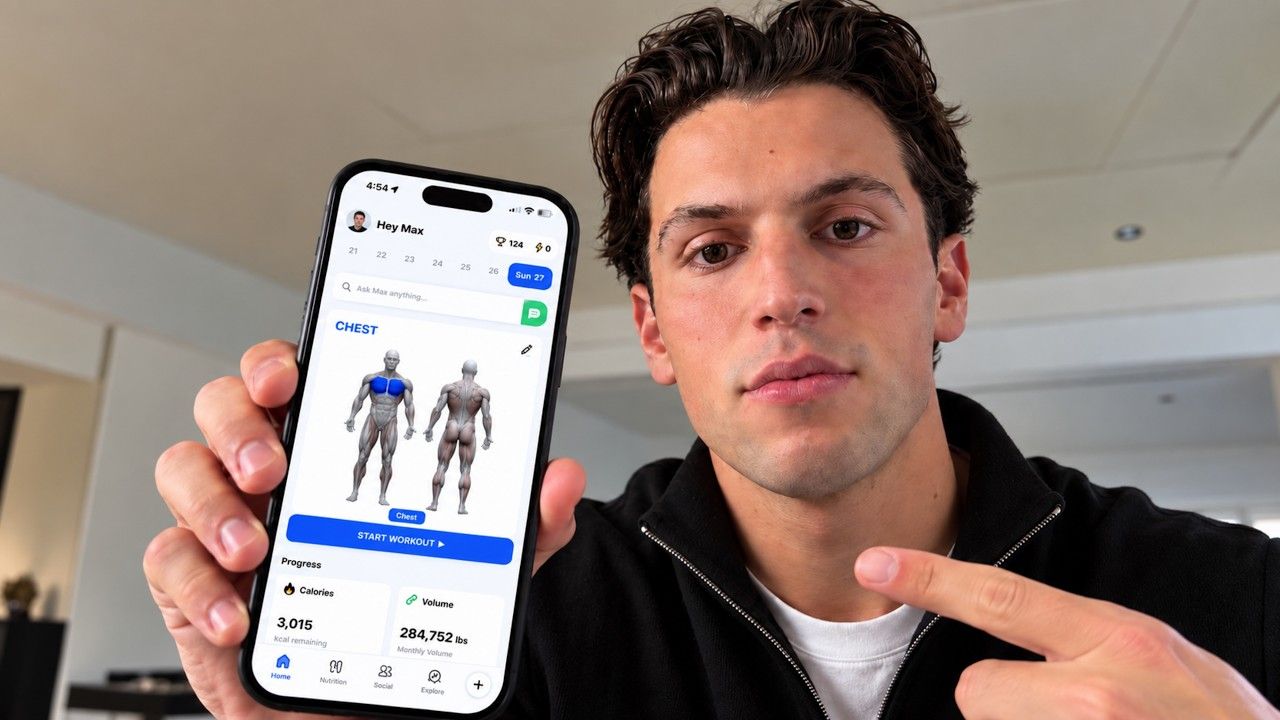
The differentiator he built: The flagship feature of Maxed AI is what he calls the "agentic coach" — an AI named Max Coach that's woven into every corner of the app. Instead of making users navigate between screens to adjust a workout, check their sleep data, or log supplements, they can do all of it from a single screen. The AI handles the context-switching for them. That's not just a nice-to-have; that's the core value proposition.
This is the part that trips most people up. They think "no-code" or "AI-assisted development" means you're building something cheap and limited. Max's story proves otherwise. The constraint isn't the tool — it's the clarity of your vision.
Step 3: Choose a Business Model That You Can Sleep With
The pricing: Maxed AI doesn't run on monthly recurring revenue. Instead, Max charges a single upfront yearly fee of $24.99 — roughly $2 a month. He made this choice deliberately and on principle.
His reasoning: He doesn't want to build a business that depends on users forgetting to cancel. That model might juice your MRR numbers, but it creates a misaligned incentive. You stop caring about delivering value and start caring about making cancellation annoying. Max wanted none of that.
Why it still works: $24.99/year sounds low, but when you're acquiring 20,000+ customers in a month, the math gets interesting fast. His RevenueCat dashboard showing $13,766 in 28 days validates the model completely. Volume plus a frictionless, honest price point can outperform a higher monthly fee with heavy churn.
There's something refreshing about a founder who builds the pricing model around what they'd actually want as a customer. It also tends to produce better word of mouth.
Step 4: Start With Founder-Led Marketing
The starting point: Max had no budget for a fleet of UGC creators, so he became his own creator. He started filming himself daily and posting 5 to 10 videos across Instagram and X.
Overcoming the fear: His biggest early obstacle wasn't technical — it was psychological. Putting yourself on camera every day, talking about something you're building and hoping people care, is genuinely uncomfortable. He pushed through it anyway, and the audience started showing up.
What he analyzed: Once he had content out in the world, he started studying the metrics — specifically hold rate and skip rate. Which videos kept people watching? Which ones made people swipe away immediately? He used those signals to understand which features resonated and which marketing angles actually drove downloads.
The flywheel: Once he identified the organic content that worked, he took that exact content and ran it as paid ads on Meta. He started with a small budget to validate, then scaled up. He now spends around $250 a day on paid ads, using organic winners as the creative.
He specifically recommends Meta over TikTok for app advertising. His reasoning: Meta attracts higher-intent buyers with a greater willingness to pay, and the demographic skews older and more financially established. TikTok gets eyeballs; Meta gets customers.
Step 5: Build in Public and Own Your Audience
The X factor: Three months ago, Max started posting on X (formerly Twitter). He now credits roughly a third of his revenue to that audience. That's a remarkable number for a channel he'd only been building for 90 days.
Why it works: People aren't just downloading Maxed AI because it's a good fitness app. They're downloading it because they've been following Max's journey and they want to support what he's building. Authenticity converts. Passion converts. A founder who shares what's working *and* what's failing creates a trust that no ad spend can fully replicate.
The clipping trend: Max also flags "clipping" as an underrated organic growth lever — taking longer content and cutting it into short clips that can spread internationally without any additional production cost. It's one of the most efficient ways to get organic downloads at scale right now.
His core advice: Go all in and document your journey. Be as public as possible. Share the wins, share the failures, show the dashboard, show the struggle. The audience you build becomes both your marketing engine and a community that's genuinely rooting for you.
Takeaways
Max's story isn't really about fitness apps. It's about a template that works across almost any niche:
- Find a gap you live inside — domain expertise beats technical expertise every time when AI can handle the code
- Use Claude (or similar tools) to build your MVP — a $15/month subscription is a shockingly low barrier to entry
- Price honestly — a model you're proud of tends to outperform one you're embarrassed by
- Create content before you buy ads — organic content tells you which angles convert; paid ads amplify what already works
- Build in public from day one — your personal brand can become a third of your revenue before you even realize it's happening
Six months ago, Max had never shipped a mobile app. Today he's running a five-figure monthly business with a lean operation, no large team, and a community that genuinely cares about what he's building. The tools exist. The playbook is out there. The only real question is whether you're willing to start.
Original video
https://www.youtube.com/watch?v=aLidq3_FwW0