 Story
StoryHow Jay Raavi Built a $140k/mo App While Traveling the World
Jay Raavi bootstrapped NomadTable to $140k MRR and 1.8M users — all as a solopreneur traveling the world. Here's his story, routine, and the philosophy behind it.
Some of the most compelling founder stories don't start with a business plan or a pitch deck. They start with a personal itch — a problem you live every day and can't stop thinking about. Jay Raavi's story is exactly that.
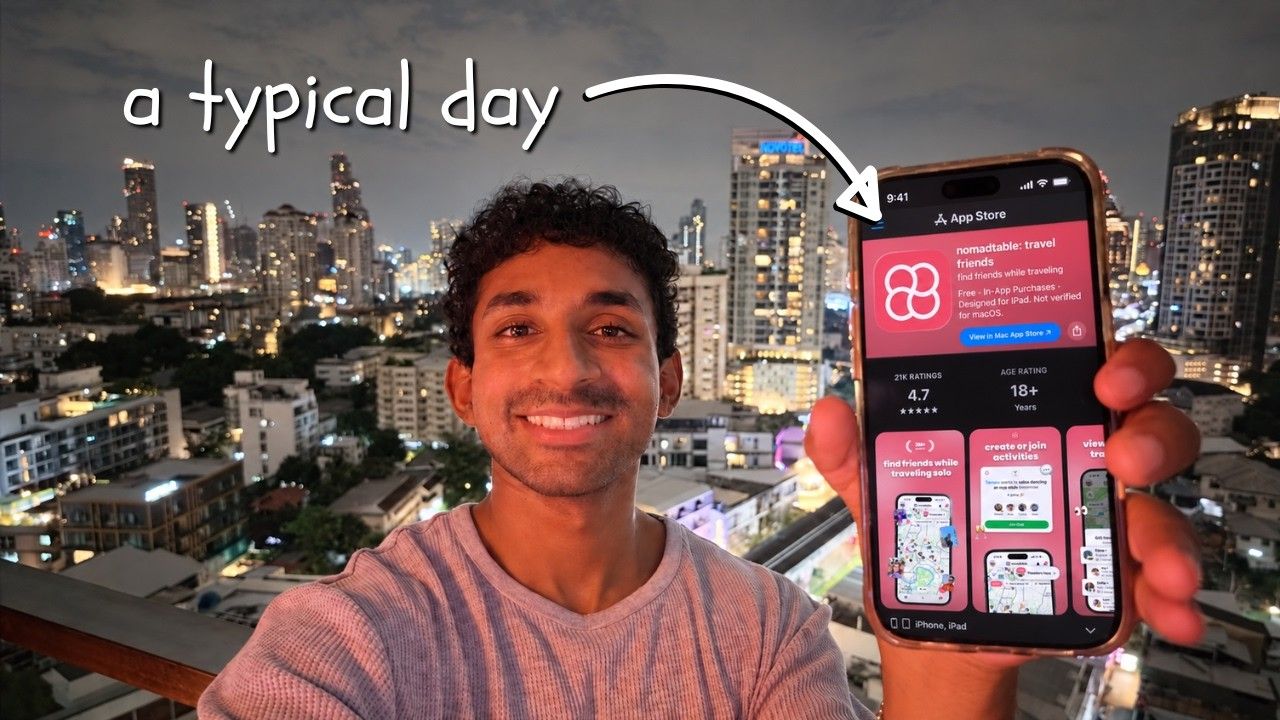
Jay is a solopreneur who bootstrapped NomadTable, a meetup app for solo travelers, expats, and digital nomads, all the way to $140k in monthly recurring revenue with 1.8 million users. No co-founder. No VC money. Just a problem he genuinely cared about and the courage to go build something about it.
The Idea: Solving Loneliness on the Road
NomadTable exists to solve one of the most underrated problems in modern travel: you're somewhere incredible, but you don't know a single person there. The app helps solo travelers find friends, facilitating real-world meetups wherever they are in the world. In just over a year since launch, it has powered more than 100,000 in-person meetups. That's not a vanity metric — that's a product actually changing how people experience travel.
Jay came up with the idea while traveling himself, working as a software engineer at Amazon. He wasn't some born entrepreneur. By his own admission, he wasn't "the entrepreneurial type." He just had a problem he wanted to solve, and he started building for fun.
What eventually pushed him to quit his job and go all-in? Not ambition, exactly. Fear. Specifically, the fear of regret. He realized the pain of asking "what if?" for the rest of his life would be far worse than the pain of actually trying and failing. In his mind, not trying was the riskier bet. That reframe — that inaction is riskier than action — is one of the most honest things a founder can say, and it's probably more universally true than most people admit.
The Morning: Phone First, Then Focus
Jay's morning routine breaks one of the classic productivity rules: he checks his phone immediately after waking up. But he has a real reason for it. He's scanning WhatsApp to see if there are any urgent issues with content creators he works with, or to make sure the app hasn't broken overnight. When you're a solopreneur running a product with 1.8 million users, a broken app at 3 AM is a real possibility. So yes — phone first.
After that, it's the usual: shower, shave, sometimes breakfast. His target is to be out of his apartment and at a workspace by 9 AM, or 11 AM at the latest if he had a rough night. He doesn't work from home if he can help it. The commute — even just a walk or a bike ride to a WeWork or a café — serves a purpose. It creates a psychological boundary between home and work. The physical transition signals to his brain that it's time to switch modes. It's a simple thing, but it makes a real difference.
The Afternoon: Deep Work, Breaks, and Moving Spots
Once he's settled in at his workspace, Jay tackles whatever time-sensitive tasks he noticed during his morning phone check. Then he locks in. He describes his first two hours as genuinely focused, heads-down work — no distractions, no half-attention. That's where the real output happens.
But he's also honest about something a lot of productivity content ignores: diminishing returns are real. After a couple of hours, his sharpness drops. So he takes breaks deliberately — not reluctantly. He treats them as part of the system, not interruptions to it.
Every three to four hours, he also changes his scenery. Sometimes he heads back to his apartment for a bit, sometimes he walks to a different café. The change of environment resets something mentally. It's a small habit, but it keeps the work feeling fresh rather than like a grind.
The Superpower: Staying Close to Your Users
This is the part of Jay's approach that I think gets underappreciated. He doesn't just *make* an app for travelers — he *is* one of his users. He actively travels to stay connected to the problems his product is solving.
He recently spent four months in Bangkok, one of the biggest hubs for digital nomads and exactly the kind of city where NomadTable thrives. While he was there, he wasn't just working on the app remotely — he was *using* it. Going to meetups. Talking to people on the ground. Listening to what they actually needed.
That kind of proximity to your audience is an enormous competitive advantage. You can't get it from analytics dashboards alone. You pick up on things — friction points, unmet needs, subtle differences between sub-segments of your users — that no amount of A/B testing will surface. Jay says this direct connection keeps him from losing track of the original problem. It's easy for founders to drift away from their early users as a product scales. Jay's lifestyle literally prevents that from happening.
If you're building something and you're not regularly putting yourself in your users' shoes — not just metaphorically, but literally — you're flying blind in ways you probably don't even realize yet.
The Evening: Move Your Body, Then Wind Down
After work wraps up, Jay is non-negotiable about one thing: exercise. He calls it a "must." After sitting and thinking all day, he needs to move. His go-tos are running, padel, tennis, or lifting at the gym — whatever suits the day. Then he heads home to make a smoothie or cook dinner.
Evenings are deliberately social. Hanging out with friends is a big part of his life, not an afterthought squeezed in around work. That balance — building a real social life on the road, not just optimizing every hour for output — is part of what makes the lifestyle sustainable long-term.
He winds down with what he calls "light work" on his laptop from the couch, usually with a cup of tea. Nothing heavy. Just tying up loose ends, maybe reviewing something low-stakes. It eases him out of the day without the cold stop that can leave you lying awake thinking about everything you didn't finish.
The Philosophy: Passion Is an Unfair Advantage
Jay's closing message is simple, but he's earned the right to say it: work on something you're genuinely passionate about and truly care about. Not because it sounds nice, but because the entrepreneurial path is genuinely hard, and if you're doing it purely for money or status, it will drain you.
But when you're solving a problem you live every day? The work feels different. The setbacks don't hit as hard. You naturally go deeper than competitors who are just chasing a market opportunity. As Jay puts it, "No one can compete with that." Passion plus proximity to your users is an edge that's almost impossible to replicate.
His final word is to not take things too seriously. Enjoy life. Travel. Go to the meetups. Build the thing that's been nagging at you. And if the thought of *not* trying fills you with more dread than the thought of failing — that's your answer right there.
That's the fear worth listening to.
Original video
https://www.youtube.com/watch?v=0sO2OSN3jZw