 Story
StoryHow Jack Link's Built a $1.6 Billion Beef Jerky Empire
From a bankruptcy crisis to a billion-dollar brand — the Jack Link's story is one of family grit, perfect timing, and a Sasquatch that changed everything.
Most great businesses are born from frustration or necessity. Jack Link's was born from both.
The Link family had been in the meat business for generations, tracing their roots back to a German sausage maker who settled in Minong, Wisconsin in the 1800s. They ran a car dealership, a general store, a slaughterhouse — the full small-town entrepreneurial portfolio. But in 1985, when Jack Link was 40 years old, the family meat business went bankrupt. That could have been the end of the story. Instead, it was the beginning of a much better one.
Strapped for cash and needing to pivot fast, the family tried everything — frying potato chips, making rice crispy bars. Nothing clicked. But they still had their smokehouses. They still had their meat processing equipment. And Jack had his grandfather's old recipe. So they made jerky.
The actual spark came during a hunting trip. Jack and his teenage son Troy stopped at a local store and noticed how expensive the packaged jerky was. Jack muttered something about the price, and the store owner fired back: *"If you don't like the price, go home and make some."* Troy tells that story like it still amuses him. That offhand comment turned into a billion-dollar company.
They made their first batch using the family smokehouse and the old recipe. It sold immediately. What's remarkable is that at the time, there wasn't even a defined "jerky category" in retail stores. Jack and Troy weren't entering a market — they were building one. They had to invent their own machinery, negotiate shelf space from scratch, and convince retailers that protein snacks deserved a permanent home in their stores. By the time Troy graduated college in 1993, the company had one nationally distributed product — a beef stick and cheese combo pack — and was doing around $25 to $30 million in annual revenue. Not bad for a business that started as a fallback.
From there, they did what smart operators do: they reinvested aggressively. They took out bank loans to expand manufacturing. They started acquiring competing businesses not just for market share, but for production capacity and equipment. Troy had worked every corner of the company from age 15 onward, so he understood the operations deeply. That hands-on foundation mattered enormously as the company scaled.
The Protein Trend That Changed Everything
Timing, as they say, is everything. And Jack Link's happened to be building a protein snack company right as American consumers fell in love with protein.
The cultural shift toward high-protein diets — fueled by fitness culture, paleo movements, and an increasing awareness of macronutrients — created a massive tailwind for the meat snack category. Troy Link put it simply: *"Protein's part of the food pyramid right now and, you know, the consumer is really back into eating a lot of protein."*
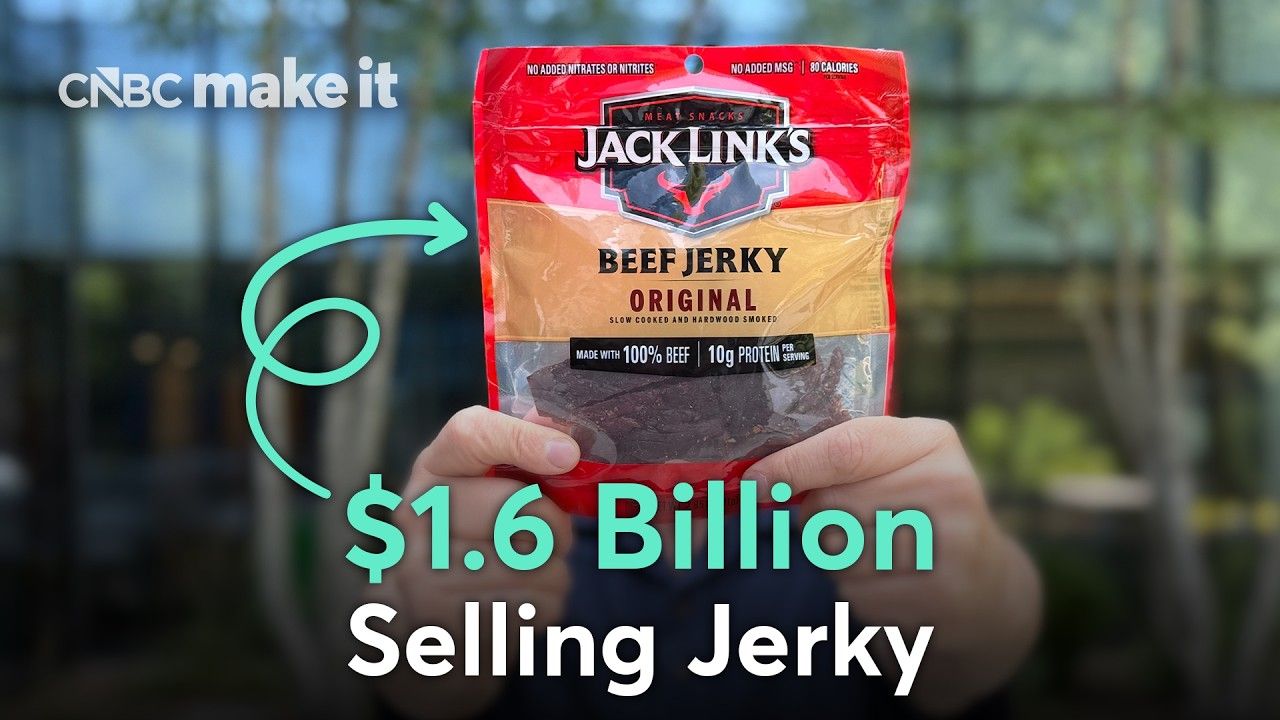
The numbers back him up. According to NielsenIQ data, the meat snacking industry grew about 16% between 2022 and 2026. By 2025, total brick-and-mortar meat snack sales are projected to reach around $4.9 billion. Jack Link's, operating under the parent company Link Snacks, captures about 33% of that market with $1.6 billion in U.S. retail sales alone. When you factor in Amazon, Costco, and other non-traditional retail channels, total 2025 revenue could push past $2 billion.
They weren't just riding a trend, though. They created infrastructure that allowed them to scale when the demand came. That's the difference between a business that gets lucky and one that compounds.
The Sasquatch Campaign That Launched Everything
For years, Jack Link's grew largely through distribution and word of mouth. They had the product, they had the shelf space, but they didn't have a brand identity that truly punched through the noise. Troy Link knew they needed marketing that reflected who they actually were — a fun, irreverent, family-owned company — not something that looked and felt like a faceless corporate food giant.
In 2006, they partnered with ad agency Carmichael Lynch and launched one of the most memorable snack food campaigns in history: "Messin' with Sasquatch."
The concept was simple and brilliant. A group of guys keeps pranking Bigfoot in the woods. Bigfoot retaliates in increasingly absurd ways. The tagline: *"Feed Your Wild Side."* It targeted their core demographic — males 18 and older — and hit them exactly where they lived: ESPN and Comedy Central. Jack Link's put $10 million into ad buys, and the campaign exploded. This was 2006, right as YouTube was taking off, and the ads went viral before "going viral" was even a standard metric for success.
The results were staggering. Sales grew 47% within two years of the campaign's launch. Sasquatch didn't just sell jerky — he became the brand. Even today, Sasquatch is synonymous with Jack Link's in a way that most companies spend decades and hundreds of millions of dollars trying to achieve. The campaign is a masterclass in understanding your audience and having the courage to lean into personality rather than play it safe with generic food advertising.
Building a Global Empire
With the brand now firing on all cylinders, Troy Link turned his attention to global expansion and strategic acquisitions.
In 2014, Jack Link's made a significant international move by acquiring the meat snacking division of Unilever — yes, the British consumer goods giant — which gave them an established footprint in the UK and across Europe. Five years later, in 2019, they purchased the Golden Island jerky brand from Tyson Foods, bringing Asian-inspired flavors and new product lines into their portfolio.
On the manufacturing side, the company has continued to invest at a scale that most family-owned businesses never approach. In 2025, they opened a new facility in Perry, Georgia — a $450 million, 400,000-square-foot plant capable of producing 820,000 meat sticks per day. That's not a snack company. That's a serious industrial operation.
They've also started thinking creatively about modern marketing. The company announced a partnership with MrBeast, one of the biggest creators on YouTube, signaling that they understand where attention is now and how to buy into it strategically.
The Hard Parts
None of this has been without real challenges. Beef commodity prices hit record highs in 2026, squeezing margins across the entire meat industry. When your core input costs go sideways, there's only so much you can absorb before it affects the business. Troy Link acknowledges this but frames it as simply the reality of operating in a global supply chain. You manage it, you adapt, and you keep moving.
What's striking about Jack Link's approach to quality is how vertically focused it remains despite the company's size. Troy talks about controlling the process "from the cow to the consumer" — a level of quality oversight that most companies of this scale have long since outsourced. It speaks to the family business ethos that still runs through the organization even as the revenue numbers climb into the billions.
There's something genuinely compelling about this story. A bankruptcy at 40 that turned into a generational business. A hunting trip comment that sparked a product idea. A Sasquatch campaign that went viral before viral was a thing. A family that built the category they now dominate.
The Link family didn't find a gap in the market. They dug the gap themselves, then filled it.
Original video
https://www.youtube.com/watch?v=P1MdTY21wVo