 Story
StoryHow He Makes $120K/Month From His Hobbies
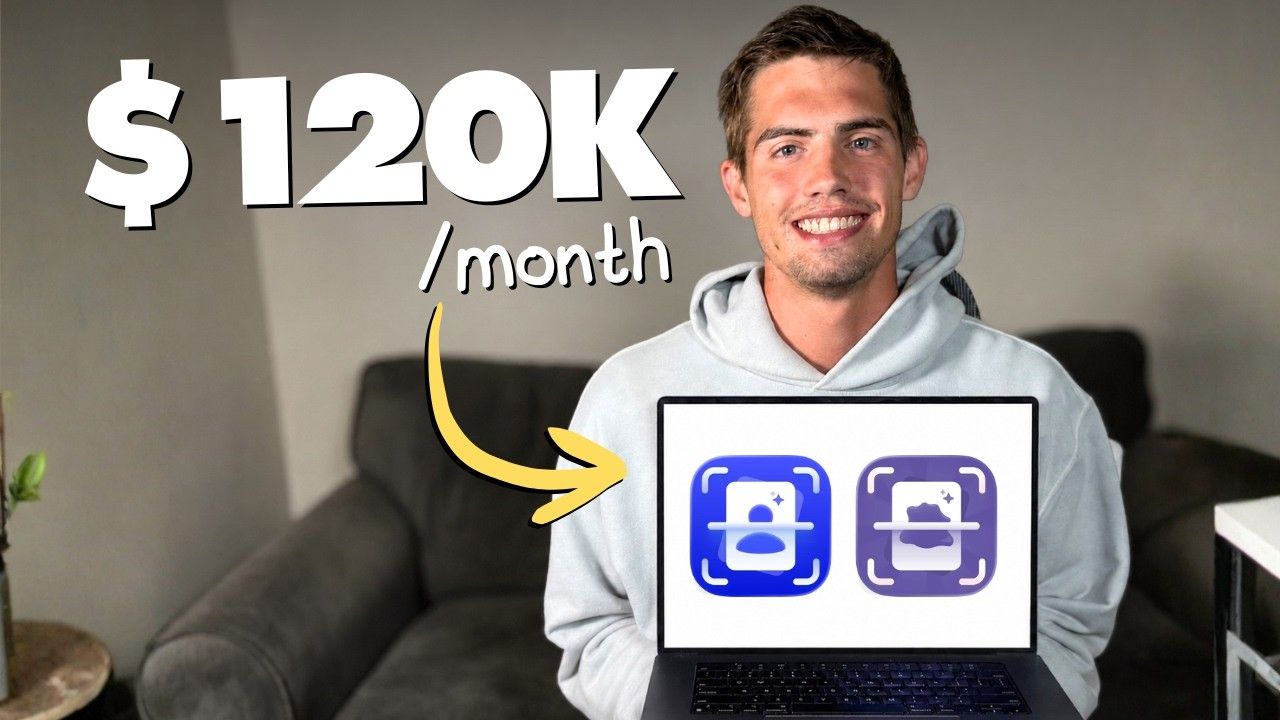
Kyle Fowler didn't chase trends. He built apps for his own hobbies — and now pulls in over $120,000 a month from two card-scanning apps.
Most people overthink finding the perfect app idea. They browse trend reports, chase AI niches, and scroll through Reddit threads looking for some secret insight. Kyle Fowler did none of that. He just looked at his hobbies.
Kyle is the creator of two apps — Cardstock and ScanéMon — that together generate over $120,000 in monthly recurring revenue. That's $1.5M a year, from sports cards and Pokémon cards. Not crypto. Not some B2B SaaS tool. Literally his hobbies.
Here's the full breakdown of how he did it, and the four-step framework he'd use if he had to start over.
App 1: Cardstock — Sports Card Scanner
What it does: Cardstock lets collectors point their phone camera at a sports card, instantly identify it, find its current market value, and add it to a tracked collection.
The origin: Kyle had a personal problem. He collected sports cards and had no easy way to know what his cards were worth. So he built the tool he wished existed. That's it. No market research. No focus groups.
The numbers: Six years in, Cardstock now has over 15,000 active subscriptions and generates around $75,000 in MRR, with roughly 13,000 new customers coming in every month. Kyle started this in a basement with two friends, Jack and Cole — teaching them to code from scratch and splitting the (initially tiny) revenue three ways.
App 2: ScanéMon — Pokémon Card Scanner
What it does: Same concept as Cardstock, but purpose-built for Pokémon cards. A dedicated scanner for a dedicated collector community.
The traction: Launched just a year ago, ScanéMon already has around 3,400 active subscriptions and $17,000 in MRR. But here's the wild part — it's currently acquiring around 16,000 new customers a month, which is actually more than Cardstock at this point. The growth curve is steep.
Why it worked: The Pokémon card community is massive, passionate, and underserved by good tools. Same playbook, different hobby.
The Tech Stack
For those who want to get into the weeds: Cardstock was built with Swift and SwiftUI, using Apple Core Data for local storage. Kyle leaned heavily on Stack Overflow in the early days. As it scaled, he brought in RevenueCat for subscription management and an AWS EC2 server for the backend card database.
His current full stack includes Cursor, Claude, Supabase, Railway, CodeRabbit, Wisprflow, Granola, Framer, Notion, Slack, and OpenAI Codex. Heavy AI assistance throughout — and he's not shy about it.
The Four-Step Framework for Building from Your Hobbies
Step 1: Find the Problem in Your Daily Life
The idea: Don't brainstorm in the abstract. Look at your actual life — your hobbies, your routines, your frustrations. Write down the things that are painful, slow, or annoyingly manual.
Kyle's example: He was already collecting sports cards. The problem surfaced naturally. If you solve something for yourself, there's a good chance thousands of other people have the exact same problem and no good solution either.
Step 2: Find the Most Minimal Solution
The principle: Resist the urge to build everything. What's the single feature that solves the core problem? For Cardstock, that was scan a card → see its value. That's the whole thing. Build that first.
Why it matters: Keeping scope small means you can actually ship. An MVP that works beats a feature-packed app that never launches.
Step 3: Build It — Use AI to Move Fast
The tools: Claude and Cursor are Kyle's go-to AI coding tools. They dramatically compress the timeline from idea to working prototype. You don't need to be a senior engineer to get something functional out the door.
The mindset: Kyle started by building a simple iOS game called Snaken just to learn the ropes. You don't need to be perfect. You need to be shipping.
Step 4: Monetize It
The platforms: RevenueCat and Superwall are Kyle's recommendations for handling subscriptions and paywalls inside mobile apps. They handle the complexity so you can focus on the product.
The logic: Once you've validated that people want the thing and it's solving a real problem, monetization is just plumbing. Good tools make it straightforward.
Marketing: TikTok Slideshows
This is the part people underestimate. Kyle doesn't run elaborate ad campaigns. His biggest acquisition channel is TikTok slideshows — simple, repeatable content formats that drive app downloads.
He also uses a platform called Noise, which distributes TikTok slideshow templates to creators and pays them based on the views they generate. It's low cost, highly scalable, and keeps the content engine running without Kyle having to create every post himself.
Find a format that converts. Repeat it. That's the whole strategy.
Conclusion
Kyle started in a basement with two friends and almost no revenue. Six years later, the business is at $1.5M ARR and still growing. The second app — built in a fraction of the time thanks to AI tools — is already outpacing the original in new customer acquisition.
The lesson isn't "build a card scanning app." The lesson is that the best ideas are already hiding in your daily life. Your hobbies, your frustrations, the clunky manual thing you do every week — that's the market research.
Oh, and Kyle's last piece of advice: don't be afraid to reach out to people who've done it. Most successful founders are surprisingly willing to share what they know. You just have to ask.
Original video
https://www.youtube.com/watch?v=xWnqY2Mav4s