 Story
StoryHow He Built 45 Apps and Hit $30K/Month
Benji built over 45 apps before finally committing to one — and that focus took Snag from $0 to $30K MRR in under four months.
Most entrepreneurs fall into the same trap: build something, get a little traction, then jump to the next shiny thing. Benji did this 44 times before he didn't.
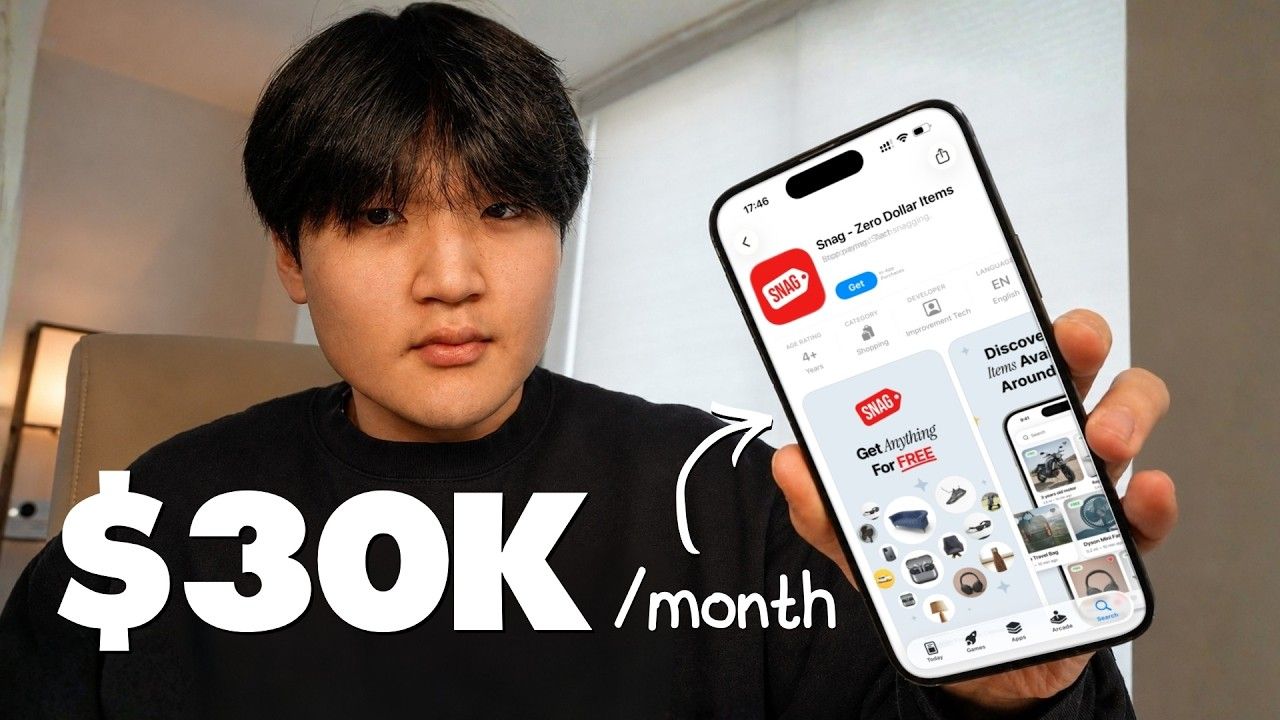
After building over 45 mobile apps in a single year — including Pillar, which reached 11,000 users with zero marketing spend before he abandoned it — Benji finally committed to one product. That product was Snag, an app that helps people find free items near them. In under four months, it went from zero to $30,793 in monthly recurring revenue, 103,000 authenticated users, and over $80,000 in total proceeds. It has a 4.6-star rating from 3,300 App Store reviews.
The lesson wasn't that he needed better ideas. It was that he needed to stop leaving them.
Here's the complete playbook he used.
Step 1: Find a Winning Idea
Where to look: Benji uses two main sources. First, platforms like YouTube and Twitter, where people openly share how they're making money — these surface underserved pain points faster than any market research tool. Second, Sensor Tower, where you can identify apps that are already profitable.
The 10% better rule: You don't need to invent something new. Find a successful app and make it 10% better — cleaner UI, stronger marketing, a better funnel. When Benji launched HeightGPT, around 20 copycat apps appeared shortly after. Many of them outperformed his original by improving on exactly those details.
What makes an idea scalable: The value proposition needs to be obvious in three seconds or less. Benji thinks about marketing *before* he thinks about building. If he can't explain why someone would download this app in a single sentence, he doesn't build it. The sweet spot is apps that help users save money or make money — those convert.
Step 2: Build It Fast
The three-step process: Benji's goal is a working front-end in 4 to 5 hours.
- Ideation — Reverse-engineer the value proposition from a marketing angle first. What's the hook?
- Design — Wireframe and design the app in Figma before writing a single line of code.
- Coding — Feed the Figma designs into Claude (his AI coding assistant of choice) and let it generate the code.
The full tech stack:
- Cursor — AI code editor ($20/month)
- Claude Code Max — AI coding assistant ($200/month)
- Figma — Design ($20/month)
- Supabase — Backend database ($50/month)
- Superwall — Paywall management and A/B testing ($49/month)
- Mixpanel — User onboarding analytics ($400/month)
- Loops — Email marketing to churned users ($50/month)
- GoDaddy — Domains ($49)
- Apple Developer account — App distribution ($99/year)
The expensive line item is Mixpanel, but Benji considers it non-negotiable. Understanding exactly where users drop off during onboarding is how you iterate intelligently instead of guessing.
Step 3: Distribution
Start with UGC: Benji's core marketing engine is user-generated content at scale. The process works in four stages:
1. Reach out to a large number of creators. 2. Put the best ones (roughly a 10% conversion rate from outreach) on a monthly retainer plus a CPM structure. 3. Test their videos organically. If a video crosses 50,000 views, it's a candidate for paid ads. 4. Run the winning creatives as Meta ads, targeting a ROAS greater than 1.
If you have no budget: Don't wait. Start making the content yourself. Get the organic reps in, learn what resonates, and then bring in creators once you have signal.
Scaling paid ads: Once a winning creative is identified, Benji runs a test campaign at $50/day. If it shows ROAS > 1 or a strong CTR, he scales — $50 to $100 to $200 to $300 per day, gradually. The catch is ad fatigue is real and it comes fast. You need to constantly test new creatives because today's winner is tomorrow's tired ad. The creative pipeline never stops.
Step 4: Iterate on the Product
Getting users in the door is only half the job. Keeping them — and increasing lifetime value while lowering customer acquisition cost — requires relentless product improvement based on actual user feedback.
Benji uses Mixpanel to track onboarding drop-off and Loops to re-engage churned users via email. Every data point is a clue about what the product is failing to deliver. The goal isn't a perfect v1. The goal is a product that gets meaningfully better every week.
The Bigger Lesson
Benji's advice to anyone starting out: create your own luck and get around great people. Not in a hollow networking sense — but by doing the work, making mistakes publicly, and iterating in plain sight. That's how he ended up working with his partner Blake Anderson, who pushed him to raise his standards and opened up new opportunities.
Forty-four apps taught him what didn't work. App number 45 taught him what commitment looks like. The playbook was always there. He just had to stop moving long enough to follow it.
Original video
https://www.youtube.com/watch?v=P4QodeA_lQ0