 Story
How George Grew 3 Apps to $120k/Month
From $17k to $120k MRR in one year — here's the exact playbook George used to scale a portfolio of niche mobile apps.
A year ago, George Lampropoulos came on the show with a wrestling app making $17,000 a month. That alone was impressive. But then he sent an email with an update: he was now clearing over $100,000 a month. Not from one app — from three. And he had a repeatable playbook to show for it.
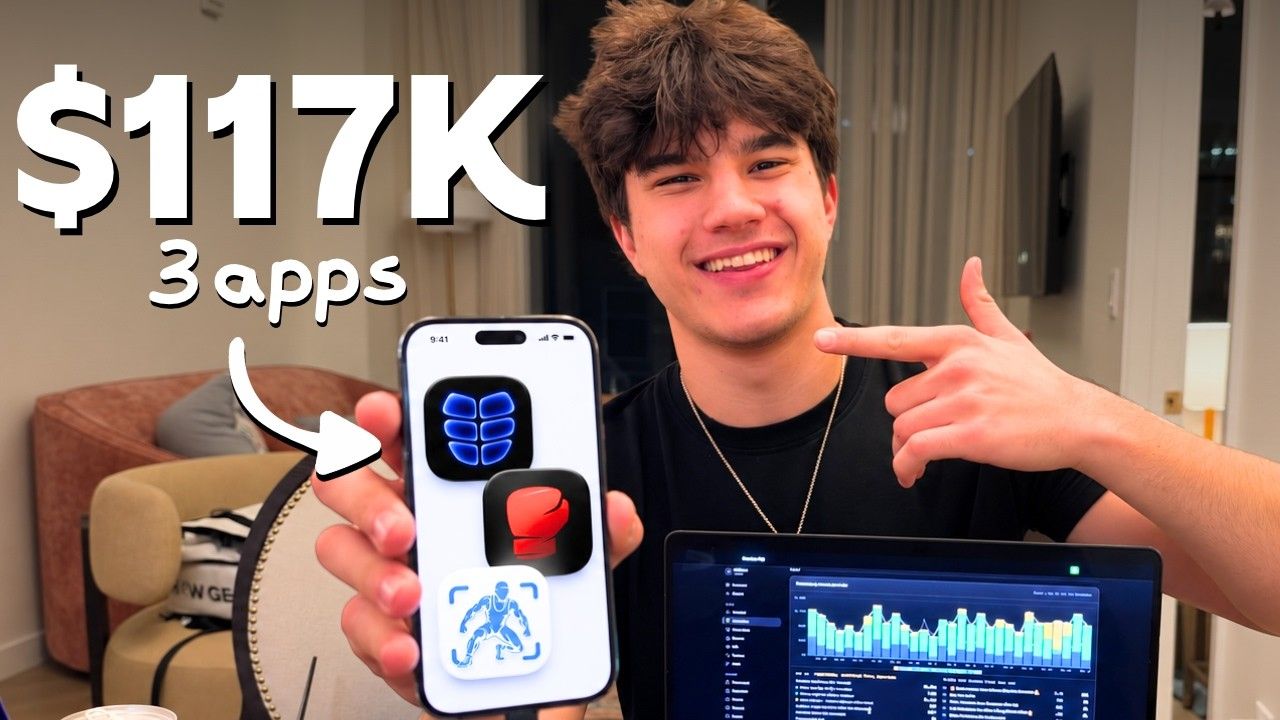
His revenue dashboard at the time of this interview showed $117,925 in the last 28 days, 50,575 new customers, and 11,141 active subscriptions. That's not luck. That's a system.
The Three Apps
George's portfolio is built around a core insight: if a concept works in one niche, it can work in another. His original app, Wrestle AI, is a wrestling-focused training app that he scaled to $40k/month purely through influencer marketing. From there, he applied the same framework to boxing, building Brawler – Future of Boxing. And a third app, AbMaxx: Become Shredded, came out of a partnership opportunity in the fitness space.
Three niches. Same playbook. Combined MRR approaching $120k.
The reason he went multi-app wasn't just ambition — it was risk management. Wrestling is a seasonal sport. It peaks from November through February, and then demand drops off. Rather than just riding that wave up and down every year, George took the same concept and applied it to boxing, which runs on a different seasonal rhythm. Smart. The fitness app came next, partly because a potential partner brought equity and creative capacity to the table. He spotted the opportunity and moved.
The Growth Playbook
Step 1: Nail the UI First
Before any marketing conversation, George is emphatic about one thing: the app's interface has to be immediately understandable. Not eventually understandable — *immediately*.
He uses what he calls the "mom test." If your mom opens the app and can't tell what it does within seconds, the design has failed. It doesn't matter how good your ads are or how many influencers you work with — if a new user lands in a confusing experience, they're gone.
This isn't just a nice principle. It's conversion math. Every drop-off in onboarding is revenue you're leaving on the table, and if you're running paid ads, it's money you're actively burning. The UI has to do the selling before the paywall even appears.
Step 2: Influencer Marketing (Especially for Niche Products)
For Wrestle AI, George didn't run a single paid ad on the way to $40k/month. He got there entirely through influencer marketing — and his reasoning for why is worth understanding.
Generic UGC (user-generated content) doesn't work well for niche products. If you're selling a wrestling training app, you need a real wrestler talking about it. The audience can tell. Authenticity is the whole value proposition of influencer content, and in tight communities like wrestling or boxing, people know who the legitimate voices are.
His recommendation for getting started: use collab posts. This builds brand authority in the niche before you've got the budget for a full-scale influencer program. You're borrowing credibility from people who already have it. For the boxing app, he works with around eight creators alongside paid ads. For AbMaxx, he leaned into a single influencer who has equity in the app and produces all the creatives — which turns out to be a powerful alignment of incentives.
Step 3: Paid Ads (Once You Have Capital and Tracking)
Paid ads are predictable and scalable in a way that influencer marketing isn't. But George is clear that you can't just throw money at Meta or TikTok and expect results. The setup has to be right.
The two non-negotiables: precise tracking and optimizing for the right event. Don't optimize your campaigns for installs. Don't optimize for awareness. Optimize for purchase events. That's the signal that matters, and the algorithm will find more people who convert if you tell it what conversion actually looks like.
On budget: George suggests starting with at least $100 per day for testing. Below that, you don't have enough data to make meaningful decisions. You're just guessing.
For the newer apps where he had more capital from Wrestle AI's success, paid ads became the primary growth driver. The fitness app in particular leans heavily on paid ads, with the equity-holding influencer producing the ad creatives. This keeps creative quality high and costs aligned — the influencer wins when the ads work.
If You're Getting Downloads But Not Purchases
This is a funnel problem, not a marketing problem. And it's a critical distinction. If people are downloading the app but not subscribing, your acquisition isn't broken — your conversion is.
George's two levers for fixing this: test different pricing models, and rework the onboarding flow. He puts more weight on the pricing side. A lot of developers pick a price and stick with it out of habit or gut feel. But the gap between $4.99/month and $9.99/month, or between weekly and annual billing, can be dramatic in terms of conversion rate and LTV. Test it. The data will tell you what the market is actually willing to pay.
Changing the onboarding flow is the other lever — reordering screens, cutting friction, hitting the value proposition harder before the paywall appears. Both are worth testing, but price is often the faster win.
The Mindset Piece
George ends with something that's easy to dismiss as soft advice but is actually the thing that separates people who scale from people who plateau: get rid of limiting beliefs.
The most common ones he hears are "I'm not smart enough to figure this out" and "the market isn't big enough for this to work." Both are usually wrong, and both are expensive to hold onto.
His reframe is simple: when you're not seeing results, the answer is usually more volume. More creatives. More influencer outreach. More ad spend. More iterations on onboarding. Most people pull back when things aren't working. George pushes forward.
That mindset shift — from "why isn't this working" to "how do I do more of this" — is probably the quietest part of his playbook and also the most important.
Takeaways
George's story is a clean example of something worth paying attention to: a replicable model, applied across niches, executed with discipline. He didn't invent something wildly new. He built Wrestle AI, figured out what worked, and did it again for boxing. Then again for fitness.
The playbook is:
- Build an app with an immediately intuitive UI (run the mom test)
- Use niche influencers to build authority, especially early
- Layer in paid ads once you have capital and proper purchase-event tracking
- Fix conversion problems with price testing and onboarding changes
- When results stall, increase volume before you assume the strategy is broken
From $17k to $120k in a year. Same framework, three times. That's the whole thing.
Original video
https://www.youtube.com/watch?v=E_z1t_Iw9jM