 Story
How Brainrot Grew from $10K to $400K/Month
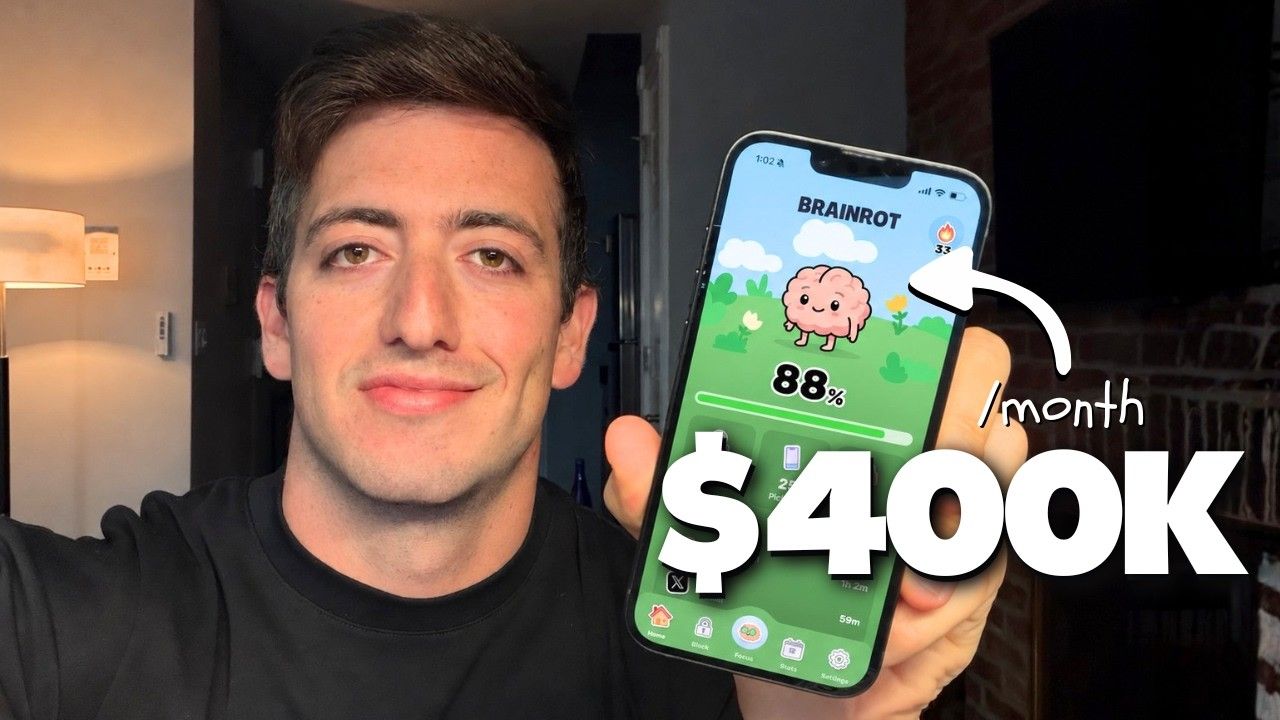
Yoni Smolyar built a gamified screen time app to solve his own phone addiction — and scaled it to $400K/month within a year. Here's exactly how he did it.
Most great products start with a personal itch. Yoni Smolyar wasn't trying to build a unicorn — he was just tired of mindlessly scrolling Instagram, YouTube, and Twitter, losing hours he knew he'd never get back. So he built something about it. That something is Brainrot: Screen Time Control, a gamified productivity app that now pulls in roughly $400,000 a month, has a couple million downloads, and sits around 150,000 active subscribers. Not bad for an ex-corporate software engineer who describes himself as an "aspiring hustler" who'd launched a handful of small businesses that never really went anywhere.
Here's the full story — and more importantly, the playbook Yoni shared in his Starter Story interview that any aspiring app founder can actually use.
The Idea: Gamify the Brain Rot
The name Brainrot is a play on the internet slang term — that fuzzy, overstimulated feeling you get after too much mindless scrolling. Yoni leaned into it with a deceptively simple mechanic: a cute little digital brain that literally rots the more time you spend on your designated distraction apps. The worse your screen habits, the grosser your brain gets. It's childish, it's funny, and it works. That combination of humor and genuine behavioral feedback is what separated Brainrot from the sea of bland app blockers that already existed.
Yoni wasn't trying to build another timer or content blocker. He wanted something nobody had done before — a gamified experience that made reducing screen time feel like a game worth winning. The idea excited him so much that he went heads down for a full month to build it. That kind of conviction matters. If the founder isn't obsessed with the problem, nobody else will be either.
Build the Audience Before You Build the App
One of the most important decisions Yoni made had nothing to do with code. Long before Brainrot existed, he started creating content online to share his journey as an aspiring entrepreneur. Gradually, that built him an Instagram following of around 150,000 people.
His inspiration came directly from the indie hacker community — specifically from people like Pat Walls of Starter Story and Pieter Levels, who had built massive personal brands alongside their products. Yoni noticed something crucial about how they operated: they had built-in distribution. When they launched something new, they weren't shouting into the void. They were talking to an engaged audience that already trusted them and cared about what they were building next.
Yoni decided to stop being a "shadowy figure" and start sharing publicly. Not after he had something to show, but during the messy, uncertain process of figuring it out. That authenticity is what compounds into a real audience.
The payoff was dramatic. Before the app launched, Yoni teased it on his Instagram, built suspense, and drove followers to a waitlist. By the time the app was actually available, there was already pent-up demand waiting to convert. On day one, Brainrot generated around $10,000 in revenue. That's not a typical app launch. That's what happens when you treat distribution as a product feature, not an afterthought.
The 4-Step Framework for Scaling to $400K/Month
Getting to $10K on day one is one thing. Growing that 40x over the following year is something else entirely. Yoni breaks his scaling process down into four concrete steps.
Step 1: Study User Behavior
What it means: You need analytics running from day one — not to look at vanity metrics like download counts, but to understand *how* people actually use your app. Where do they drop off? What features do they engage with repeatedly? What does the first session of a paying subscriber look like versus someone who churns after three days?
Tools Yoni uses: He specifically calls out Mixpanel and PostHog for behavioral analytics, and uses Claude and Codex to help interpret and act on that data. The goal is to identify the "activation moment" — the specific action or sequence that turns a new user into an engaged, paying one.
Why it matters: Without this data, you're guessing. And guessing at scale is expensive.
Step 2: Identify Your Power Users
What it means: Not all users are equal. Some people will use your app every single day, evangelize it to friends, and subscribe year after year. Those are your power users, and they're worth a disproportionate amount of your attention.
How to apply it: Find out what power users have in common. What did they do in their first session? Which feature did they hit first? What acquisition channel did they come from? Once you know what makes a power user, you can design your onboarding and marketing to create more of them.
Example: For Brainrot, power users were people who immediately connected their most-used distraction apps and checked on their little digital brain pet regularly. That loop — check in, see the brain, feel accountability — was the core retention driver.
Step 3: Do More of What's Actually Working
What it means: Once you know what drives growth, stop spreading yourself thin and double down relentlessly on those channels.
For Brainrot specifically: The two biggest growth levers turned out to be influencer content and paid ads. Once Yoni confirmed those were producing high-quality users who converted and stuck around, he scaled both as aggressively as he could.
Key nuance: Not all acquisition channels bring in equally valuable users. Yoni is explicit about this — you have to analyze which channels are producing users with good retention and LTV, not just the highest volume. A channel that brings in 10,000 downloads but with 90% churn in week one is worse than a channel that brings 1,000 downloads with strong retention.
Step 4: Get a Co-Founder
The insight: Yoni credits partnering with Brock Anderson as a "huge force multiplier" for Brainrot's growth. Going from $10K to $400K/month isn't a solo journey — at least not without paying a serious opportunity cost in time and energy.
Why complementary skills matter: If you're a builder, find a marketer or operator. If you're a growth person, find someone who can handle product depth. The goal is to eliminate the bottlenecks that slow you down when you're wearing every hat.
The bigger point: Yoni's original playbook for 2026 app founders includes "build a team or find a co-founder" as step two, right after finding a problem you care about. Going solo is possible, but having the right partner compounds everything.
When to Quit Your Job
Yoni didn't jump ship the moment Brainrot showed promise. He waited until the entrepreneurial leap felt meaningfully less risky than staying put. His framing here is worth sitting with: every path carries risk. Staying in a job that's unfulfilling and building someone else's dream isn't "safe" — it's just a different kind of risk with a salary attached.
His practical advice is straightforward: make sure you have enough savings to give yourself a real financial runway, then commit fully. And remember that if it doesn't work out, getting another software engineering job is always an option. The downside is smaller than it feels when you're standing at the edge.
The Full 2026 App-Building Playbook
If you distill everything Yoni shared into an actionable checklist, it looks something like this:
- Find a problem that genuinely excites you — passion isn't fluff, it's what keeps you going through the long stretches where nothing is working yet
- Build in public and grow an audience early — treat distribution as a product decision, not a marketing problem you'll deal with later
- Find a co-founder or build a small team — complementary skills accelerate everything
- Use real analytics from day one — Mixpanel, PostHog, Claude, Codex; know your activation moments and your best cohorts
- Iterate relentlessly with small experiments — don't wait for the perfect big swing
- Analyze acquisition channels by user quality, not volume — the best-converting channel and the best-retaining channel aren't always the same one
- Be patient and persistent — there is almost always a delay between the effort you put in and the results you see
That last point is the one most people underestimate. Yoni went from $10K to $400K in roughly a year, but the groundwork — building an audience, learning to code in public, trying businesses that didn't work — happened well before that. The overnight success had a very long runway.
Brainrot is a genuinely clever product, but the real story is the series of deliberate decisions that made its launch and growth possible. Build an audience first. Solve a real problem with a memorable angle. Understand your users obsessively. Find the levers that actually move revenue and pull them hard. And get the right people around you to move faster than you ever could alone.
That's the playbook. Now go build something.
Original video
https://www.youtube.com/watch?v=hnxn16HtLIk