 Story
StoryHow a Solo Founder Makes $18k/mo in a Saturated Market
Kourosh built a speech-to-text app in one of the most crowded categories imaginable — and now clears $18k/mo. The secret? Finding the people nobody else was building for.
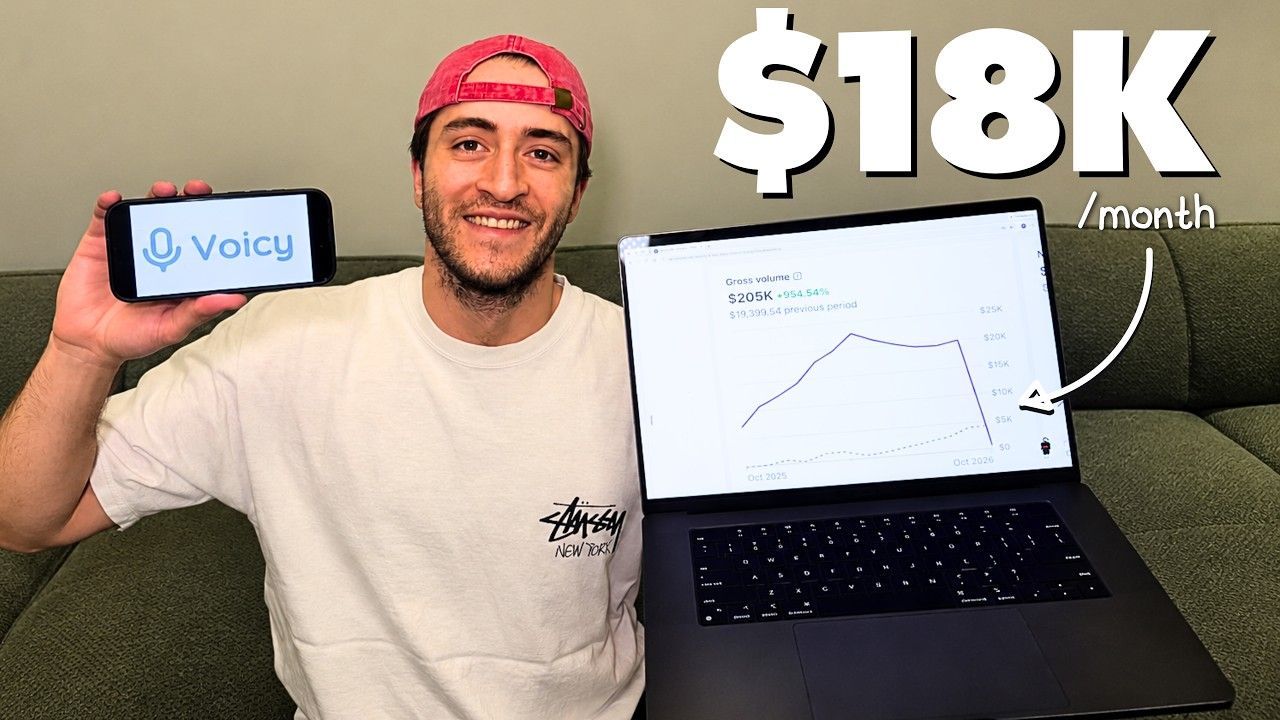
Most people look at a saturated market and walk away. Kourosh Ghaffari looked at the speech-to-text space — packed with well-funded competitors — and found a gap nobody was filling. Two years later, his app Voicy is pulling in $16,000 to $20,000 per month as a side project. No big marketing budget. No VC money. Just smart positioning and a relentless focus on a customer everyone else ignored.
Here's how he did it.
The Origin: A Tool for His Dad
Voicy started as a Chrome extension Kourosh built as a "fun tool" for his dad, who was struggling with typing. No grand vision, no five-year roadmap — just a simple solution to a real problem someone he cared about was having.
Then something unexpected happened. People started downloading the extension organically from the Chrome Web Store, without a single dollar spent on marketing. That kind of unsolicited traction is a signal you don't ignore. Kourosh picked it up as a serious side project and expanded fast — Windows, Mac, Linux, iOS, Android. Voicy is now available on virtually every platform, which matters enormously when your users aren't necessarily the most tech-savvy people in the room.
The Numbers Are Real
Let's talk specifics, because the numbers here are worth examining closely.
- MRR: ~$11,277 in recurring revenue
- Total monthly revenue: $16,000–$20,000 (boosted by lifetime deals)
- Pricing: $8.49/month or a one-time $260 lifetime plan
- Daily active users: ~2,500
- Monthly active users: ~10,000
- Active subscriptions: ~1,400
The gap between MRR and total monthly revenue is intentional. Lifetime deals attract a customer segment that's skeptical of subscriptions — older users and people with disabilities who want to pay once and be done with it. About 20% of customers use a "Disability Discount" that gives them 20% off, and that discount has become a meaningful part of the brand's identity, not just a pricing footnote.
The app itself is powered by OpenAI's Whisper API, letting users dictate into any app or website on their device. The underlying tech isn't proprietary magic — it's the *application* of it that matters.
The Painkiller vs. Vitamin Insight
This is the part that makes Voicy's story genuinely instructive for anyone building a product in a crowded space.
Kourosh has a non-technical background — he studied business and worked as a product manager before this. What he's exceptional at is talking to customers. When he actually got on user calls and listened, he discovered something his initial assumptions had missed entirely.
About 60–70% of his users were professionals using Voicy as a productivity boost. They liked it. It made their workflow a little faster. For them, it was a vitamin — nice to have, easy to churn off if the price goes up or a competitor launches.
But 20–30% of his users were seniors or people with disabilities for whom typing was physically difficult or outright impossible. For them, Voicy wasn't a convenience. It was a painkiller — an essential tool they desperately needed and couldn't easily replace. These users don't churn. They don't comparison-shop obsessively. They find something that works and they stick with it.
Here's the kicker: the big, well-funded competitors in the speech-to-text space were laser-focused on the productivity-professional crowd. They were ignoring the seniors and disabled users almost entirely. Kourosh found the people nobody else was building for, and he built for them on purpose.
That shift in focus changed everything — the product decisions, the content strategy, the discount structure, all of it.
The Growth Playbook
Chrome Web Store: This is where it all started. The Web Store functions like a mini app store with its own search algorithm, and it gave Kourosh his first 100 users completely free. If you're building a browser extension, this is an underrated distribution channel that most founders don't take seriously enough. Organic visibility here is real and compounding.
Reddit: In the early days, Kourosh posted frequently on Reddit to build momentum. It's scrappy, it's manual, but it works for getting initial signal and feedback from people who are actually interested in what you're building.
SEO at scale: This is the engine underneath Voicy's growth. Kourosh has published over 200 blog posts and built 30 different landing pages targeting specific search queries. He's also localized the website into 4–5 languages, which opens up entirely new organic traffic pools that most English-first founders never bother to tap. This is not passive work — it's a serious content investment — but the compounding returns on SEO are hard to beat when you're playing a long game without a paid acquisition budget.
YouTube — "AI for Seniors": This is the most recent chapter and honestly the most impressive. Kourosh launched a YouTube series specifically called "AI for Seniors," designed to reach his core demographic where they actually spend time. The results? His channel went from 1,000 to 12,000 subscribers in a single month. That's not a small jump. When your content strategy is perfectly matched to your niche, the algorithm rewards you — and more importantly, the right audience finds you.
What This Actually Teaches Us
The deeper lesson from Voicy isn't about speech-to-text apps. It's about what happens when you resist the urge to chase the obvious customer.
The obvious customer for a dictation app is a busy professional who wants to write faster. Every competitor in the space is fighting for that person. The market is loud, the CAC is high, and differentiation is hard when you're all solving the same productivity problem for the same kind of user.
Kourosh stumbled onto a different customer — and then had the discipline to actually pivot toward them. Seniors and people with disabilities aren't a consolation prize. They're a loyal, underserved, high-retention customer base that larger companies are too distracted or too disinterested to pursue properly. The Disability Discount isn't just a nice gesture; it's a signal that says *we see you, we built this for you* — and that kind of intentional positioning builds trust that no amount of Google Ads can replicate.
There's also something worth noting about the "first product wins" dynamic Kourosh talks about. In a crowded market, visibility often beats superiority. The product a customer *discovers first* tends to be the one they stick with, assuming it clears a basic quality threshold. That's why the Chrome Web Store, SEO, and a YouTube series targeting a specific audience matter so much — they're all distribution plays designed to make sure Voicy is the first thing the right person finds when they go looking.
Kourosh built this as a side project. He's not a technical founder by background. He found a problem, talked to real customers, listened carefully, and then built his entire growth strategy around the insight those conversations gave him. That's the playbook — and it's available to anyone willing to do the work.
The market being saturated isn't the obstacle. Building for the wrong customer is.
Original video
https://www.youtube.com/watch?v=LrLDsvbdPr0