 Story
How a Simple Website Makes $30K/Month
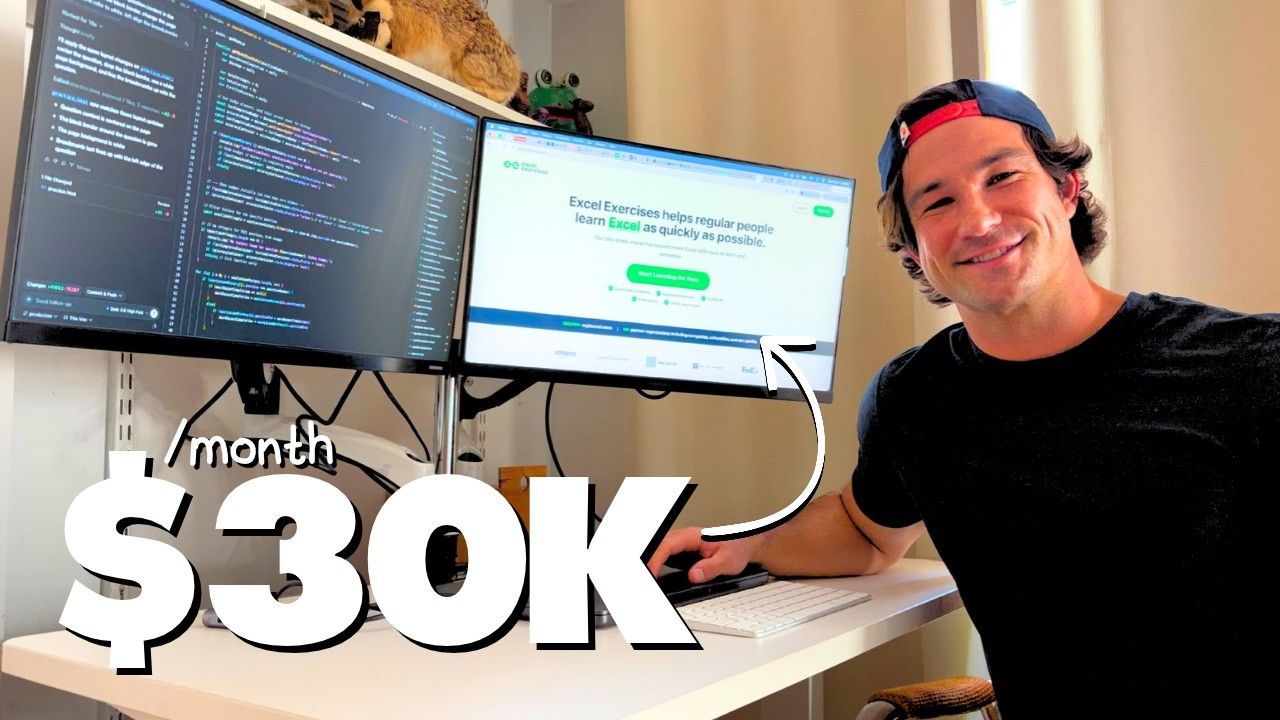
Jake Shimota built ExcelExercises.com as a nights-and-weekends side project. Five years later, it generates over $30K/month — almost entirely on autopilot.
Jake Shimota built ExcelExercises.com as a 5-to-9 side project — working nights and weekends while holding down a full-time job and finishing grad school. Five or six years later, the site generates between $30,000 and $35,000 per month, runs almost entirely on autopilot, and has grown 5x since Jake quit his job two years ago to work on it full-time. No massive team. No VC money. Just one well-scoped idea executed patiently over time.
The site does exactly one thing: teach Microsoft Excel. Users work through interactive exercises and simulations directly in the browser, practicing real functions and keyboard shortcuts rather than passively watching tutorial videos. It's the difference between watching someone do pushups and actually dropping to the floor yourself. That hands-on format is the entire product.
The Origin: Monetize Your Own Frustration
Jake studied finance in college and got curious about how software was actually built. He taught himself to code through YouTube videos — which, given how that story ends, is a pretty satisfying origin. The idea for Excel Exercises came straight from a painful personal experience. At a finance job, he was forced to sit through a mandatory, video-based Excel training that was crushingly boring. He wasn't retaining anything. He was just watching someone else click through spreadsheets.
The 'aha' moment hit while he was using Duolingo. He thought: *why doesn't something like this exist for Excel?* Interactive, bite-sized, hands-on. That single analogy became the product. He built his first web project around it.
The early validation story is worth lingering on. The site was still rough — his words were "scary" and unfinished — when a complete stranger paid him $50. That payment wasn't just revenue. It was proof that someone out there had the problem he was solving and valued the solution enough to hand over money for it. That's the signal most first-time builders spend months waiting and hoping for. Jake got it early, with an ugly site, and he kept going.
Business Model and Key Metrics
Excel Exercises runs on a freemium model. New visitors get access to a handful of free lessons so they can feel the interactive format before hitting a hard paywall. It's a smart structure — the product sells itself once someone actually uses it.
The numbers Jake shared from his Stripe dashboard: just over $30,000 gross volume in the past four weeks, roughly 50,000 visitors per month, and approximately 2,500 active paying subscribers. That's a conversion rate from visitor to paying customer that most SaaS founders would kill for, and it's been achieved with a lean, largely automated operation. The business runs with minimal daily intervention. Jake built systems that let it take care of itself.
Growth Phase 1: SEO from $0 to $10K/Month
To get the business off the ground, Jake went all-in on SEO. He created a large number of blog articles targeting specific Excel functions — the kind of content someone types into Google when they're staring at a formula they don't understand. High intent, specific queries, real problems.
He also added substantial text to his landing page — 1,500 to 2,000 words — which runs counter to a lot of conventional marketing advice about keeping things short and punchy. But the goal wasn't to win a copywriting award. It was to give search engines enough signal to understand what the page was about and surface it for the right searches. It worked. Organic traffic became the engine that took the business from zero to $10,000 per month.
This phase is replicable. If you have a specific, well-understood problem and you're willing to write detailed, useful content around it, SEO can build a real traffic foundation without spending a dollar on ads. It's slow, but it compounds.
Growth Phase 2: Paid Ads from $10K to $30K/Month
Once Jake had organic traction and a proven product, he shifted to paid advertising to accelerate. This transition changed how he thought about the business entirely. Running ads forces you to care about numbers you might have been loosely tracking before — user acquisition costs, conversion rates, customer lifetime value. Every dollar in has to have a clear path to more dollars out.
But here's the part that made the biggest difference, and it's something most early-stage founders skip: Jake didn't rely on blended, averaged metrics from Stripe. He exported his payment data into a spreadsheet and segmented it. Monthly subscribers in one column, annual subscribers in another.
What he found was stark. His annual customers were solidly profitable. His monthly customers were barely breaking even. The blended LTV number looked fine — but that average was hiding a serious problem underneath it. Once he could see the segments clearly, the move was obvious. He doubled the price of his monthly plan while leaving the annual price unchanged. That single pricing change significantly accelerated the business's growth trajectory.
This is the real lesson: unit economics aren't just a metric you report to investors. They're a decision-making tool. Granular beats blended, every time.
Product-Led Growth and Corporate Deals
Another growth engine that emerged organically: product-led word of mouth. An individual employee tries Excel Exercises on their own, finds it actually works, and then recommends it to their manager for team-wide training. That bottom-up motion has led to corporate and university deals, where companies or schools sign up dozens of users at a time.
Jake didn't engineer this from the top down. It emerged because the product is genuinely good and the use case — onboarding employees or students who need to level up their Excel skills — is something that hiring managers and team leads care about. Building something people actually like turns your users into your sales team. That's the compounding power of product-led growth.
Jake's Playbook for Finding a Simple App Idea
Jake's advice for aspiring founders boils down to two things, and neither of them is particularly complicated.
First: solve a problem you have intimate knowledge of. Not a problem you've read about, or one you think sounds interesting, or one that showed up in a market research report. A problem you've personally felt and understand from the inside out. Jake's deep familiarity with the frustration of bad Excel training wasn't incidental to his success — it was central to it. That knowledge shaped every product decision he made.
Second: ship the MVP as soon as possible. A lot of people spend months polishing something before they let anyone touch it. Jake got a paying customer from a site that looked "scary" and was still unfinished. The version you're embarrassed by is the version that gets you real feedback from real people. He quoted the classic line: *"If you're not embarrassed by the first iteration, you've waited too long."*
The combination of those two things — genuine problem knowledge and early shipping — is what gets you to that first $50 payment from a stranger. And that payment is worth more than six months of polish.
What This Actually Proves
ExcelExercises.com isn't a complicated business. It doesn't have a viral growth hack or a secret distribution channel. It has a well-scoped idea, built by someone who understood the problem deeply, grown steadily through SEO and then paid ads, and optimized with clear-eyed analysis of the numbers that actually matter.
The $30K/month number sounds impressive — and it is. But what's more impressive is how Jake got there: patiently, methodically, with a product that does one thing really well. There's a version of this for almost any recurring, painful problem that someone has intimate knowledge of.
You probably already know what yours is.
Original video
https://www.youtube.com/watch?v=pwvnH9S4j60