 Story
StoryHow a Simple Scanner App Prints $2.3M Every Month
A basic PDF scanner — doing what your iPhone already does for free — earns $2.3M/month. Here's the repeatable system behind it.
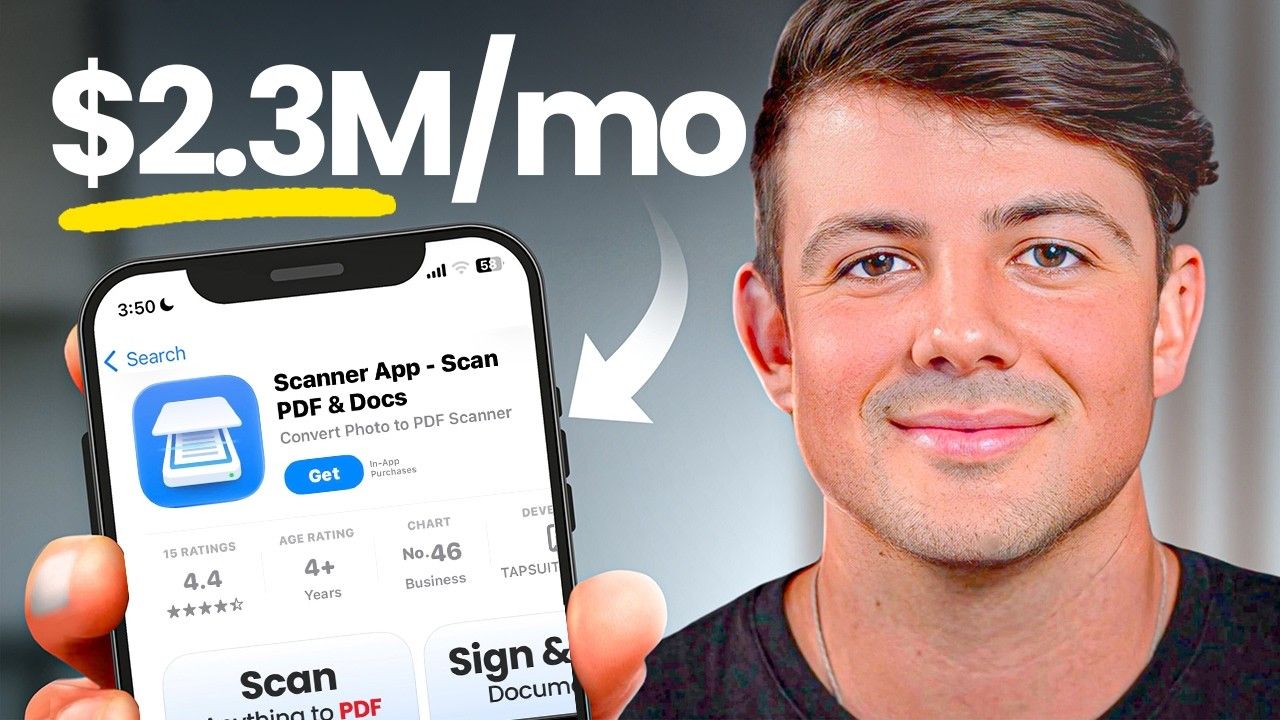
There's a scanner app sitting in the App Store right now. It does nothing your iPhone can't already do for free. And it makes $2.3 million every single month.
That's the paradox the host opens with, and honestly, it's the kind of thing that stops you mid-scroll. Because the app — "Scanner App - Scan PDF & Docs" — isn't winning on features. It isn't winning on design. It's winning on a system. A repeatable, reverse-engineerable system that turns one of the most commoditized functions on a smartphone into a money-printing machine. Let's break it down.
The Numbers (and the Studio Behind Them)
The revenue figures come from two sources: Sensor Tower pegs the app at $2 million per month, while Screens.Design puts it closer to $2.3 million. Either way, we're talking about serious, sustained MRR from a utility that Apple bundles into every device it ships.
But here's what makes this even more interesting. The studio behind it — a Turkish company called TAPSULTE YAZILIM HIZMETLERI ANONIM SIRKETI — doesn't just have one hit app. They have an entire portfolio of utility apps collectively pulling in $4 million per month. A deep search assistant, a cleanup storage app, a chatbot, a heart rate monitor — all of them generating hundreds of thousands of dollars monthly on their own.
This is the tell. One successful app could be luck. A whole portfolio operating at this level? That's a system. These people have figured out a formula and they're stamping it across every niche they enter.
Why a Commoditized Idea Still Wins
Before getting into tactics, it's worth understanding *why* this category works at all. A few things line up perfectly here.
Evergreen demand. People need to scan documents constantly — contracts, receipts, medical forms, tax paperwork. The need never goes away. It's not a trend. It's not seasonal. It's a recurring, urgent problem that shows up in someone's life and they need solved *right now*.
Zero emotional attachment. Nobody has brand loyalty to their scanner app. Users don't care which one they use — they just need the thing that shows up first and makes the process painless. That means the winner isn't the best app. It's the app that appears at the top of search results and converts the hardest once someone lands on it.
Zero learning curve. Everyone already understands scanning. You don't need to educate the user on what the product does. The value proposition is basically: take a photo, get a clean PDF. That clarity makes every downstream step — the marketing, the onboarding, the paywall — dramatically easier to execute.
When you combine massive demand with low friction and no brand loyalty, you get a market where distribution wins. And that's exactly where this app focuses its energy.
The Marketing Strategy: ASO Dominance
The app's primary acquisition channel isn't paid ads or social media. It's App Store Optimization, and they've taken it further than most developers even think to try.
Using AppFollow, the host shows that this app ranks for over 31,700 keywords in the App Store. More importantly, it holds the number one position for high-intent searches like "scanner app," "photo to pdf scanner," and "app scanner" — the exact phrases someone types when they have a document in front of them and need a solution immediately.
How do they dominate? It starts with the name itself: "Scanner App - Scan PDF & Docs." That's not a creative brand name. That's a keyword list dressed up as an app title. The subtitle continues the same approach: "Convert Photo to PDF Scanner." Every word is doing ASO work.
And then there's something most developers miss entirely. Apple's algorithm analyzes the *text inside your App Store screenshots*. This app's screenshots are packed with relevant terms — "Scan," "Sign & Edit," "Convert" — meaning even the visual assets are pulling double duty as keyword real estate. The screenshots aren't just pretty; they're strategically indexed.
This is the kind of detail that separates apps that plateau at a few thousand downloads from apps that compound. When you rank for 31,700 keywords and you're sitting at number one for the highest-intent terms in your category, you own the top of the funnel. Everything else — onboarding, paywall, retention — flows from that position.
The Onboarding Flow: Earning the Paywall
Getting the user to download is only half the battle. What happens next is where the money is actually made.
The onboarding flow is intentionally designed to build value *before* the price ever appears. The app walks users through what it can do — scanning, editing, signing, converting — in a way that makes the tool feel indispensable before they've been asked to spend a single dollar. By the time the paywall arrives, the user has already mentally committed. They've seen the value. They're not evaluating whether to pay; they're deciding *how* to pay.
This sequencing matters enormously. Most apps that struggle with paywall conversion make the mistake of asking for money before demonstrating worth. This app flips that. It earns the yes before it asks for it.
The Monetization Tactic: The Trial Trap (in the Best Way)
The paywall strategy itself is aggressive and clever. The app typically leads with a low-cost, short-term trial — the kind of offer that feels like a no-brainer to accept. But the trial automatically converts to a higher recurring subscription price once it ends.
This structure works for a few reasons. The entry price is low enough to eliminate hesitation. The trial period is short enough that many users forget to cancel. And by the time the full subscription kicks in, the user has already integrated the app into their workflow — scanning receipts, sending contracts, storing documents — making cancellation feel like more friction than just letting the charge go through.
It's not manipulative in a dark-pattern sense. The mechanics are disclosed. But it is a masterclass in reducing the psychological friction at the moment of commitment while maximizing long-term revenue per user.
The Repeatable System
Zoom out and you can see what TAPSULTE has actually built. It's not a scanner app. It's a machine with interchangeable parts:
- Find a problem that's recurring, urgent, and simple to explain
- Dominate ASO by treating your title, subtitle, and screenshots as keyword infrastructure
- Onboard with value first so the paywall lands after commitment, not before
- Use a trial-to-subscription funnel that converts on low price and retains on habit
- Repeat across niches — cleanup apps, chatbots, health monitors, all running the same playbook
The feature doesn't matter. The design is secondary. What matters is showing up at the top of search when someone has an urgent problem, then walking them through an experience so frictionless that pulling out a credit card feels like the obvious next step.
Takeaways
What's wild about this case study is how transferable it is. You don't need a novel idea. You don't need a technical breakthrough. You need a real problem that people search for urgently, a disciplined approach to ASO from day one, and an onboarding flow that earns trust before it asks for money.
The scanner app space is obviously saturated now. But the *system* works anywhere these conditions exist: high-intent search volume, low brand loyalty, simple value proposition. Productivity tools, health trackers, file converters, finance utilities — the same machine can run in all of them.
TAPSULTE figured that out and built a $4 million per month portfolio to prove it. The question is whether you're going to keep waiting for a breakthrough idea, or start building the system.
Original video
https://www.youtube.com/watch?v=6dL_Zfoz6Tg