 Story
How a Non-Developer Built a $25k/Month App From One Viral Post
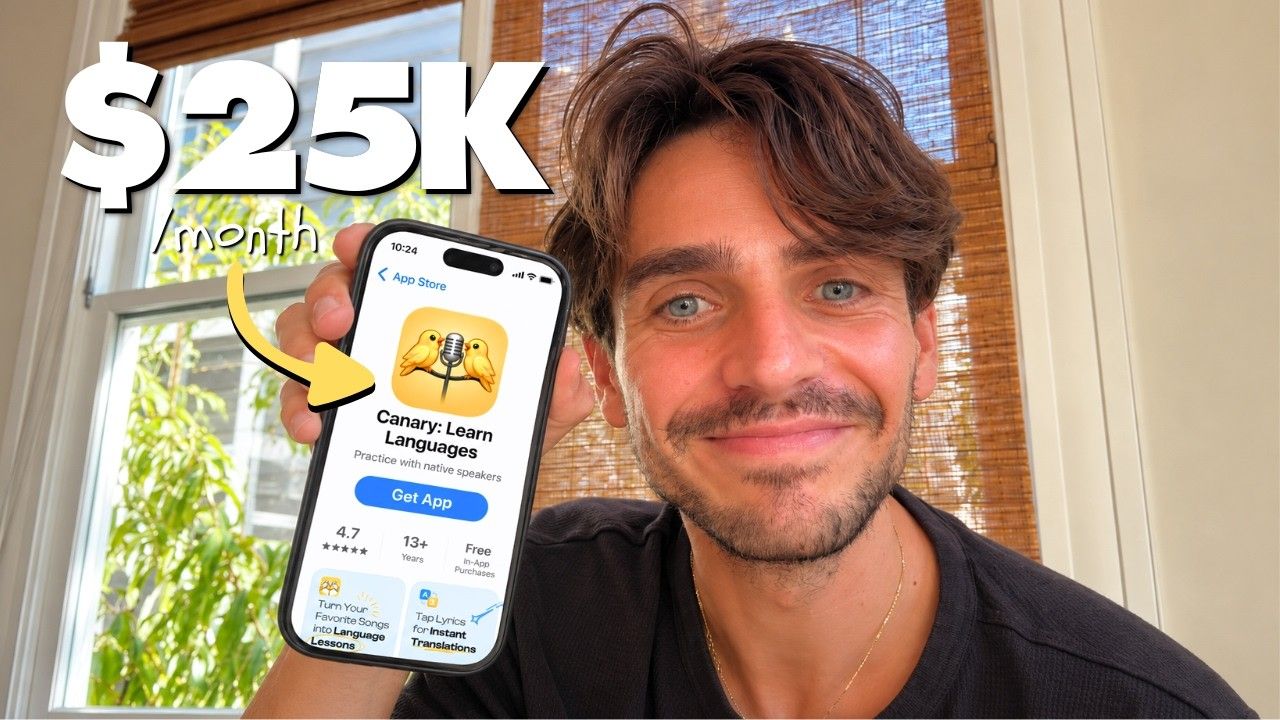
Ben Guez had no coding experience and one viral Instagram video. Nine months later, his language-learning app Canary pulls in $25k a month. Here's exactly how he did it.
Ben Guez had no coding experience. He wasn't a software engineer moonlighting as a founder, wasn't grinding through tutorials, and wasn't part of some tech accelerator. He was a digital nomad and content creator who had grown a social media following to over a million people after selling a previous business. And then, about a year ago, he posted a video of himself singing a French song with lyrics and translations overlaid on screen — and it blew up.
That one piece of content became the seed of Canary, a language-learning app that now generates $25,000 per month, just nine months after launch. 50,000 downloads. 2,000 paying customers. And a founder who started learning to code himself only four months ago. This story is worth unpacking carefully, because almost every part of it goes against conventional startup wisdom.
What Is Canary?
Canary is a language-learning app built around a simple but genuinely compelling insight: people can't remember vocabulary drilled into them by Duolingo, but they can remember every word of a Bad Bunny or Stromae song after hearing it twice. The app lets you learn languages through songs you actually enjoy — Spanish through Bad Bunny, French through Stromae, and so on. Beyond passive listening, there's AI-powered training built into the app, plus a community layer where you can practice with other learners around the world.
The target user is someone who's bounced off traditional apps and found them too dry, too gamified in the wrong ways, or just not sticky enough. Canary positions itself as the more engaging alternative — learning that feels like entertainment.
Business model: Freemium, with a premium tier at $10/month or $79/year. Notably, 60% of subscribers opt for the annual plan, which is a healthy sign — it means users trust the product enough to commit long-term. In the last 28-day period Ben shared from his revenue dashboard, the app brought in $25,015 total. MRR sits at $13,880, which looks lower than the monthly number because so much of the revenue is locked into annual subscriptions. The dashboard also showed 23,079 active customers, 11,276 new customers, and 2,310 active subscriptions in that same window.
The Viral Validation Strategy
Before there was an app, there was an Instagram post. Ben posted himself singing a French song with lyrics and translations visible on screen. It resonated massively. And instead of just pocketing the dopamine hit and moving on, he read the signal correctly: people genuinely want to learn languages through music, and they're not getting it anywhere else.
He created a dedicated Instagram page — @singwithcanary — which grew to 262,000 followers before he'd even built a product. That's the part most founders skip entirely. They go straight to building, then discover nobody cares. Ben essentially ran a free, low-risk market test using content, and the results told him clearly: build this thing.
This kind of social proof does something important beyond validating demand. It de-risks the whole operation. When you go to hire a developer, they can see real traction. When you pitch early users, they can see a community already forming. When you're deciding whether to invest months of your life into something, the data is already there. It's not perfect certainty, but it's miles better than a hunch.
Building as a Non-Developer
Ben's initial approach was practical: he hired a developer to build the first version. The MVP launched in about a month, and by his own admission it was "really ugly." But his philosophy was clear — ship early and gather feedback. Perfection was never the goal. Getting something real into users' hands was.
The turning point came four months ago when Ben started coding himself, which he describes as a "game-changer" for his ability to iterate quickly. When users give feedback, he doesn't have to wait for a developer's availability or budget another sprint. He can go fix it. That speed of iteration is a massive competitive advantage for a small indie app trying to find its footing.
His tech stack is lean but thoughtful:
- Firebase for the back-end ($200/mo)
- RevenueCat for subscription management ($260/mo)
- PostHog for product analytics ($250/mo)
- Claude for AI coding assistance ($200/mo)
- Beehiiv for email ($169/mo)
- OpenAI API for in-app AI features ($150/mo)
- AppsFlyer for install tracking ($97/mo)
- ManyChat for chatbot automation ($30/mo)
Total infrastructure cost sits well under $1,500/month for an app doing $25k in revenue. That's a genuinely impressive margin profile for a solo founder at this stage.
The Growth Playbook
Ben's approach to growth is refreshingly unsexy. No growth hacking. No PR stunts. Just a repeatable loop that he runs consistently across TikTok, Instagram, and YouTube.
Step 1 — Post a lot of content. Ben tested a wide variety of formats across all major platforms without committing too hard to any single approach up front. Volume creates the data you need to make smart decisions.
Step 2 — Identify a winning format. Some posts land. Most don't. The ones that do tell you something real about what your audience responds to — a specific hook, format, emotion, or use case.
Step 3 — Create variations of the winner. Once you know what works, you don't abandon it and chase the next idea. You run variations. Different songs, different languages, different people, same core format.
Step 4 — Boost the best organic posts with paid ads. This is the key leverage point. You're not spending money to find out if something works — you already know it works because it performed organically. You're spending money to amplify a proven winner. That's a fundamentally different and smarter use of ad budget.
Step 5 — Analyze and repeat. The loop doesn't end. Data from paid campaigns feeds back into step one, and the whole thing compounds over time.
Ben also did something a lot of founders overlook in the early days: he actively studied what other successful apps were doing, listened to founder podcasts, and even reached out to past Starter Story guests for paid consulting on his app's onboarding flow. Learning from people who've already solved the problems you're facing is one of the highest-ROI things you can do early on, and Ben treated it seriously.
Advice for Aspiring Founders
When asked what he'd tell someone just starting out, Ben's answer was grounded and direct. First, look for ideas on social media. Scroll through comments in a niche you understand and find the recurring pain points — the things people say they can't figure out, the tools they complain about, the results they want but can't get. That's where real product ideas live.
For Ben, the insight was watching his followers say they couldn't retain anything from Duolingo but could sing along to entire songs in a foreign language after just a few listens. That gap between what tools offered and what actually worked for people was the entire business.
Second — and this is the advice he came back to most — "perfection is the enemy of good." Launch early. Launch ugly if you have to. The feedback you get from real users using a real product is worth more than any amount of pre-launch theorizing. A product is always a work in progress. The question is whether you're making progress in the dark, based on assumptions, or in the light, based on actual user behavior.
Canary isn't a fluke and it isn't magic. It's the result of someone who validated an idea before building it, shipped fast, learned to code when he needed to move faster, and ran a consistent content and paid growth loop without overcomplicating it. The whole thing started with one viral post and a founder who paid attention to what it was telling him.
That part — paying attention — might be the most underrated skill in this whole story.
Original video
https://www.youtube.com/watch?v=KgS3hbpxTzE