 Story
StoryHow a 23-Year-Old Built a $50k/Month App Working 20 Hours
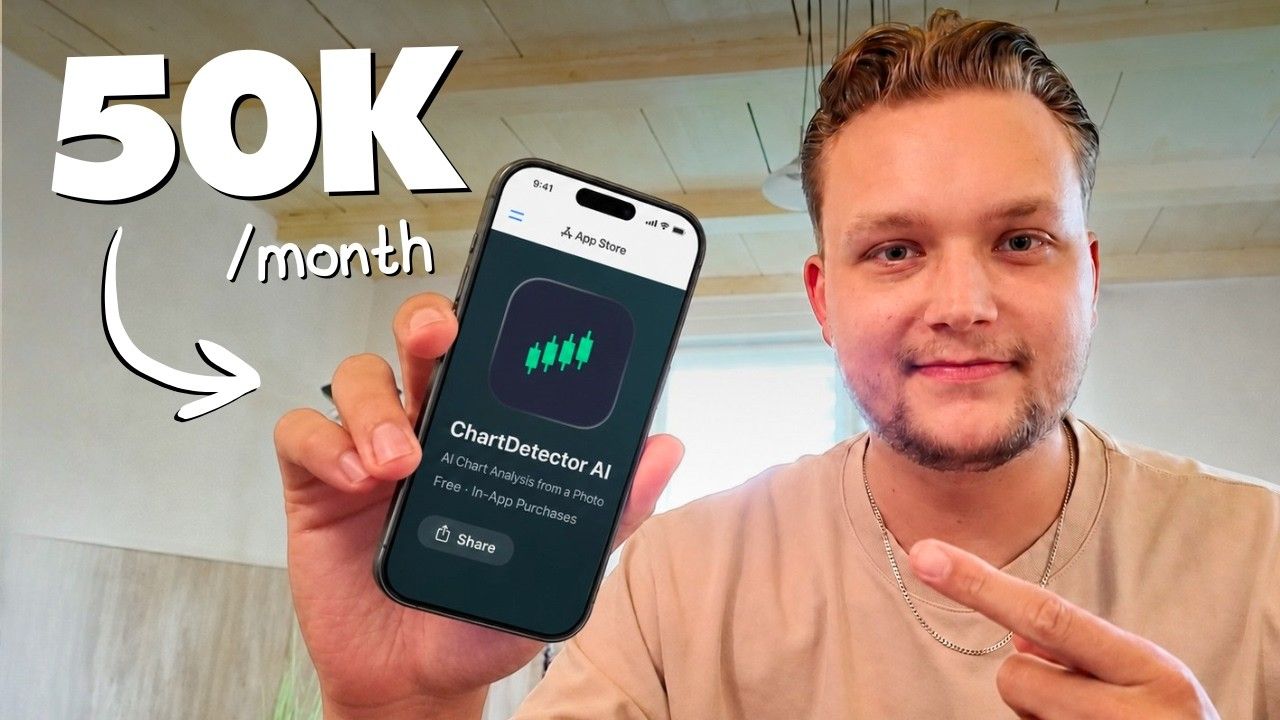
Timo built ChartDetector AI, a mobile app doing $50k/month — and only works 20 hours a month on it. Here's his exact four-step playbook.
What if you could build a business that generates $50,000 a month while you travel the world, clocking just 20 hours of work? That's not a headline from a sketchy newsletter — that's exactly what Timo, a 23-year-old developer from Germany, has pulled off with his app ChartDetector AI.
In 13 months, the app went from zero to over 90,000 downloads and $260,000 in total revenue. His most recent 28-day revenue dashboard showed $56,225 coming in from over 13,000 new customers. He and his brother built it while working full-time jobs as software engineers at a large car brand, and then quit once the app proved itself.
The idea itself came from a surprisingly humble place: a new ChatGPT feature that allowed image uploads. They started with a simple Telegram bot that let users upload stock or crypto chart images and get AI-powered analysis back. That bot evolved into a full mobile app, and the business snowballed from there. The app's premise is simple — take a photo of a chart, and the AI gives you insights and directional guidance. Niche, useful, and apparently wildly in-demand.
But the product is almost secondary to the *system* Timo built around it. The real story here is his growth engine.
Step 1: Optimize Your Onboarding
Before spending a single dollar on ads, Timo says you need to make sure your app is actually ready for paid traffic. That means ruthlessly optimizing the onboarding experience, because this is where conversions happen or die.
Focus on outcomes, not features: Users don't care what your app does — they care what it does *for them*. Show them the value they'll get, not a feature list.
Use social proof: Download counts, ratings, testimonials — anything that signals other people trust the product. This matters especially when someone lands on your app cold from an ad.
Study what's already working: Timo uses a tool called screens.design to analyze the onboarding flows of successful apps. Don't reinvent the wheel. Reverse-engineer what's proven.
Implement a hard paywall: This is one of Timo's most counterintuitive moves, and it's central to everything else. No free trials. You hit the paywall immediately. ChartDetector AI offers a weekly plan at $12.99 and a six-month plan at $59.99, and users choose one before they can access anything.
The hard paywall sounds aggressive, but it's actually a feature of the business model, not a bug. It generates immediate revenue, and more importantly, it gives the ad algorithm clean, clear data on who is actually converting into a paying customer — which feeds directly into Step 2.
Step 2: Set Up Tracking Properly
This is the most technical step, and Timo says it's the one most people get wrong. If your tracking is broken, your ad campaigns are flying blind — and you'll burn money fast.
Create a TikTok Business Manager account: This is your control center for everything ad-related on the platform.
Integrate a Mobile Measurement Partner (MMP): Timo uses AppsFlyer. An MMP sits between your app and the ad platform, accurately attributing which installs and purchases came from which ads. This is critical because the data Apple and Google provide natively is imperfect.
Connect AppsFlyer to your TikTok Ads account: Once connected, every time a user converts — meaning they subscribe — that event gets sent back to TikTok. The algorithm learns from this. Over time, it gets smarter about who to show your ads to, specifically targeting people who look like your paying customers, not just people who download and churn.
Timo's practical advice here: hire a freelancer on Upwork to handle this setup. It's technical, the stakes are high (a misconfigured MMP means bad data feeding the algorithm), and a specialist can do it correctly in a few hours for a reasonable cost. This is not the place to wing it.
Step 3: Set Up Your Ad Campaigns
With your onboarding dialed in and tracking live, you're ready to run ads. Timo's entire growth strategy is built around TikTok paid ads, and he's very specific about how to set them up.
Post at least six organic videos first: Before running a single paid campaign, post organically. This gives TikTok's algorithm some data to work with and helps your account look legitimate.
Use TikTok's Smart+ campaign type: Smart+ uses TikTok's own AI to handle audience targeting and budget allocation automatically. Timo keeps audience targeting broad — often just targeting by country — and lets the algorithm do the heavy lifting.
Optimize for subscription events, not installs: This is probably the most important campaign setting. If you optimize for installs, TikTok will find people who download apps. If you optimize for subscription events, it finds people who *pay*. The latter is obviously what you want, and the hard paywall from Step 1 is what makes this data signal clean and fast.
Start with at least $50/day: Too small a budget and the algorithm doesn't have enough data to learn effectively. $50/day is Timo's minimum starting point.
Test in less competitive markets first: Before going all-in on the US, test your ads in smaller, less expensive markets. Lower cost-per-click means cheaper data, which means you can learn faster without burning through budget.
Respect the 7-day learning phase: Once a campaign is live, leave it alone for seven days. TikTok's algorithm needs this window to calibrate. If you start tweaking before it's done learning, you reset the process and waste the data already accumulated. This requires patience, but it's non-negotiable.
Step 4: Monitor and Scale
Once campaigns are running, Timo's weekly routine is pretty simple, and this is where the 20-hours-a-month thing starts to make sense.
Monitor ROAS weekly: The core metric is Return On Ad Spend. Timo's example is clean: if you spend $1.50 per download and your average user generates $3.00 in revenue, you have a 2x ROAS. Once that number is positive and stable, the strategy is straightforward — spend as much as you can afford.
Scale budgets slowly: When it's time to increase spend, do it gradually. Timo's rule is never increase the budget by more than 20% every three days. A sudden budget jump forces the campaign back into the learning phase, which disrupts performance. Slow, steady increases preserve the algorithm's learned patterns.
Combat creative fatigue constantly: Every ad has a lifespan. Eventually, enough people have seen it that performance drops — this is creative fatigue. Timo maintains a constant pipeline of new video content to rotate in. If ROAS drops, his first move is to create new creatives, not adjust budgets or targeting. For video editing, he uses CapCut, which keeps production fast and lightweight.
The system essentially runs itself once it's profitable. Timo checks in weekly, makes small adjustments, and lets the machine keep printing.
The Tech Stack Behind It
For anyone curious about what actually powers ChartDetector AI, the stack is modern and relatively lean:
- React Native + Expo for the cross-platform mobile app
- Supabase for the backend
- Cursor AI for coding assistance
- OpenAI for the AI chart analysis functionality
- RevenueCat for managing in-app purchases and subscriptions
- AppsFlyer for mobile attribution
- CapCut for video ad production
Nothing exotic. These are all tools a solo developer or a small team can get up to speed on quickly, and most have generous free tiers to start.
The Takeaway
What Timo built isn't magic — it's a system. A niche app, a hard paywall that generates clean revenue data, a tracking setup that feeds good signals to TikTok's algorithm, and a disciplined approach to scaling that doesn't break what's working.
The 20-hours-a-month number isn't the goal, it's the result. When your ad system is profitable and your app delivers value, the business largely runs itself. You're not grinding — you're monitoring.
His parting advice is probably the most important part: take action now and learn while doing it. Not after you've read every blog post, watched every video, built the perfect plan. Now. The learning happens in the doing, and the people who move fast are the ones who figure it out first.
Original video
https://www.youtube.com/watch?v=DPb-M0Vt4uI