 Story
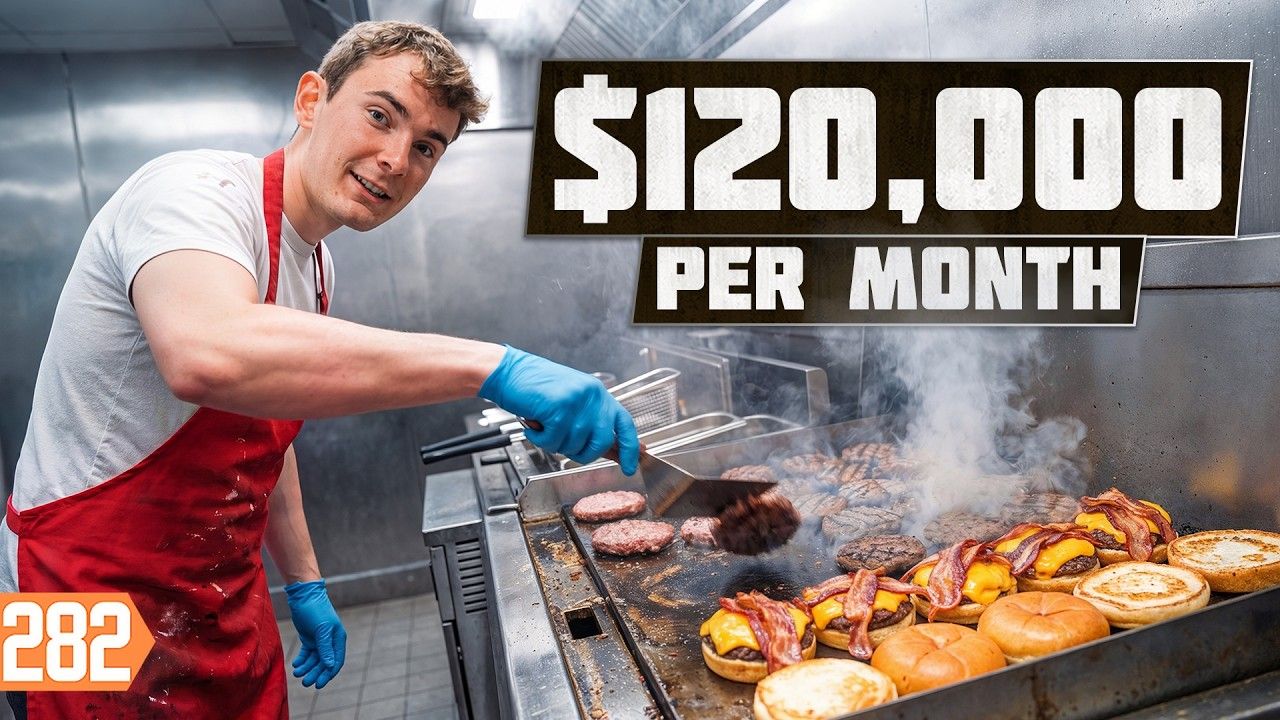
StoryHow a 22-Year-Old Built a $120K/Month Burger Empire
Henry Smith had zero restaurant experience at 18. He learned from YouTube, started with a food trailer, and now runs Smashers — a burger spot doing $1.45M a year.
No culinary school. No restaurant family. No industry connections. Just a YouTube thumbnail of a smash burger that caught the eye of a 17-year-old who, by his own admission, couldn't even boil water.
That's where Henry Smith's story begins. Today, at 22, he runs Smashers — a smash burger restaurant in Norfolk, Virginia that pulls in $120,000 a month. It's the kind of origin story that sounds too clean to be real, but the numbers back it up: $1.45 million in revenue in 2025, with projections of $1.7 million in 2026, and transactional growth up 17.5% year-over-year.
Here's how he did it.
Step 1: Get Obsessed With the Product
Henry didn't start by writing a business plan or researching the restaurant industry. He started by cooking burgers — over and over again, three to four times a week for six months straight. Since burgers made up roughly 60% of his diet anyway, learning to perfect them felt less like work and more like a personal mission.
The turning point came when his dad — not exactly the easiest critic — tasted one and said, "This burger's not that half bad." That was all the market validation Henry needed. Friends and family started requesting his burgers. The hobby was becoming something more.
The lesson here is deceptively simple: before you worry about margins, locations, or marketing, make something people genuinely want. Henry went deep on one product — smash burgers — and didn't move on until he'd nailed it. The Maillard reaction, the right heat, the parchment paper technique to get that dark, crust-sealed patty without sticking — he figured all of it out through YouTube and relentless repetition. His menu today reflects that same philosophy: smash burgers, fresh-cut fries, and hand-scooped milkshakes. Simple. Focused. Executed well.
Step 2: Start Small and Prove the Concept
At 18, Henry made it official — LLC, branding, and a food trailer. He launched with his best friends as his first crew, which sounds chaotic, but it let him test the concept with minimal overhead and maximum flexibility.
The trailer was the training ground. It generated revenue, built a customer base, and proved the product had real demand before he committed to the much larger financial risk of a brick-and-mortar location. This is the move most aspiring restaurant owners skip. They go straight to the lease, the buildout, the full staff — and they get crushed by fixed costs before they've figured out if anyone actually wants what they're selling.
Henry validated first, scaled second. That sequencing matters enormously.
When he expanded to a new area in Norfolk, he had to hire people who had more restaurant experience than he had years of being alive. His own description of the early interviews is hilarious and honest: to avoid exposing how little he knew about job descriptions and formal hiring, he'd redirect conversations toward kitchen equipment placement. His actual hiring criteria? "So, you want to work for me?" It's not a playbook anyone would teach in business school, but it got him started.
Step 3: Go Learn From Your Competition (Undercover)
One of the smartest things Henry did before opening his physical location was work at Five Guys for four days. He called it "Operation Trojan Burger."
He worked a day shift, two mid shifts, and a night shift — enough to absorb how a well-run fast-casual burger operation actually functions from the inside. How they handle ticket times. How they manage the line during a rush. How their systems hold up under pressure. Four days isn't long, but if you're paying close attention, it's enough to learn what took someone else years to figure out.
The kicker? The manager who oversaw Henry at Five Guys later became the general manager of Smashers. That's not just a good story — it's a sign that Henry was building real relationships and credibility even while he was technically someone else's employee.
Step 4: Pick the Right Location and Control Your Costs
Smashers operates out of an end-cap unit in Norfolk, Virginia — high visibility, near a busy intersection, with strong foot and drive-by traffic. But the real smart move was choosing a second-generation restaurant space, one that had previously been a Fatburger. That meant the plumbing, ventilation, and basic kitchen infrastructure were already in place, dramatically reducing buildout costs.
Monthly rent runs about $7,000. For a location doing $120K a month in revenue, that's a very manageable fixed cost — roughly 5.8% of revenue. Henry clearly understood that location decisions aren't just about traffic; they're about what the space costs you relative to what it can realistically generate.
On the numbers side, Henry is precise about his targets. His biggest two expenses are cost of goods sold (COGS) and labor, and he aims for those two combined to sit around 56% of revenue — a benchmark that keeps the business viable in an industry famous for its thin margins. The Original Smasher, his flagship double-patty burger, sells for $10.99, with a full meal running $16–17. He targets roughly 25% profit margin on burgers before toppings. His highest-margin items? Fries and drinks — which is true of virtually every burger concept and worth leaning into.
Revenue breaks down as 75% in-store and 25% online, with the online chunk spread across their own website, a dedicated app, and third-party platforms like DoorDash and Uber Eats. Having their own ordering infrastructure means they're not entirely at the mercy of platform fees, which is a smart long-term play.
Step 5: Build Systems Before You Scale
This is where Henry's thinking really sharpens. When you're hiring people older and more experienced than yourself, you can't rely on personal authority. Nobody is going to take direction on faith from a 19-year-old with a food trailer. Henry figured this out the hard way and landed on a solution that actually works: make the *brand's* standards the authority, not yourself.
When he needed something done a certain way, it wasn't "do it because I said so" — it was "this is how Smashers does it." Checklists, documented processes, standard operating procedures. The system became the boss, which took Henry out of the position of having to enforce his own rules against employees who had forgotten more about kitchen operations than he'd learned yet.
This is the kind of infrastructure that makes growth possible. Without it, you're not running a business — you're just personally present at all times hoping nothing falls apart. The 17.5% year-over-year growth in transactions Henry attributes to better operations, faster ticket times, and improved food quality — all of which are downstream of having solid systems in place.
Step 6: Embrace Failure as Tuition
Henry's framing of entrepreneurship is one of the most honest I've heard: "biting off more than you can chew and then figuring out how to chew it." He calls failure his best friend. Not in a clichéd, motivational-poster way — but in the practical sense that every mistake he made in the food trailer phase was a lesson that cost him relatively little, compared to what the same mistake would have cost in a fully staffed brick-and-mortar restaurant.
The food trailer wasn't just a revenue vehicle. It was an incredibly affordable MBA in restaurant operations.
Starting with no experience and learning from YouTube might sound reckless. But Henry treated every gap in his knowledge as a problem to solve — whether that was watching tutorials, cooking hundreds of test burgers, or working a week at a competitor to observe their systems. The willingness to feel incompetent in the short term is exactly what accelerated his learning curve.
Where Smashers Goes From Here
Henry's stated goal is to build Smashers into a national brand — a titan in the burger space, in the same conversation as Chick-fil-A or In-N-Out. That's an ambitious target, but the foundation he's building toward it is sound: a focused menu, strong unit economics, real systems, and year-over-year growth that's still accelerating.
He's 22 years old, doing $1.45 million a year out of a single location, with the operations infrastructure to scale. Most people his age are still figuring out what they want to do.
The whole story is a reminder that you don't need credentials or connections or even experience to build something real. You need a product worth making, the humility to learn from anyone and anything, and the willingness to start before you're ready. Henry learned to make burgers from YouTube. The rest he figured out as he went.
Original video
https://www.youtube.com/watch?v=_gtcpgoHWXI