 Story
StoryHow a 19-Year-Old Hit $10k/Month With a No-Code AI App
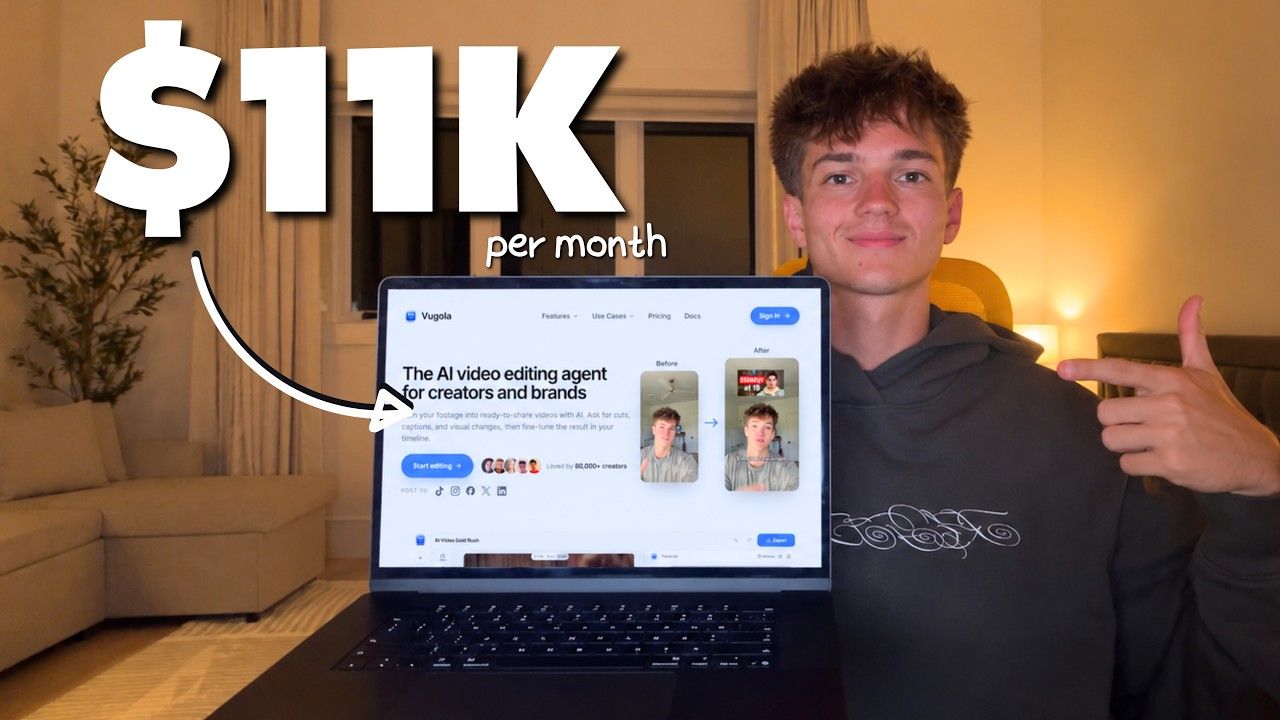
Vadim built Vugola, an AI video editing app, to $11k MRR in five months — no coding background, no big budget, just a 45-minute daily routine.
Most people assume you need a CS degree, a co-founder with deep technical chops, or a mountain of VC money to build a software product that actually makes money. Vadim is 19, had zero coding experience, and proved all of that wrong. His AI video editing app, Vugola, hit $11,200 in monthly recurring revenue within five months of launching — up 61.23% from the previous period. Around 50,000 people have signed up, and roughly 400 of them are paying customers. It's the kind of number that sounds made up until he pulls up his Stripe dashboard on screen.
The story isn't about a clever shortcut or a viral moment that came out of nowhere. It's about finding something simple that works and doing it every single day until it compounds.
What Vugola Actually Does
Vugola is an AI video editing agent. You paste in a YouTube link, a Twitch stream, or a podcast URL, and the AI processes the long-form content and outputs multiple short-form clips styled for virality. Customers can pick from different caption presets — Hormozi-style, MrBeast-style — and choose output formats like vertical, square, or landscape depending on where they're posting.
Beyond the automated clipping, there's also an agentic video editor built into the platform. So if the AI gets something close but not perfect, users can jump in and make fine-tuned adjustments without leaving the app. It combines the speed of an automated clipper with the control of a full end-to-end editor.
His target customers are clippers, content creators, agencies, and brands sitting on libraries of long-form content. These are people who already know they need short clips — they're just spending hours creating them manually. Vugola cuts that process down dramatically.
From Lemonade Stands to SaaS
Vadim's entrepreneurial instinct isn't new. He was selling lemonade and slime in elementary school. At 17, he was working at a marketing startup, learning how the business side of things worked, but always wanting to build something of his own. Eventually he quit — no backup plan, no coding knowledge — to go build a web app from scratch. He describes it as "burning all the bridges," which is a pretty accurate framing for leaving a job to learn to code and build a product simultaneously at 17.
The idea for Vugola came from doomscrolling, which honestly might be the most relatable origin story for a 2024 startup. He kept seeing short clips pulled from podcasts, gaming streams, and livestreams everywhere on his feed. It clicked: this is a proven, growing market. People are already paying for this kind of content. And he didn't need to dominate the space — he just needed a tiny percentage of it. That belief, that "you only need a tiny percentage of the market" to build something meaningful, became the foundation he built Vugola on.
The Building Process: Vibe-Coding to Real Code
Vadim calls his approach "vibe-coding," which is a term that's been floating around AI developer circles but fits his process perfectly. He started with Lovable, a no-code platform, and used it for about four months to get the initial version of Vugola built and out the door. As he learned more about how software actually worked, he started leaning on Claude to help him understand and write real code, and eventually moved off the no-code platform entirely.
His current tech stack is surprisingly mature for a solo founder with no formal training:
- OpenAI Codex for development assistance
- GitHub for code management
- Supabase for the backend
- Vercel for deployment
- Cloudflare for infrastructure
- PostHog for product analytics
- DataFast for revenue tracking
- AWS for the video rendering infrastructure
That's a real production stack. Not a toy. The point here is that AI coding tools — Codex, Claude, Lovable — have genuinely lowered the floor for what a non-technical person can ship. You still need to put in the time and be willing to learn, but the ceiling on what you can build without a traditional engineering background has moved dramatically.
The 45-Minute Daily Growth Strategy
This is the part of Vadim's story that deserves the most attention, because it's where most founders would've gone wrong by overcomplicating things.
His entire growth engine is a four-step process that takes 45 minutes a day and runs almost entirely on Instagram.
Step 1: Set up the basics. Get an Instagram account and a ManyChats subscription. ManyChats handles the comment automation — when someone comments on a post, it can automatically DM them a link, driving conversions without Vadim having to do it manually.
Step 2: Study the market through doomscrolling. Vadim spends time on Instagram actively looking at what competitors are posting and which of their videos are going viral. He's looking at UGC (user-generated content) campaigns, hooks, transitions, audio choices, and CTA formats. He's treating the feed as a live market research tool.
Step 3: Copy the format exactly. Not the product demo itself — the *format*. The text style, the pacing, the hook timing, the transition rhythm, the demo length, the call to action structure. If a competitor's video is blowing up, Vadim asks: what made that format work? Then he replicates it, adapting only what's necessary to feature his own product instead.
Step 4: Post 3 to 6 times per day. Volume matters. He's not waiting for a perfect video — he's publishing consistently using proven formats. The only things that genuinely need to change between videos are the hook and the sound. The core demo and CTA stay the same. Find a format that works, then spam it until it saturates. When it stops performing, go back to step two and find the next one.
There's something almost counterintuitive about this advice in an era where everyone is chasing originality. Vadim's take is that originality in marketing is overrated — at least at the early stage. What matters is identifying what's already proven to work and executing it faster and more consistently than anyone else. Double down on what works. Don't get precious about it.
The 45-minute time commitment is also important context. Vadim isn't spending eight hours a day on marketing. He built a system that's repeatable, low-friction, and doesn't require creativity from scratch every single morning. That's what makes it sustainable for a solo founder who's also building the product, handling support, and running the business.
The Biggest Advice: Simplify Everything
When asked what he'd tell aspiring founders, Vadim didn't talk about fundraising or hiring or finding a co-founder. He said: simplify everything.
Simplify how you build. Simplify how you market. Simplify how users understand your product. He believes most founders are doing at least twice as much work as they need to — that you can cut your effort and time by 50% just by ruthlessly stripping away complexity from every workflow.
As a solo founder in the AI age, time is your most valuable asset. Every hour you spend on something complicated that could be simple is an hour you're not spending on the thing that actually moves the needle. And from a product perspective, the simpler your users can understand what your tool does, the more revenue you'll make. Clarity converts.
Vadim's story is a clean reminder that you don't need permission, a big team, or a technical background to build something real. You need a market you understand, tools that let you move fast, and a simple system you'll actually stick to. The rest is just showing up every day and doing the 45 minutes.
Original video
https://www.youtube.com/watch?v=QXxESN94Y6s