 Story
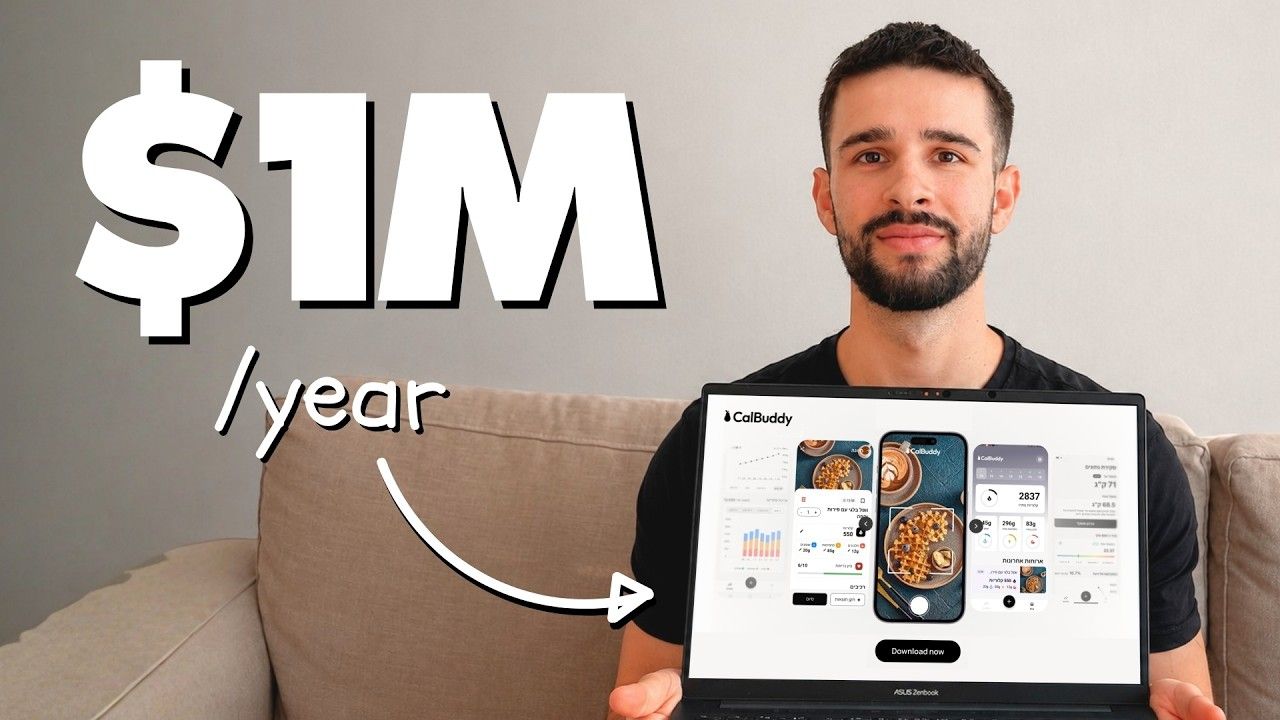
StoryHe Cloned an App and Made $1M in 12 Months
Tomer Cnaan didn't invent a new idea. He took a proven US app, localized it for Israel, and hit $80K/month in under a year. Here's exactly how he did it.
You don't always need an original idea. Sometimes the smartest move is finding something that already works in one market and being the first to bring it somewhere else. That's exactly what Tomer Cnaan did — and in 12 months, he built CalBuddy into an app generating over $80,000 in monthly recurring revenue.
Here's how he went from $1,028 in month one to a million-dollar annual run rate, and what you can steal from his playbook.
Step 1: Find a Proven Winner in Another Market
The insight: Tomer's breakthrough moment came from listening to a podcast featuring Zach, the founder of Cal AI — an AI-powered calorie tracking app that had scaled to over $1.12 million per month in the US. Tomer's realization wasn't "I need to compete with this." It was "this doesn't exist in Israel yet."
Why it works: An app being wildly successful in one country doesn't lock out other markets. Most founders are too focused on building something original that they ignore the massive opportunity sitting in plain sight — proven demand, proven mechanics, just an underserved geography.
The niche he picked: Tomer zeroed in on fitness and nutrition, a global market worth $278 billion. He also had a genuine personal interest in the space, which matters when you're grinding through the early months. He identified that Israeli users had no equivalent to Cal AI — no localized, AI-powered food photo tracker that understood local cuisine, local language, and local culture. That gap was his entire business.
Step 2: Build It Fast With AI Tools — Even Without Being a Developer
The reality: Tomer wasn't a professional developer. He had some coding experience from high school, but nothing close to what you'd normally associate with shipping a mobile app to the App Store.
How he pulled it off: He used Cursor, an AI coding tool that had just launched at the time. By leaning heavily into AI-assisted development and experimenting with how to prompt it effectively, he had a working version of CalBuddy — with all the core features — within two weeks. The full journey from writing the first line of code to launching on the App Store took roughly two months.
The real bottleneck wasn't the code: Tomer is clear about this. The hardest part wasn't building the product — it was the administrative delays. Waiting for Apple to approve his developer program application, then waiting on App Store review cycles. The bureaucratic friction was slower than the actual engineering. If you're planning to build something similar, factor this in. The code will probably come together faster than you expect. The gatekeepers are a different story.
What this means for you: The barrier to building and shipping an app has collapsed. Two weeks to a working prototype with no professional dev background. That's the world we're in now, and Tomer is proof that distribution and marketing matter far more than technical sophistication at this stage.
Step 3: Start With Paid Ads to Build Traction and Social Proof
Phase one of growth: Tomer's biggest unfair advantage wasn't his product — it was his marketing background. Before CalBuddy, he worked in marketing for other businesses. He understood paid acquisition deeply, and he knew how to study what was already working.
The playbook he ran: He studied viral content from Cal AI and similar US apps, then cross-referenced it with popular Israeli fitness content to understand what resonated locally. He used this research to craft paid ads that felt native to the Israeli market, not like transplanted US creatives.
The numbers: CPMs in Israel are significantly lower than in the US, which gave him more room to experiment and iterate cheaply. This paid ads strategy scaled the app from zero to $20,000 per month within four months. That's not a small achievement — $20K MRR is real money and proof that the concept worked in this market.
Why start with ads first: Paid ads give you something influencers and partners need before they'll take you seriously — data. Revenue. Proof that people are actually paying for this. You can't walk into a conversation with a major celebrity and say "trust me, it's good." You show them $20K per month and a conversion rate. That changes the conversation entirely.
Step 4: Scale With Revenue-Share Influencer Partnerships
The ceiling on paid ads: Once Tomer hit $20K/month, he recognized that paid ads alone wouldn't get him to the next level without significantly more capital and risk. The growth lever he needed was brand — and in Israel, brand is built through faces people already trust.
The move that changed everything: Instead of paying influencers for one-off sponsored posts — the standard playbook — Tomer formed revenue-share partnerships with two well-known Israeli celebrities. He didn't pay them upfront. He aligned their incentives with the app's long-term success.
Why this is smarter than standard influencer deals: When someone has a stake in the outcome, they show up differently. They're not just posting once and moving on — they're motivated to keep promoting, keep engaging, keep growing the user base because their income depends on it. It also creates a completely different brand association. These aren't just paid promoters; they're partners. That's a story users can feel.
The result: This strategy took CalBuddy from $20,000 per month to over $80,000 per month. That's a 4x multiplier from a single strategic shift in how he approached distribution. The product barely changed. The go-to-market did.
The Bigger Lesson Here
Tomer's story is a masterclass in separating "original idea" from "good business." He didn't invent AI calorie tracking. He didn't build a category. He found a category that was already proven at massive scale — $1.12M/month in the US — and asked a simple question: does this exist for my market? It didn't. So he built it.
The localization angle is underrated as a startup strategy. Most people look at successful apps and think "that's too competitive" or "I missed that wave." What they're missing is that waves hit different shores at different times. While the US market for AI calorie tracking was already crowded, Israel had zero serious players. Same product category, completely different competitive landscape.
And the execution was disciplined. He didn't try to do everything at once. He used AI tools to compress the build timeline. He used paid ads to prove the market before approaching bigger partners. He used revenue-share deals to align incentives and supercharge distribution. Each phase funded and unlocked the next.
Takeaways
- Localization is an underrated strategy. A proven product in one market is a roadmap for another. Find the gap.
- AI tools have genuinely collapsed the build barrier. Cursor got Tomer to a working app in two weeks with limited coding experience. There's no excuse to wait.
- Paid ads first, influencers second. Build the data, prove the revenue, then walk into influencer conversations from a position of strength.
- Revenue-share beats one-off sponsorships. Aligned incentives create lasting distribution. A partner who earns with you will outwork a promoter who took a flat fee.
- Marketing skill is the real moat. Tomer is honest about this — his marketing background was his biggest advantage, not his coding ability. If you can build and market, you're nearly unstoppable.
From $1,028 in month one to $81,452 twelve months later. One person, one localized idea, the right tools, and a smart distribution strategy. That's the whole story.
Original video
https://www.youtube.com/watch?v=GQ27QVp3SzQ