 Story
He Built a Simple App That Makes $31,500/Month
Charlie Clark built a Linktree alternative in two weeks as a side project. Now it generates $31,500/month in recurring revenue — and he quit his job twice to get there.
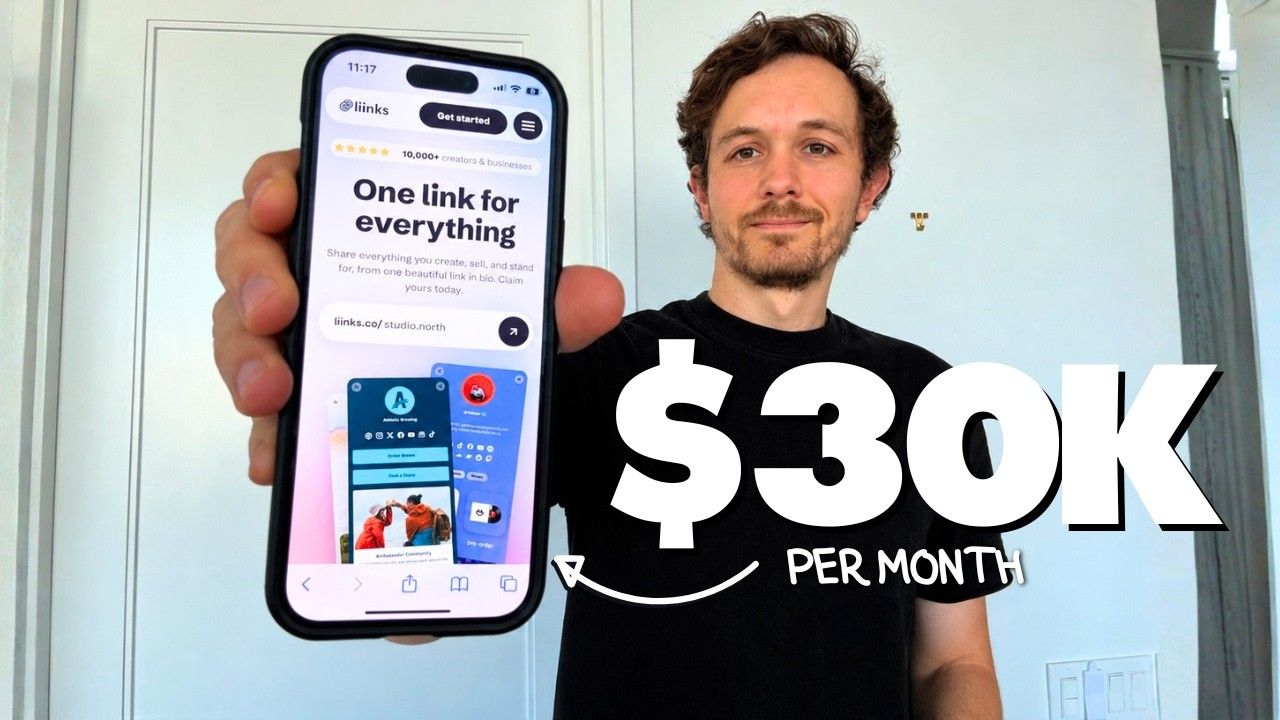
Charlie Clark was a software engineer at Squarespace. On the side, he gave himself a two-week challenge: build a better Linktree. That small experiment is now generating $31,597 in monthly recurring revenue, and Charlie has quit his full-time job — for the second time — to run it full-time.
The app is called [Liinks](https://liinks.co). It's a link-in-bio and mini-website builder that lets people centralize their entire online presence into a clean, mobile-first page at `liinks.co/yourname`. Think Linktree, but with more advanced features: multiple pages, powerful content blocks, and far more customization. The customer base is diverse — creators, small brands, freelancers — but they all share one thing: they're trying to make money online and need a simple hub to tie it all together.
What makes Charlie's story compelling isn't just the numbers. It's that he entered one of the most crowded corners of the internet — Linktree alone has over 70 million users — and found a way to win anyway.
The Origin Story
Charlie studied graphic design in college and taught himself to code. His first job was in web development at an ad agency, and eventually he landed a software engineering role at Squarespace, where he learned the fundamentals of building real products at scale.
In 2019, he quit that job to go all-in on his first big idea: VSUAL, a print-on-demand marketplace for artists. While building VSUAL and talking to artists every day, he kept noticing them linking to their Linktree in their Instagram bios. And every time he clicked those links, he felt the same thing: these pages look kind of bad.
The design wasn't there. The functionality was limited. And he knew he could build something better. So he gave himself two weeks to try.
Then COVID hit. VSUAL was making little money, and the uncertainty pushed Charlie back to the stability of a full-time job — back at Squarespace. But he kept working on Liinks on the side. Quietly, consistently, evenings and weekends. By the summer of 2024, Liinks' monthly revenue had grown to match his salary. That was the signal. He quit his job for the second time, now with a family to support, to focus entirely on Liinks.
The Growth Playbook
Charlie's growth strategy happened in three clear phases, and he's refreshingly honest about what worked and what didn't.
Phase 1 — Manual outreach. In the early days, Charlie would personally message people. The pitch was simple: *"Hey, I built this for you. You can try it for free."* No hard sell, just genuine product placement in front of people who actually needed it. This got him early users and, more importantly, early feedback.
Phase 2 — Product Hunt. Launching on Product Hunt brought a meaningful spike in traffic and forced Charlie to think seriously about monetization. He introduced a premium plan priced at $3/month and hit $100 MRR within a couple of months. That moment — seeing real strangers pay real money — changed the trajectory of how he thought about the product.
Phase 3 — Paid ads. Once the product was proven, Charlie scaled with advertising. He started with Instagram ads and found early success, but over time their performance declined. He shifted to Google Search Ads, targeting high-intent users who were actively searching for tools like his. This became his primary acquisition channel. Over four years, he's spent around $100,000 on Google ads — a meaningful investment, but one that's clearly paid off at $31k+ MRR.
The lesson here is that paid acquisition only works when the product can retain users. Charlie wasn't throwing money at ads from day one. He did the manual, unglamorous work first, validated that people would pay, and then poured fuel on the fire.
The Pricing Strategy
One of the most interesting parts of Charlie's business is his pricing philosophy. It's built around one core idea: always undercut Linktree.
Linktree's starter plan sits at $6/month. Liinks' is $5/month. That $1 difference might sound trivial, but it's a deliberate positioning decision. When someone is comparing options, Liinks is the obvious value play — similar features, better design, lower price.
Charlie prefers a high-volume, low-price model. A large base of customers each paying a small recurring fee creates a stable, predictable business that doesn't rely on landing a few big accounts. And the math at scale is remarkable: when he raised his price from $4/month to $5/month, that single dollar increase translated to nearly $5,000 in additional MRR because of the sheer number of subscribers. You can see it clearly in his Stripe dashboard — the revenue chart bends upward at exactly the moment he made that change.
But Charlie doesn't leave money on the table either. Liinks also offers a Pro plan starting at $12/month, which unlocks custom domains and the ability to manage multiple profiles — starting with five. Some Pro users who manage many pages end up paying upwards of $100/month. So the model has real ceiling potential, even if the floor is intentionally low.
It's a smart balance. Cast a wide net with approachable pricing, then offer a natural upgrade path for power users who need more.
What This Actually Proves
Charlie's story is a good reminder that you don't need a brand-new idea to build a successful business. Linktree had 70 million users when he launched. The market was "taken." But he looked at those Linktree pages and saw an opening — better design, more features, sharper positioning — and went for it.
The two-week build constraint forced him to ship something real instead of over-engineering it. The manual outreach phase forced him to talk to actual users before spending a dollar on ads. The Product Hunt launch forced him to put a price on it and see who would pay. Each step was a filter, not a leap.
Now he's a full-time solopreneur, building a product he genuinely cares about, with the flexibility to be present for his family. The revenue isn't life-changing money in the Silicon Valley sense, but $31,500/month as a solo operator running lean? That's real freedom.
If you've been sitting on a side project, looking at a crowded market and talking yourself out of it — Charlie's story is worth sitting with. The market doesn't have to be empty. It just has to have room for something better.
Original video
https://www.youtube.com/watch?v=RSlhgyAXsBI