 Story
He Built a $41K/Mo App in 3 Weeks — No Code, No Ads
Rasty Turek had zero iOS experience, used AI to write every line of code, and turned a simple photo vault app into $41K in a single month. Here's exactly how he did it.
Most successful apps aren't revolutionary. They don't reinvent the wheel or disrupt an entire industry. Sometimes the best move is to find a proven category, spot the gap your competitors are lazily ignoring, and execute better than everyone else. That's exactly what Rasty Turek did with Vaultaire — and the numbers are hard to argue with.
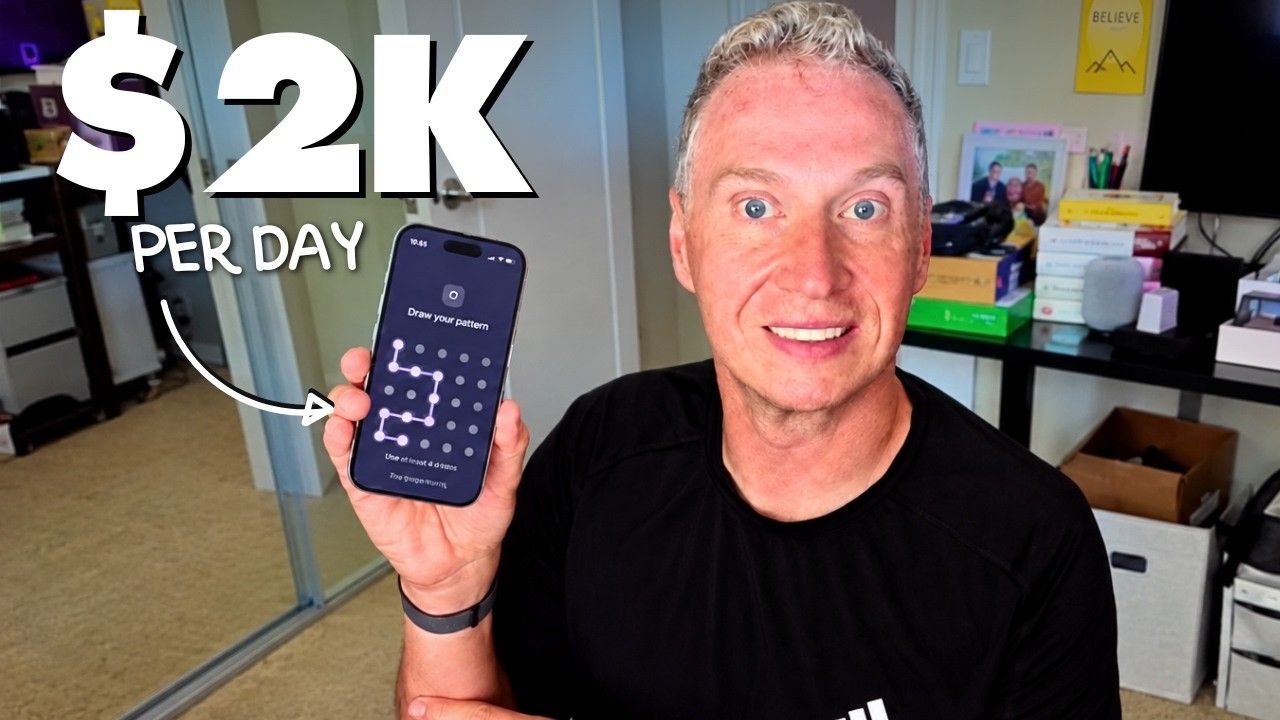
Rasty had never built an iOS app before. No Swift experience, no mobile dev background. He built Vaultaire in roughly three weeks and didn't write a single line of code or a single sentence of marketing copy himself. Today the app averages $2,000–$3,000 per day. In its first month it made $66. Six months later, it generated $41,000 in a single month. That's the kind of growth curve that makes you stop and pay attention.
What Vaultaire Actually Does
The concept is simple: Vaultaire is a private, encrypted photo and file vault for iPhone. Think of it like Dropbox, but with a hardcore privacy focus. All encryption happens on-device. There are no servers. Not Rasty, not Apple — nobody can access your files except you.
Rasty built it because he personally needed it. He wanted somewhere secure to store crypto wallet keys, IDs, birth certificates, and other sensitive documents. That's one of the oldest rules in the startup playbook — scratch your own itch — and it held up here. When you're building something you genuinely need, you don't have to guess at the user experience. You already know what good looks like.
The app is free to download, with in-app purchases unlocking advanced features. The pricing tiers are $1.99 for a weekly plan, $19.99 for an annual plan, and $39.99 for a lifetime plan. Rasty almost launched it completely free at the last minute — he added the paywall almost as an afterthought. Fortunately, he didn't talk himself out of it.
The Monetization Model Nobody Talks About
Here's where things get interesting. Most subscription-focused founders obsess over MRR. Rasty's MRR is only $1,470 — which sounds low for an app doing $41K months. But that number is misleading, because roughly 60% of his purchases are lifetime plans, which account for over 80% of total revenue.
That's a front-loaded revenue model, and it comes with a tradeoff: lower predictable monthly income, but massive upfront cash. With total proceeds at $84,100 and 60,000+ downloads, the math works cleanly. Daily downloads are currently around 800, and he's converting a meaningful portion of those into real money — just not on the timeline most founders expect.
The Conversion Funnel That Runs Backwards
Most consumer apps live or die on day-one conversion. You download Cal AI, it asks for your money immediately, and either you pay or you churn. Vaultaire works completely differently.
The day-one download-to-paid conversion rate sits at 5.47%. That grows to 8.62% by day 35. The peak conversion window is actually around day 60 — not day one. Users download the app because they have a specific problem. They use it. They store their files, trust it, build a habit around it. Then somewhere around the two-month mark, they hit a feature limit or just decide the thing is worth paying for.
This matters a lot. It means the value is doing the work, not the onboarding flow. Rasty isn't trying to trick anyone into a subscription before they've experienced the product. The app earns the purchase over time, which is why the lifetime plan is so popular — by the time users reach for their wallet, they're already sold.
The Growth Strategy: Ignoring What's Trendy
Rasty didn't run TikTok ads. He didn't do influencer partnerships or paid acquisition of any kind. His entire growth strategy was built on web SEO — a channel his competitors had completely abandoned.
Think about that for a second. Vaultaire's competitors are 15-year-old apps with millions of downloads and strong App Store rankings. They've been in the game forever. But they built their audience through the App Store in an era where SEO didn't matter for mobile apps, and they never bothered to build a web presence. So they're ranking on page one of the App Store and essentially invisible everywhere else.
Rasty saw that gap and walked straight through it. He built a marketing website packed with comprehensive guides targeting every possible keyword related to hiding photos and files on an iPhone. How to hide photos. Best photo vault apps. Encrypted file storage for iPhone. Every angle, every long-tail variation. He was publishing one to two high-quality articles per day.
None of those articles were written by a human. Rasty used Claude and Codex — AI coding and writing agents — to generate all of the SEO content on the site. The same tools he used to build the app itself. He outsourced the code and the copy to AI and focused his own energy on strategy and distribution.
This is the part that deserves more attention. SEO has a reputation for being slow and boring — the "old" way to grow. But boring strategies work when everyone else has abandoned them. Rasty's competitors weren't ignoring SEO because it doesn't work. They were ignoring it because they got big before it mattered and never looked back. That inertia created a real opening, and Rasty took it.
Building the App Without Writing a Line of Code
Rasty used AI coding agents — specifically Codex and Claude — to write every line of the app's code. This wasn't vibe coding a toy project. This was a production iOS app with real encryption, a subscription paywall, and 60,000 downloads. He shipped it in about three weeks.
This is exactly the kind of story that matters right now. The barrier to building real software has dropped dramatically. You don't need to be a developer to ship something people will pay for. You need to understand your user's problem deeply, have clear product intuition, and be willing to iterate fast. Rasty had all three. The AI handled the implementation.
The implication is significant: the constraint is no longer technical. If you have a good idea, a specific target user, and the patience to work through the rough edges with AI tooling, you can get to market. What used to take a co-founder or a six-month bootcamp now takes a few weeks and a clear head.
What You Can Take From This
There are a few things Rasty got right that are worth internalizing.
First, he picked a proven category. Photo vault apps have existed for 15 years. There's demonstrated demand. He didn't have to educate the market or convince anyone they needed privacy storage — people were already searching for it. He just needed to show up and be better in one specific dimension.
Second, he found a real distribution gap. His competitors were strong in one channel (App Store search) and invisible in another (web SEO). He didn't try to beat them at their own game. He went where they weren't.
Third, the product solved his own problem first. He wasn't guessing at user needs. He was the user. That leads to better product decisions and a lot less wasted time building things nobody wants.
Fourth, the monetization model matched the product's natural usage curve. Instead of forcing an immediate conversion, he let the product build trust over 60 days and then captured revenue from users who were already convinced. The lifetime plan sweetened the deal for users who were ready to commit.
And fifth — and maybe most importantly — he didn't overcomplicate the launch. No team. No funding. No complex tech stack. He identified a gap, built a simple solution with AI tools, and found an undervalued distribution channel. From $66 in month one to $41,000 six months later.
That's the whole story. And it's more replicable than most people want to admit.
Original video
https://www.youtube.com/watch?v=NuYO7DWzlaM