 Story
StoryHe Built a $30K/Month App While Working at Meta
Matt Robinson is a senior software engineer at Meta who quietly built a golf SaaS doing $350K ARR on the side. Here's how he did it — and why he finally quit.
Most great business ideas are hiding inside a frustration you've already had a hundred times. For Matt Robinson, that frustration showed up on the fairway.
Matt is a senior software engineer on the AI team at Meta. By any reasonable measure, that's a dream job — stable, well-compensated, prestigious. But a few years ago, while playing in a tournament at his local course in Valencia, California, he noticed something strange: the staff were running the whole event with paper. No software, no live scoring, nothing digital. When he asked the course pro why they weren't using any tools, the answer was simple — Golf Genius, the market leader, was too complicated and too expensive. It wasn't worth the headache.
Matt saw a gap. And then he filled it.
The App: Live Tourney
He built the first version of Live Tourney about four years ago, specifically for an event at his own course. The concept is clean and focused: it's a SaaS platform that helps golf courses manage their tournaments without the complexity or cost of legacy software.
The way it works is elegant. When players arrive at a tournament, they get a scorecard with a QR code printed on it. They scan the code, and it takes them straight to a live leaderboard. As the round progresses, players enter their scores hole-by-hole directly from their phones. The leaderboard updates in real time — everyone can see exactly where they stand throughout the round. No manual tallying, no waiting until the 18th hole to know the standings.
On the technical side, Matt built Live Tourney as a web app using Next.js for front-end rendering and Google Firebase on the back-end. For a senior Meta engineer, the stack probably felt natural. But what's impressive isn't the technology — it's the discipline it took to build and grow it entirely on the side.
The Numbers That Changed Everything
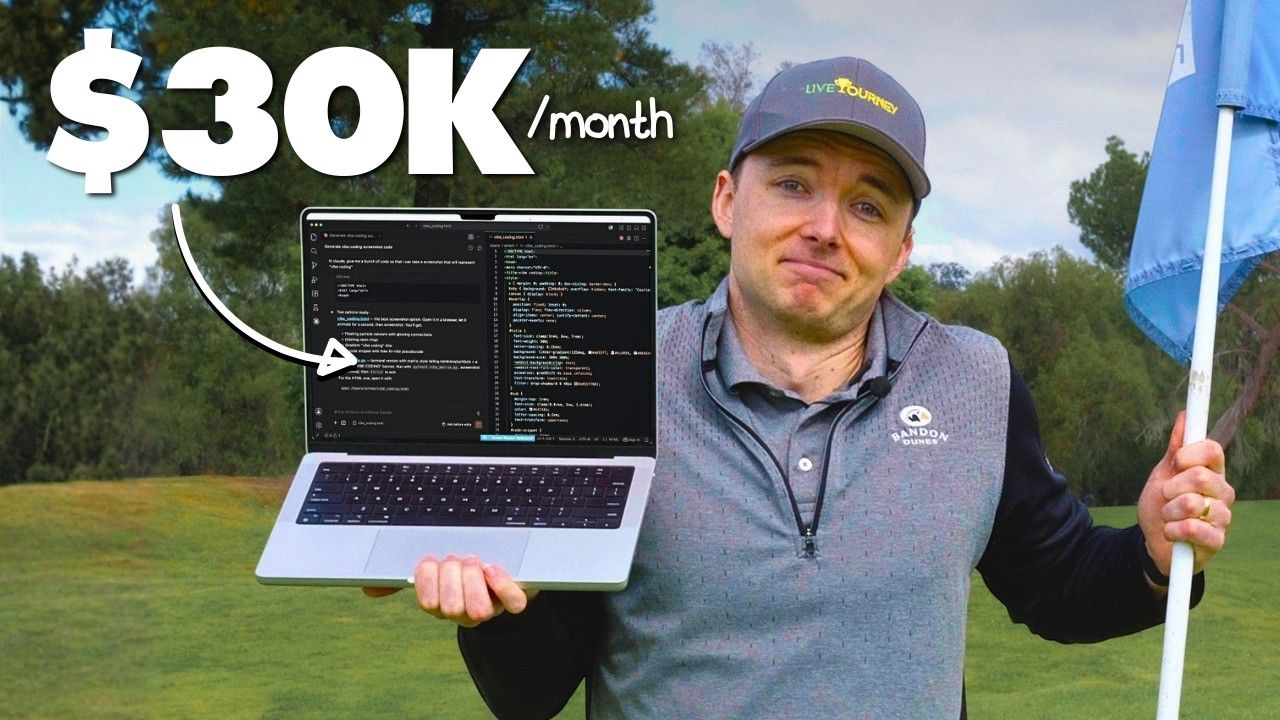
Fast forward to today, and Live Tourney is used by roughly 150 golf courses. It's generating $350,000 in Annual Recurring Revenue, with a current run rate approaching $800,000. That works out to over $30,000 a month — while Matt still has a full-time job at one of the biggest tech companies in the world.
That's the kind of number that forces a decision.
When host Pat Walls from Starter Story met Matt at the Vista Valencia Golf Course to talk through the situation, the dilemma was clear. Matt had DM'd Pat asking for advice: should he quit Meta and go all-in on Live Tourney, or keep riding the dual-income train? It was the classic side hustle inflection point — the moment where the opportunity gets too big to keep treating it like a hobby, but walking away from stability still feels terrifying.
The Case For Staying — and the Case For Leaving
Matt laid out the pros and cons honestly. Staying at Meta meant a reliable, great income. It meant comfort. After six years there, he knew the rhythms of the job. That's not nothing.
But the cons were real too. A stable job at a big tech company is never as secure as it feels — layoffs happen, priorities shift, teams get restructured. And every hour he spent in meetings or on Meta's roadmap was an hour he wasn't spending on a business that was growing fast and was entirely his own.
The upsides of going all-in on Live Tourney were compelling: genuine freedom over his time, the ability to be his own boss, and the chance to chase something he'd built from scratch out of pure passion. But the downsides were equally real — no guaranteed income, the full weight of the business on his shoulders, everything on the line.
He described the feeling as fear. Not panic, but that specific kind of fear that comes from considering walking away from something genuinely good in pursuit of something potentially great.
How He Built It While Holding Down a Demanding Job
When Pat asked Matt what advice he'd give to others trying to build on the side, his answer was direct: time management is key.
For Matt, that looked like this — wake up at 6 AM, spend the hours from 6 to 9 working on Live Tourney, then start his Meta workday. Three hours every morning, before the rest of the world needed anything from him. It sounds simple, but the consistency of it is what made the difference. He didn't build Live Tourney during a sabbatical or a lucky gap year. He built it in the margins.
His second piece of advice was just as important: build something you actually care about. Because he genuinely loves golf, working on the app never felt like a second job grinding him down. It felt like an obsession — his word — to make the product better. That intrinsic motivation is what kept him going through early mornings, long weekends, and the inevitable moments where progress felt slow.
There's a real lesson here. Plenty of people try to build SaaS businesses by chasing market size or hunting for "validated" ideas in a spreadsheet. Matt found his idea by just paying attention to a problem inside a world he already lived in. The niche was narrow — golf tournament management — but that specificity was a feature, not a bug. He understood the customer, the pain, and the competitive landscape better than anyone because he was the customer.
The Decision
Three weeks after the on-course conversation with Pat, Matt got back on a call to reveal his answer.
He's quitting Meta. He's going all-in on Live Tourney.
Interestingly, the recent wave of Meta layoffs played a role in clarifying his thinking — not because he was affected, but because the threat of it made the illusion of stability harder to maintain. If the job could disappear anyway, the calculus shifted. The risk of staying started to look more like the risk of leaving.
His wife is fully supportive, which matters more than most people acknowledge when making this kind of leap. And Matt is excited — genuinely, visibly excited — about what comes next. More time with his family. Full control over his schedule. The chance to direct all of his energy into something he owns and believes in.
The Takeaway
Matt's story is a useful reminder that you don't need perfect conditions to build something real. You need a genuine problem, a niche you already understand, and the discipline to show up for three hours every morning before the rest of the day takes over.
He didn't raise money. He didn't quit his job to build a prototype. He found a gap on a golf course, built a clean solution, grew it to $800K ARR, and *then* made the jump — with revenue, customers, and conviction already in hand.
That's not lucky timing. That's a playbook worth paying attention to.
Original video
https://www.youtube.com/watch?v=2_lpZ503ZGg