 Story
He Built a $14k/Month Side App Without a New Idea
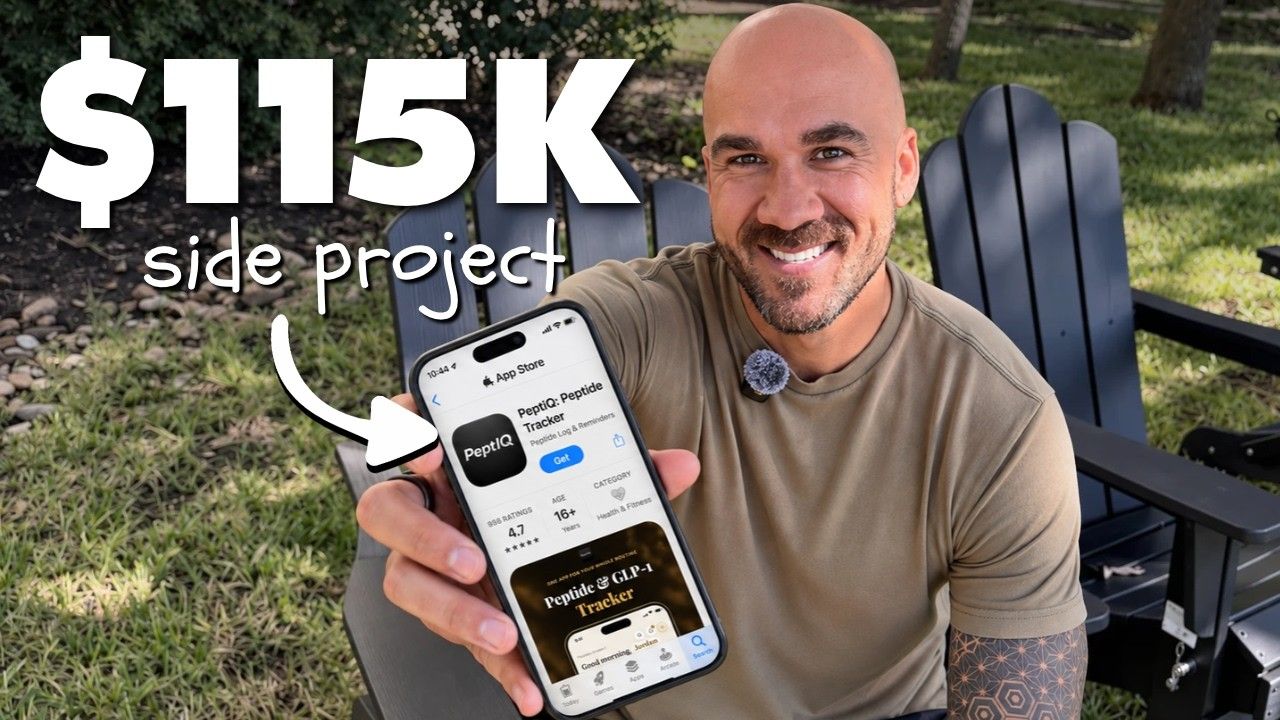
Kris Chase built PeptIQ, a peptide tracker, to $14k MRR in just nine months — no paid ads, no original concept. Here's exactly how he did it.
Most people think you need a completely original idea to build something profitable. Kris Chase proved otherwise. He's a full-time software engineer, a fractional CTO, and someone who's been programming since the MySpace era — he was making around $40,000 a month in high school building stuff on that platform. He knows code. But PeptIQ, his first personal app project, wasn't some moonshot invention. Dozens of apps already did the same thing. He built it anyway, and nine months later he crossed $115,000 in revenue for the year and hit $14,539 in monthly recurring revenue. No paid ads. No influencer deals. 590,000 people visited his website in the last 12 months.
That's the story worth paying attention to.
Step 1: Validate the Market Before You Build
Kris didn't sit in a room brainstorming. He noticed a trend he was personally interested in. He was looking for information about peptides — specifically the kind of detailed tracking data that didn't have a great home yet — and he started seeing signals everywhere. Reddit threads. Instagram posts. TikTok content blowing up around the topic. He didn't stop at vibes, though. He went to Google Search Trends and saw a hockey-stick growth curve for related search terms. That curve told him the interest was real, growing, and not yet saturated on the product side.
The lesson here is simple but underrated: you don't have to invent demand. You just have to find it before the market is fully served. If people are already talking about a problem on Reddit and searching for answers on Google, the market has validated itself. Your job is to show up with the best solution.
Step 2: Find the Untapped Sub-Niche Inside a Crowded Market
This is where Kris got genuinely smart. The peptide tracking space wasn't empty — there were already apps doing well, specifically around GLP-1 peptides used for weight loss. Those apps were successful. Kris didn't try to out-compete them head-on. Instead, he noticed something: GLP-1 was just one of dozens, maybe hundreds, of peptides people were using. All those other peptides had almost no dedicated tools.
So his angle was to build a *personalized tracker for all things peptide-related* — not just the one everyone else was building for. That single positioning decision created a whole sub-niche he could own. He also did his homework on the competition. App Store reviews and Reddit comments are a goldmine for this. People will tell you exactly what they hate about the existing apps, what features are missing, what makes them frustrated. Read enough of those and you essentially have a product roadmap handed to you for free.
Step 3: Build the MVP Fast and Cheap
Kris built the first version of PeptIQ in a single week. One week. He used an AI code generation tool called VibeCode to accelerate the development, which let him move from idea to shippable product at a pace that wouldn't have been possible even a few years ago.
His tech stack is lean by design:
- Expo + React Native for the mobile framework
- TypeScript as the language
- Supabase for the database and authentication ($25/month)
- RevenueCat to manage subscriptions (1% of revenue)
- Vercel for the marketing website ($20/month)
- PostHog for analytics (free tier)
- Sentry.io for crash logs (free tier)
The total infrastructure cost is minimal. For a product now doing over $14k a month, that's an extraordinary margin. And the subscription model itself is straightforward: $30 per month or $130 per year, with a hard paywall. No freemium ambiguity, no confusing tiers. His RevenueCat dashboard at the time of filming showed 70 active trials, 1,413 active subscriptions, and $22,081 in revenue over the last 28 days. The business is real, and the numbers back it up.
Step 4: Commit to SEO as Early as Possible
This is where most indie developers completely drop the ball. They build something beautiful, ship it to the App Store, and then wonder why no one shows up. Kris went a different route. From the very beginning, he built a marketing website and started writing blog articles that answered the specific questions people were already typing into Google.
He's the first to admit it: SEO is a long game. It took six or seven months before he saw significant results. That can feel brutal when you're checking your analytics every day hoping for a spike. But here's what that patience bought him — 590,000 total clicks and 13.2 million impressions over the last 12 months, according to his Google Search Console. And roughly 70% of his clicks and revenue now come from organic Google search at zero cost per click.
Paid ads give you traffic the moment you open your wallet and take it away the moment you close it. SEO builds an asset. Kris's articles are out there working for him 24/7, compounding month over month.
Step 5: Use the SEO Playbook That Actually Works
Kris breaks his SEO approach down into a few concrete moves that anyone can follow.
Make your site technically ready first. Organize your content properly, use the right semantic HTML tags, and implement schema markup. This is the unglamorous foundation that lets everything else work. Tools like SEMrush and Ahrefs can audit your own site and show you exactly where you're leaving traffic on the table — and they'll let you spy on what's working for your competitors too.
Research what people actually want to know. Go on Reddit. Find the subreddits where your target audience hangs out. Notice which questions get asked over and over again. Those recurring questions are your content calendar. Write an article that answers each one thoroughly and honestly, and Google will eventually reward you for it.
Embed a tool inside your content. This is Kris's most clever tactical move, and it's the kind of thing that separates good SEO from great SEO. He built a reconstitution calculator directly into one of his blog articles. Someone searching for how to reconstitute a peptide lands on his article, uses the calculator to get their answer, and then — here's the funnel — the natural next step is to save that data somewhere. Where do they save it? The app. The content doesn't just bring people in; it moves them down the funnel organically.
The Bigger Takeaway
Kris Chase isn't a unicorn. He's a skilled engineer who made a series of smart, deliberate decisions: he validated a trend before building, found a sub-niche inside an already-proven market, shipped an MVP in a week using modern AI tools, and then played the long SEO game with discipline.
He didn't raise funding. He didn't go viral. He didn't get lucky with a Product Hunt launch. He just kept writing articles and improving the product, and nine months later he has a business doing $14k a month on the side while working a full-time job.
The app itself has a 4.7-star rating on the App Store. The revenue is real and recurring. And the marketing engine — 590,000 clicks driven entirely by organic search — costs him essentially nothing to maintain.
If you've been waiting for proof that you don't need an original idea, a big budget, or a viral moment to build something meaningful, this is it. Find the trend. Find the gap inside the trend. Build fast. Write articles. Be patient. That's the whole playbook.
Original video
https://www.youtube.com/watch?v=B7b_2LaWOzs