 Story
StoryFrom Zero to $69K/Month: A Concrete Coating Story
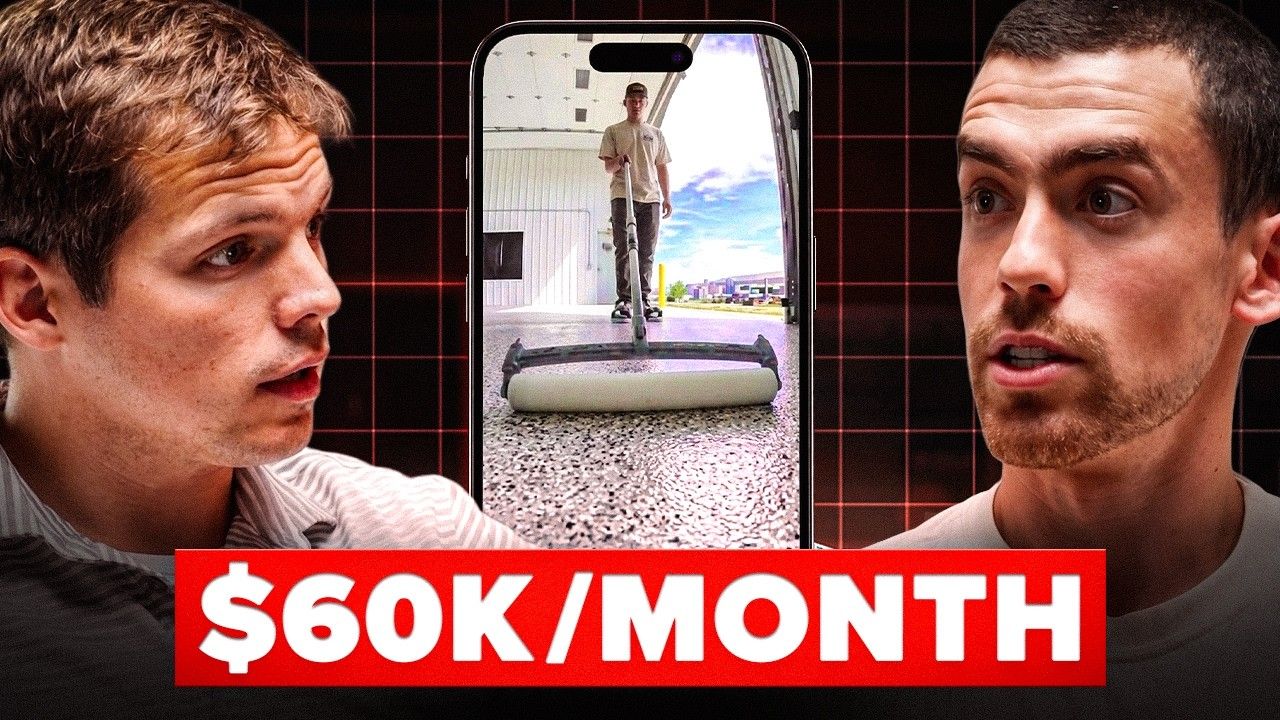
Mike Stuart launched a concrete coating business in March and hit $60K in April alone. Here's how he did it — and what other entrepreneurs can learn from it.
Most people assume scaling a business to $69,000 a month takes years of grinding. Mike Stuart did it in about three months.
Mike is a tile-setter by trade out of Iowa City. Good at his craft, steady work — but somewhere along the way, he started feeling like he was on autopilot. The business was fine. It just wasn't exciting anymore. So when a friend named Corey started exploring a concrete coating business in Illinois, Mike got curious. Corey FaceTimed him from a job site, and something clicked. Mike recognized the opportunity immediately and decided to jump in.
His mindset going in? "Flying the plane as I build it." He partnered with two people who already had experience in the field, and they launched in March. By April, the company was doing $60,000 in revenue. This month, they're on track for $69,000 — booked every single day, currently a full month out in advance, working four to five days a week.
That's not a slow build. That's a rocket ship.
The Business: Garage Floor Coatings
The core service is coating garage floors with epoxy flake systems. It sounds niche, but that's actually a feature, not a bug. The process is simple and highly repeatable. Layouts shift slightly from job to job, but the core tasks are the same every time. That standardization is what makes the business scalable — you're not reinventing the wheel on each project, you're running a proven system over and over.
And the numbers are genuinely impressive. A single job can generate $3,000 to $4,000 in profit. Not revenue — profit. When you're doing multiple jobs a week, consistently, that adds up fast. Their first-year target is $1 million in revenue, and based on current momentum — before they've even hit peak season — that goal looks very achievable.
Who They Sell To (And Why It Matters)
One of the smarter decisions Mike made early on was positioning the service as a premium offering. By charging a premium price, you self-select for a higher-end clientele — people with disposable income who want their home to look great and aren't haggling over every dollar.
Mike is pretty direct about what this service actually is: "Nobody needs their concrete coated. Nobody needs an epoxy flake garage floor." It's a luxury. It's an aesthetic upgrade. And that's exactly why it sells so well to the right audience. People who want it aren't comparing you to the cheapest option in town — they're comparing you to the experience they want to have. That shift in positioning makes the sales process easier and protects your margins.
When your customer values quality over price, you stop competing on price.
The $200 Referral That Turned Into $30,000
Word-of-mouth is often talked about in abstract terms — "it's important, you should do it" — but Mike has a concrete example that illustrates just how powerful it can be.
He was at his gym and mentioned a $200 referral bonus to someone he knew there. That single conversation, that single $200 incentive, eventually led to a chain of connected jobs that resulted in a $30,000 project. Two hundred dollars in, thirty thousand dollars out.
That's the kind of ROI that makes you rethink where you put your energy. Before spending thousands on paid ads or building out a full marketing funnel, think about whether you're fully leveraging the people already in your orbit. Friends, neighbors, gym contacts, former clients — anyone in your network is a potential referral source. Incentivize them. Make it easy. Make it worth their while.
A simple referral program isn't a secondary marketing strategy. For a business like this, it might be the primary one.
Stop Overthinking the Start
Mike is pretty candid about something most aspiring entrepreneurs won't admit: the reason people don't start isn't that it's too complicated. It's that they've convinced themselves it's complicated as a way to protect their ego.
If you tell yourself there are hidden secrets you don't know yet, or that you need more research, more planning, more preparation — you never have to actually launch. And if you never launch, you never fail. The overthinking is a shield.
His message is blunt: it's not that complicated. You can just start. You learn as you go. He calls it "flying the plane as I build it," and that philosophy is what got him off the ground in the first place. A tile-setter from Iowa City with no prior experience in concrete coatings decided to figure it out in real time — and within weeks, he was booked solid.
The path to starting is almost always more straightforward than it appears from the outside. The gap between "thinking about it" and "doing it" is mostly mental.
Using AI to Handle Marketing Without Being a Marketer
Here's something that might surprise you: Mike isn't a marketing expert. He doesn't have a background in copywriting or advertising. But his ads work.
How? "All of our ads are copy and pasted from Claude."
That's it. He uses Claude — Anthropic's AI tool — to generate ad headlines and copy, and then runs those ads. No expensive agency. No months spent learning the craft of copywriting. Just a clear prompt, a solid output, and a willingness to test it.
This is genuinely one of the most underrated advantages available to small business owners right now. You don't need to be a great writer to have great marketing copy. You don't need to hire a specialist on day one. AI tools like Claude can get you 80-90% of the way there for free, immediately. Mike's advice to new entrepreneurs is simple: use AI to help you get started. Don't let "I don't know how to market" become another excuse to stay on the sidelines.
The Bigger Picture
What makes this story resonate isn't just the numbers — it's the model. A blue-collar service business with a repeatable process, premium positioning, a simple referral program, and AI-assisted marketing. No venture funding, no complicated tech stack, no team of twenty.
Mike also points out something worth sitting with: blue-collar work is remarkably resilient. The wave of AI disruption that's reshaping knowledge work and creative fields isn't coming for your garage floor coating business. Physical, skilled service work has a durability that a lot of other industries don't right now. That's not a small thing.
The market is huge, the process is learnable, and the demand is clearly there — they've been booked every day since the beginning of April. If you've been turning over a similar idea in your head, waiting for the right moment or the right amount of knowledge, Mike's story is worth paying attention to.
Sometimes the smartest move is just to get in the plane and figure out the rest on the way up.
Original video
https://www.youtube.com/watch?v=HcR7Wqgi4lU