 Story
StoryFrom Dorm Room to $25k/Month in Five Months
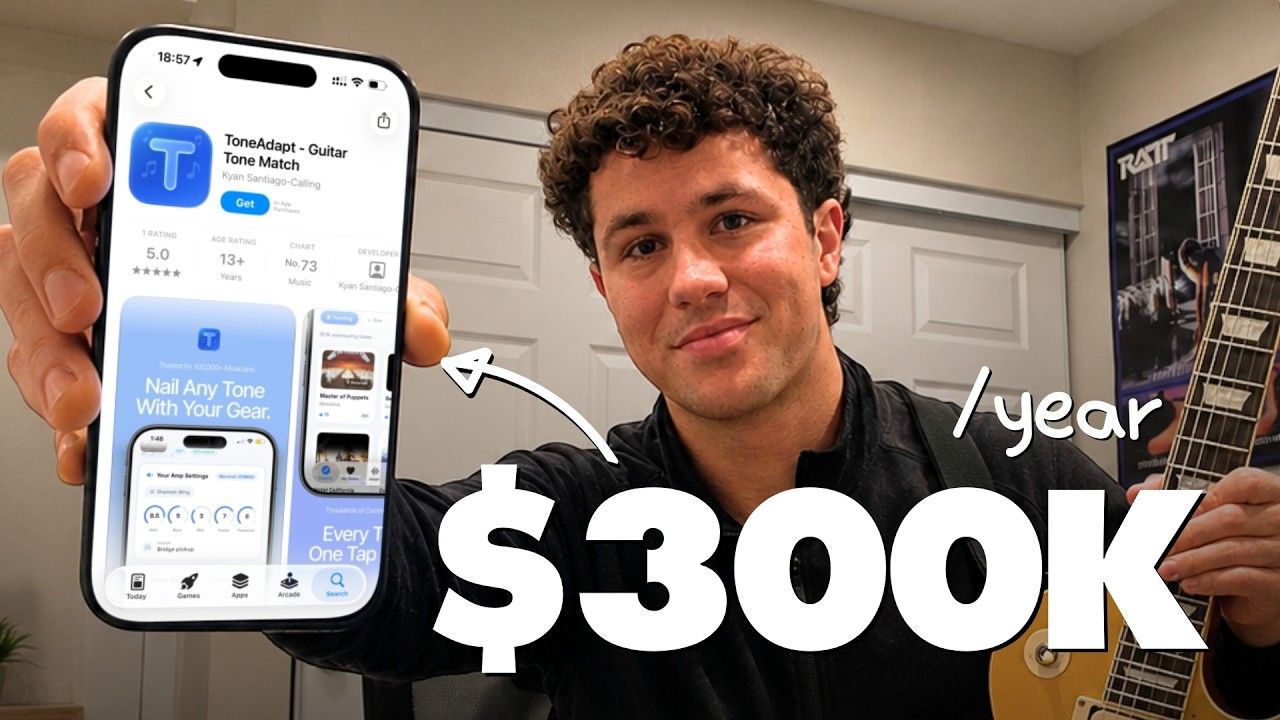
Kayan, a 21-year-old college student, built ToneAdapt in one week using AI coding tools and grew it to 100,000 users and $25k MRR. Here's exactly how he did it.
Most successful apps don't come from a brilliant, original insight dreamed up in a boardroom. They come from someone being genuinely annoyed by a small, specific problem and deciding to fix it. That's exactly what happened with Kayan, a 21-year-old computer science student at San Diego State University who had never shipped a single project before.
In under five months, he built ToneAdapt into an app with over 100,000 users and $25,000 in monthly recurring revenue. He used AI to write every line of code. He spent about a week building the first version during Thanksgiving break. And he grew the whole thing almost entirely through social media.
Let's break down how he actually did it.
Step 1: Solve Your Own Problem
Kayan picked up guitar about a year and a half ago and quickly became obsessed. Like most guitarists, he ran into a deeply frustrating wall: getting his amp and pedals to sound like the songs he loved. He started using ChatGPT to ask for tone settings, but the results were consistently inaccurate and unreliable. The AI just didn't have the precision a guitarist needs.
He realized this was a real problem worth solving — not just for him, but potentially for millions of guitarists. Before building anything, he did something smart: he went to Reddit and Instagram, talked to other guitarists, and asked if they shared the same frustration. They did. And crucially, there was no good existing solution.
This is the move. You don't need to invent something nobody has ever thought of. You need to find a painful, recurring problem in a niche you already understand — and confirm that other people in that niche feel it just as strongly as you do.
Step 2: Build V1 Fast (Embarrassingly Fast)
Once the idea was validated, Kayan built ToneAdapt's first version in roughly one week. He used a process he calls "vibe coding" — essentially, letting AI write every line of code while he directed and iterated. His tool of choice was Cursor.
The tech stack he ended up with is clean and relatively lean for what the product does:
- Supabase for the database (~$25/month)
- Vercel for hosting and analytics (~$50/month)
- Mailgun for transactional emails (~$25/month)
- Stripe for payment processing (2.9% of revenue)
- OpenAI API for the AI layer (~$100/month)
- Tavily for search/retrieval (~$150/month)
For the mobile app, he built it natively in Swift and layered in RevenueCat for subscription management and Superwall for paywall optimization.
The total infrastructure cost is well under $500 a month. Against $25,000 in MRR, that's an incredibly healthy margin — and it's all running on tools that a solo developer can set up in days, not months.
The key mindset here: don't wait until it's perfect. Ship V1 as quickly as possible, start charging immediately, and let real users tell you what to fix. Kayan didn't spend months polishing before launch. He got it live, got people paying, and iterated from there.
Step 3: Build Something Genuinely Useful for a Niche
ToneAdapt does one thing really well. You tell it the song you want to sound like, it figures out your gear, and within 30 seconds it gives you the exact settings to dial in your amp and pedals to match that track. That's it. No bloat, no feature creep — just a clean, specific solution to a specific problem.
The monetization is tiered and straightforward. There's a Beginner plan at $6.99/month and an Expert plan at $10.99/month, plus annual options around $60. The $25k MRR is split across both platforms: roughly $11,500 from the website and $14,260 from the mobile app in a recent 28-day window. Over three months, the web app alone generated $45,000 in gross volume with 1,495 new subscribers.
Those are real numbers. For a tool built in a week by someone who had never shipped a project before, it's genuinely remarkable — and it's almost entirely because the value proposition is crystal clear. Guitarists know exactly what they're getting and exactly why they'd pay for it.
Step 4: Post Three Times a Day, Every Day
Here's where most builders drop the ball. They spend weeks perfecting the product and then barely tell anyone about it. Kayan did the opposite.
His marketing strategy was almost aggressively simple: post on social media three times a day, every day, and repost across Instagram, TikTok, YouTube, and Facebook. He put his face in the videos from day one to build personal trust with his audience rather than hiding behind a brand logo.
His first video went viral. But he's clear that the viral hit wasn't the strategy — it was the byproduct of a strategy. The real playbook is:
1. Pick something you're genuinely interested in 2. Find a specific pain point within that interest 3. Ship V1 as fast as possible 4. Post three times daily across platforms 5. When something works, go all in on it
That last point deserves more attention. When Kayan found a content format that resonated, he didn't just repeat it a couple of times. He remade it with variations, brought in UGC creators to expand reach, and rolled out paid ads to amplify what was already working organically. That's how you take a spark and turn it into a fire.
Step 5: Get Over the Fear of Posting
Kayan is honest about this part: his first video was "super embarrassing." His friends made fun of him. He cringed watching it back.
He posted it anyway.
He says the embarrassment only really exists around that first post. Once you've done it, the psychological barrier collapses. And the math is simple — every post is a lottery ticket. Most of them won't go anywhere. But some of them will, and you can't win if you don't play.
His advice is to start posting on social media *today*, even if you don't have a product yet. Build the habit, build the audience, build the skill. He genuinely believes that the ability to create and distribute content is one of the most valuable skills anyone can develop right now — it opens doors that no amount of cold outreach or paid marketing can replicate.
Any content beats no content. Every single time.
Takeaways
Kayan's story is a clean proof of concept for something a lot of people talk about but fewer actually execute: find a real problem in a niche you know, use the tools available to build fast, charge for it immediately, and market it relentlessly.
He didn't have a team. He didn't raise funding. He didn't have years of development experience. He had a problem, a holiday break, Cursor, and the willingness to post videos while his friends were laughing at him.
Five months later: 100,000 users, $25k MRR, and a business that runs on less than $500/month in infrastructure costs.
The tools are all there. The playbook is pretty clear. The only question is whether you're willing to start.
Original video
https://www.youtube.com/watch?v=Q4k8JNYKJT0