 Story
StoryFrom Accountant to $200K/Month: The Retail Arbitrage Playbook
Ryan Grant quit his accounting job to resell clearance items from Walmart on Amazon. Four years later, he runs an 11-person team doing over $200,000 in monthly sales.
Most people walk past the clearance aisle without a second thought. Ryan Grant turned it into a six-figure business.
Grant is 28 years old and makes his living through retail arbitrage — buying discounted products from stores like Walmart, Target, and Toys R Us, then flipping them on Amazon for a profit. It sounds almost too simple. But the numbers don't lie: over $200,000 in monthly sales, a warehouse, and a team of 11 people, all built from scratch in four years.
The origin story is familiar to anyone who's ever hustled in college. Grant started reselling used textbooks on Amazon as a student — a low-risk, high-margin play that a lot of broke undergrads stumble into. It worked well enough that he kept the idea in the back of his mind. After graduating, he did what most people do: he took the safe road and became an accountant.
He lasted about as long as you'd expect.
The accounting job paid the bills, but Grant quickly realized he wasn't on the path he actually wanted. So he dusted off his old playbook, expanded beyond textbooks, and started hitting the clearance aisles of big-box retailers. The model was straightforward: find items marked down heavily in-store, scan the barcode with the Amazon Seller app, and instantly see what the same item is selling for online. If the margin is there, you buy it. If not, you move on.
The Amazon Seller app is the real engine of this whole operation. It's free, and it does the math for you in real time. Grant gives a concrete example in the video: a Shoreline Marine Fender Line and Rope Keeper, the kind of obscure item most shoppers would walk right past. It clears for cheap in-store, but it's sitting at $12.95 on Amazon. That gap is the profit. Multiply that across dozens of items per store visit, and you start to see how the numbers add up fast.
The turning point came when Grant was making more from reselling than from his salary. That's the moment most people talk themselves out of the leap. Grant took it anyway. He quit.
Three months into selling full-time, he made $9,000 in profit in a single month. His own words: "Making that amount of money in one month was a big boost in my confidence to be able to scale up further from there." That kind of early validation is everything. It's not just about the money — it's proof that the model works and that you can actually execute it.
From there, the growth got messy in the best way. His house filled up with boxes. Inventory was everywhere. That's the inflection point most small resellers hit and never push past — they cap out because they can't physically handle more volume. Grant's move was to stop treating it like a side hustle and start treating it like a business. He rented a warehouse. He hired employees. He built systems.
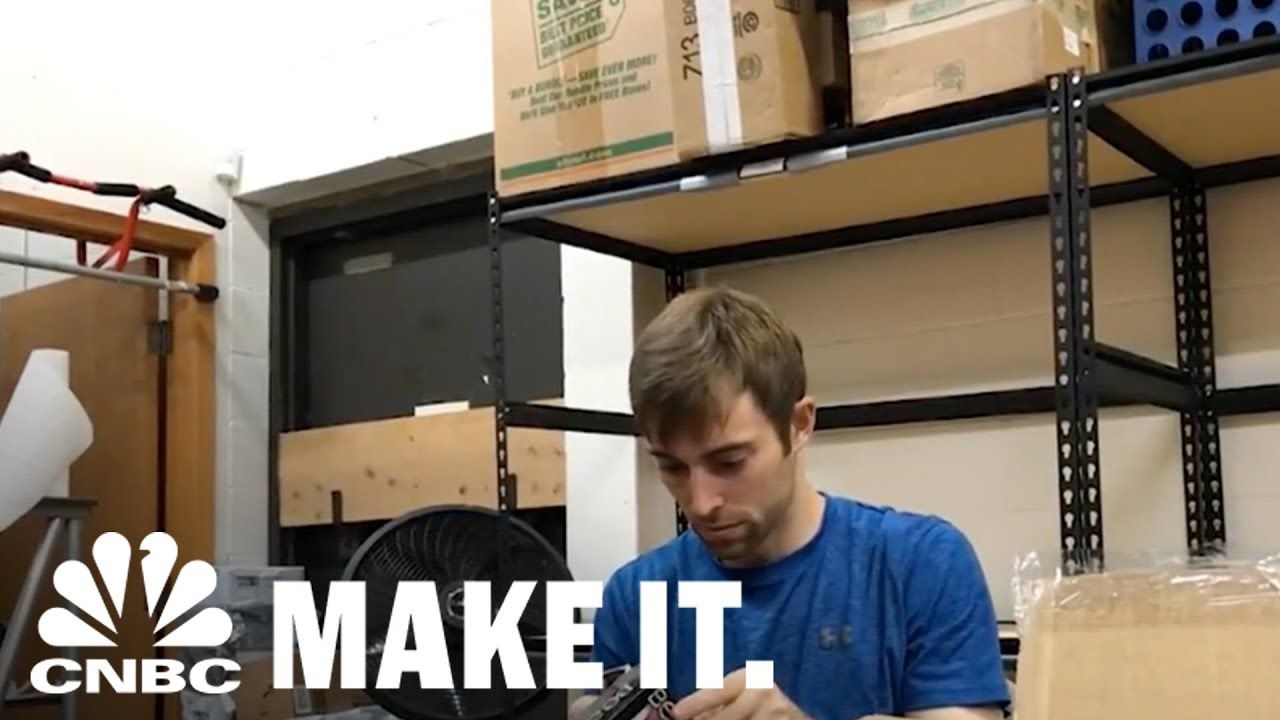
Four years after quitting his accounting job, he went from a solo operation run out of his living room to a team of 11 people moving over $200,000 in product every single month. The jump from "guy with boxes in his house" to "legitimate e-commerce operation with staff and a warehouse" is exactly the kind of scaling most aspiring entrepreneurs talk about but rarely pull off.
What makes Grant's story compelling isn't the revenue number — it's the reasoning behind it. His original goal wasn't world domination. He just wanted freedom of schedule and enough income to replace his salary. That's a refreshingly honest benchmark. No grand vision, no billion-dollar exit fantasy. Just: can I work on my own terms and pay my bills?
He cleared that bar, and then some. He's said the outcome has been "honestly better than I could've hoped" and that he'd absolutely do it again without hesitation. That kind of clarity — the certainty that you made the right call — is rare. Most people spend years second-guessing the safe road. Grant doesn't have that problem.
The retail arbitrage model itself is worth understanding because it flies under the radar compared to the flashier corners of e-commerce. You're not building a brand. You're not designing products. You're not managing a Shopify store or running Instagram ads. You're doing something much more old-school: finding price inefficiencies between the physical and digital world and pocketing the difference. Stores like Walmart and Target regularly discount items to clear shelf space. Amazon's marketplace has millions of buyers who either don't know or don't care that the same item is sitting in a clearance bin somewhere for half the price.
The Amazon Seller app collapses the research time that used to make this kind of arbitrage impractical for individuals. You don't need a spreadsheet or an hour of Googling. You scan, you see the price, you make a decision in seconds. That speed is what makes it possible to source efficiently and at scale.
The real lesson in Grant's story isn't about Walmart or Amazon specifically. It's about the compounding effect of taking an early side hustle seriously, validating it with real numbers, and then making the uncomfortable decision to bet on yourself before the outcome is certain. He didn't quit his accounting job the moment he had the idea. He quit when the data told him to — when the side hustle was already outperforming his salary.
That's the part worth paying attention to. Not the app, not the clearance aisle, not Amazon FBA. The decision to act on what the numbers were already telling him.
He'd do it again. Would you?
Original video
https://www.youtube.com/watch?v=vzrtdUCsYTQ