 Story
StoryFrom $150 to $10k/Month: One Founder's Pivot Story
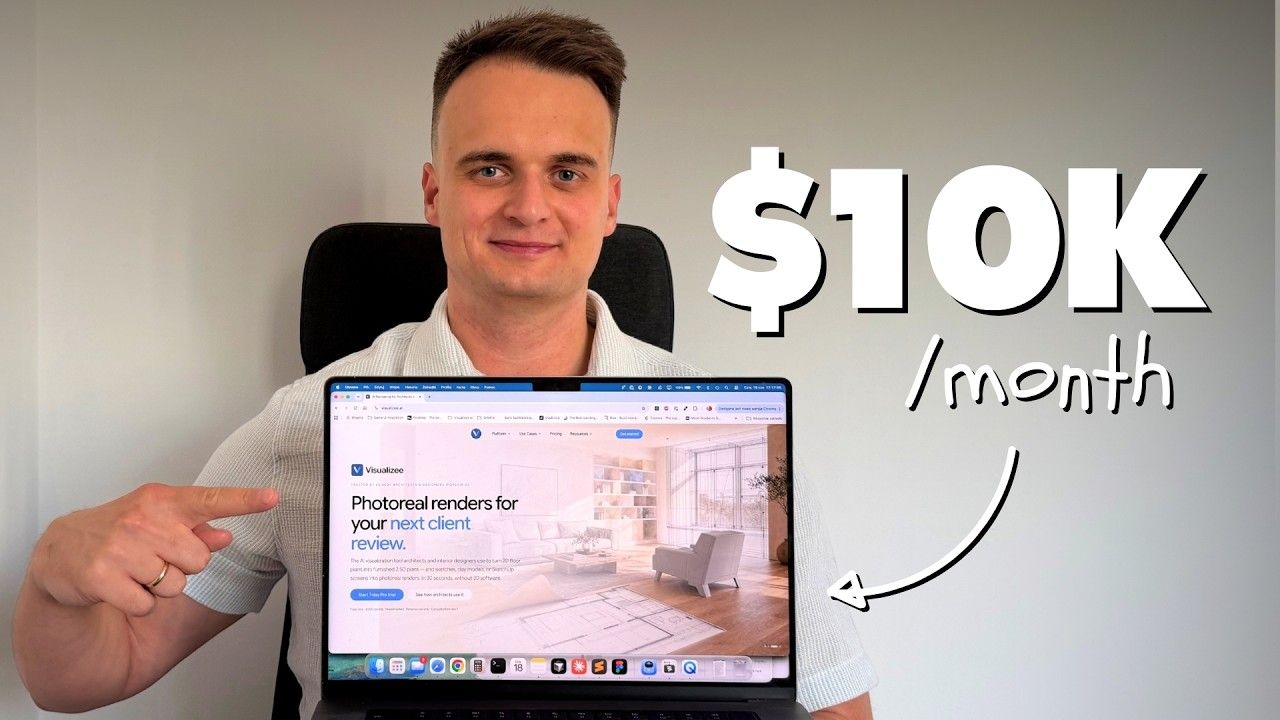
Piotr spent two years stuck at $150/month on his AI rendering SaaS. Six months after a single pivot, he crossed $10,000/month — while still working a full-time job.
Two years. Two full years of building on nights and weekends, watching your revenue flatline at $150 a month. That's the kind of slow-burn nightmare that makes most people quit. Piotr Obidowski didn't quit — but he also didn't grow. Not until he made a decision that changed everything.
Piotr is a software developer from Poland with over 20 years of experience, currently working as a Tech Lead at a software house. After two decades of building things for other people, he wanted something of his own. About three years ago, when AI image generation started gaining serious traction, he saw an opportunity. But he was deliberate about it — he didn't want to build another "generic AI toy." He wanted to find a real niche with a real problem. That led him to architects and interior designers.
What Visualize AI Actually Does
The core promise of Visualize AI is straightforward: upload a hand sketch, a 3D model, or a photo, describe the look you want, and get a photorealistic, client-ready render in about 30 seconds. The traditional rendering pipeline is painfully slow — architects and designers know this better than anyone. Piotr saw that AI could compress that timeline dramatically, and he built a tool specifically for that workflow.
The platform includes a chat assistant called "Vizy" that helps users with prompt engineering, so you don't need any technical background to get a great result. Today, Visualize AI gets over 300 daily landing page visitors, converts 25% of its 5–10 daily trials into paying customers, and has around 300 active subscribers across two pricing tiers: $35/month and $80/month. Those numbers didn't happen overnight — and they definitely didn't happen in the first two years.
The Mistake That Burned Two Years
The original version of Visualize AI took Piotr five months to build. It was powerful. It was flexible. And it was built around a node-based system — think ComfyUI-style visual programming — that gave users granular control over the rendering pipeline.
Architects hated it.
The feedback he kept hearing, over and over, was simple: *it's too complicated.* And for two years, Piotr didn't fully listen. He kept tweaking, kept adding, kept trying to market his way out of a product problem. He blamed slow growth on marketing. He thought if he could just get the word out more effectively, the conversions would follow.
They didn't. Because the real problem wasn't visibility — it was friction. The gap between a new user signing up and that user successfully generating their first render was too wide. The node system, as sophisticated as it was, stood directly in the way of that first win. And if users can't get a quick win, they leave.
This is one of those lessons that sounds obvious in retrospect and is agonizing to learn in real time. You build something complex because you want it to be powerful. You're proud of the architecture. And then you have to accept that the thing you're proudest of is the thing that's killing your product.
The Pivot That Changed Everything
Piotr made the call. He deleted the node system entirely and rebuilt the product from scratch around a simple, chat-based interface. No visual programming. No configuration overhead. Just describe what you want, and Vizy — the built-in AI assistant — helps you get there.
The reduction in friction was immediate and dramatic. Users could now go from signup to their first successful render without needing a tutorial, a walkthrough, or any prior knowledge of how AI image generation works. That first success moment — the thing that converts a trial user into a believer — was suddenly accessible to everyone.
At the same time, he made a second critical change: he scrapped one-time payments and switched to a subscription model. This one seems almost too obvious to mention, but it's worth dwelling on. One-time payments feel like revenue. They're not. They're a transaction. A subscription is a relationship — it's predictable, it compounds, and it gives you a real MRR number you can actually build a business around. Piotr admits he stuck with the one-time model for too long, and it cost him.
These two changes — simpler product, recurring revenue — were the entire catalyst. In six months, Visualize AI went from $150/month to just under $10,000/month. Same founder. Same niche. Same core idea. Completely different execution.
The Lessons Worth Keeping
Piotr is generous about sharing what he learned, and the takeaways are worth spelling out clearly.
Friction kills conversion — not marketing. When growth is slow, the instinct is to market harder. Run more ads, post more content, do more outreach. Sometimes that's the right call. But if your product has friction baked into the core experience, marketing just brings more people to a broken funnel. Fix the product first. Specifically: find the shortest possible path between signup and the user's first meaningful success, and eliminate everything that blocks that path.
Charge subscriptions from day one. One-time payments don't build businesses. They build a revenue graph that resets to zero every month. If you're solving a recurring problem — and most SaaS products are — your pricing model should reflect that. Subscriptions give you predictability, which gives you the ability to plan, invest, and grow.
Listen to feedback faster. Piotr knew architects thought the product was too complicated. He heard it repeatedly. He just didn't act on it quickly enough. The cost of ignoring clear, consistent user feedback is measured in years — in his case, literally two of them. The hardest part of building something is letting go of the version you spent months creating and being honest about what users actually need.
Niche specificity is a feature. Piotr could have built a general AI image generation tool. He didn't, and that choice shaped everything — the product design, the messaging, the user base, the feedback loops. When you build for a specific person with a specific problem, everything gets easier. Your marketing is clearer, your users are more engaged, and your feedback is more actionable.
The Bigger Picture
What makes Piotr's story compelling isn't the number — $10k/month is a milestone, not a finish line. It's the *how*. He built this entirely on nights and weekends while working a demanding full-time job as a Tech Lead. He didn't have a co-founder, a funding round, or a growth team. He had persistence, a willingness to eventually kill his darlings, and a clear-eyed view of what his users actually needed.
The two-year stagnation wasn't wasted time. It was expensive, frustrating, humbling — but it also taught him exactly what wasn't working and why. The pivot only made sense because of everything that came before it.
If you're sitting on a side project that isn't moving, the question worth asking isn't "how do I market this better?" It's "what is standing between my user and their first win?" Find that answer, remove the obstacle, and see what happens.
Sometimes the unlock is simpler than you think.
Original video
https://www.youtube.com/watch?v=TUN8Y8__QGU